EUR/USD Price Forecast: Door open to extra gains near term
- EUR/USD advanced to weekly tops north of 1.1600 the figure on Wednesday.
- The US Dollar dropped markedly as investors speculated over extra rate cuts.
- President Trump announced an extra 25% tariff on India, bringing the total to 50%.


The Euro (EUR) edged higher on Wednesday, adding to Tuesday’s small gains against the US Dollar (USD). That said, EUR/USD managed to finally leave behind the 1.1600 barrier to hit new multi-day highs past 1.1650.
The Greenback’s pronounced retracement came on the back of investors’ assessment of extra interest rate cuts by the Federal Reserve in the second half of the year. This was also underpinned by comments from Neel Kashkari, President of the Federal Reserve Bank of Minneapolis, who argued that two rate reductions in the next few months remain “appropriate”.
Trade truce relief evaporates
The US Dollar gathered pace following the US–EU trade framework announced in past days. Under that accord, most European exports to America now bear a 15% levy—up from April’s 10% but below the 30% threat initially floated. Key industries like aerospace, semiconductors, chemicals, and certain farm products secured tariff exemptions, while steel and aluminium remained at 50%. In exchange, Europe has committed to buying $750 billion of US energy, ramping up defence procurement from American firms, and funnelling over $600 billion into US investment.
Critics, however, voiced concern: Germany’s Chancellor Friedrich Merz warned of pressure on fragile manufacturing, and France’s President Emmanuel Macron lamented a “dark day” for the Continent.
Let’s take a look at what’s coming on the trade front: On August 7, President Trump is expected to issue an order imposing “reciprocal” tariffs on exports from 69 trading partners, raising duty rates to between 10% and 41%, effective in seven days, and also warning that the United States would impose further tariffs and other measures on Russia if Moscow failed to make progress toward ending its war in Ukraine.
Then, on August 12, he will decide on whether to extend the trade truce with China—set to expire on that day—or allow tariffs to revert to triple-digit levels, a move that could reignite a trade war between the world’s two largest economies and threaten global growth.
Central banks press pause
Both the Federal Reserve (Fed) and the European Central Bank (ECB) held rates steady in their latest meetings. At the Fed, Chair Jerome Powell kept a cautious tone, even as Governors Waller and Bowman dissented—highlighting uncertainty over when easing might begin.
In Europe, President Christine Lagarde called growth “solid, if a little better”, but markets have since pushed back their bets on rate cuts until spring 2026.
Speculators pare back EUR longs
CFTC data through July 29 show traders trimming their bullish EUR positions: net longs fell to about 123.3K contracts—their lowest in three weeks—while institutional net shorts eased to roughly 175.8K contracts. Open interest also declined for the first time in six weeks to around 828.6K contracts.
Levels that matter
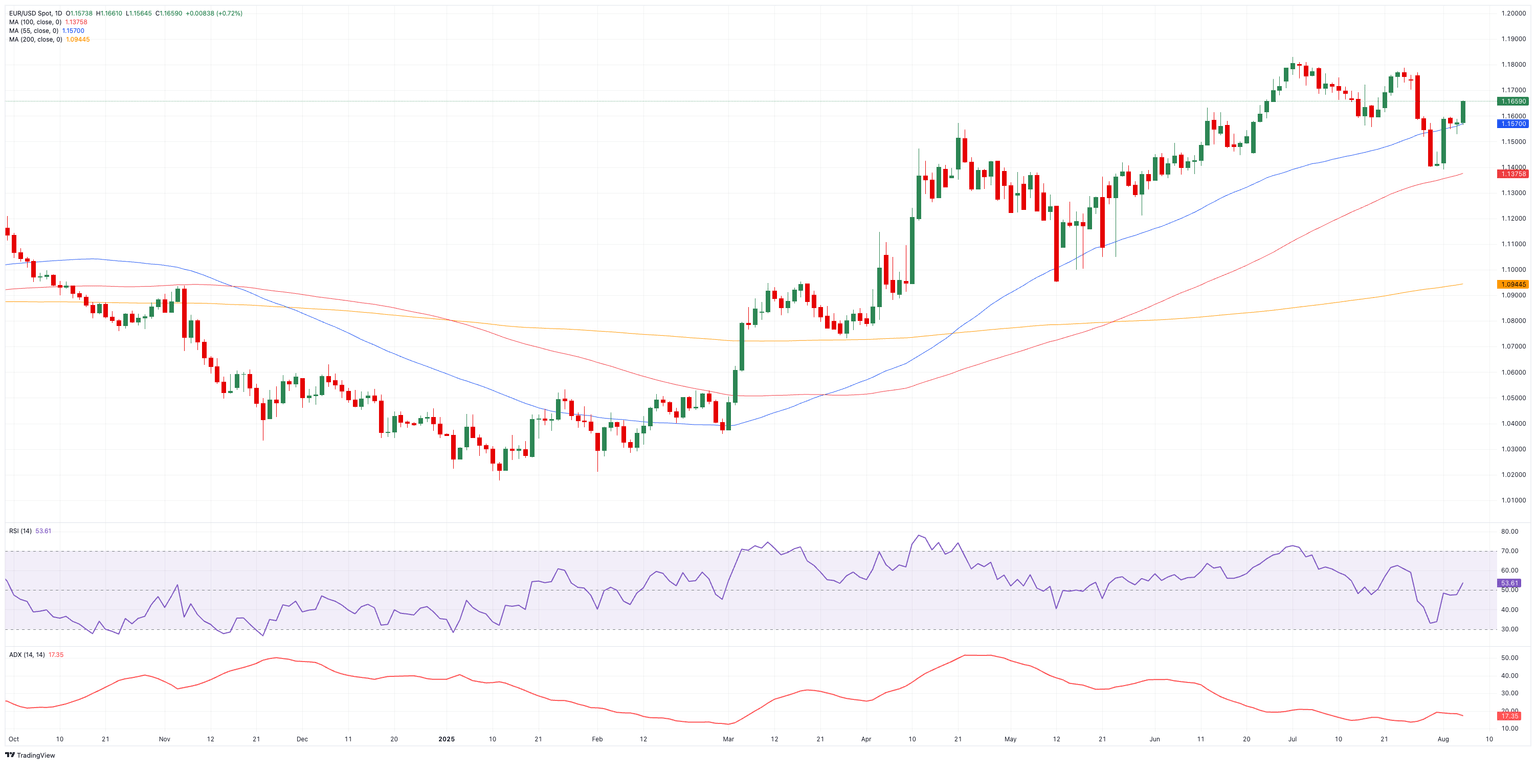
Resistance lies first at the weekly peak of 1.1788 (July 24), then the 2025 high of 1.1830 (July 1), with the September 2021 top at 1.1909 (September 3) and the psychological 1.2000 mark looming beyond.
Support tests begin at August’s low of 1.1391 (August 1), seconded by the transitory 100-day SMA at 1.1383, and the weekly trough of 1.1210 (May 29).
Furthermore, the Relative Strength Index (RSI) flirts with the 55 mark, suggesting that further upside appears in the pipeline; the Average Directional Index (ADX) near 20 points to a still inconclusive trend.
EUR/USD daily chart
What’s next
Without a dovish surprise from the Fed or relief on trade tensions, EUR/USD looks set to grind within its familiar range, with traders keeping a close eye on Dollar dynamics for the next directional cue.
Euro FAQs
The Euro is the currency for the 19 European Union countries that belong to the Eurozone. It is the second most heavily traded currency in the world behind the US Dollar. In 2022, it accounted for 31% of all foreign exchange transactions, with an average daily turnover of over $2.2 trillion a day. EUR/USD is the most heavily traded currency pair in the world, accounting for an estimated 30% off all transactions, followed by EUR/JPY (4%), EUR/GBP (3%) and EUR/AUD (2%).
The European Central Bank (ECB) in Frankfurt, Germany, is the reserve bank for the Eurozone. The ECB sets interest rates and manages monetary policy. The ECB’s primary mandate is to maintain price stability, which means either controlling inflation or stimulating growth. Its primary tool is the raising or lowering of interest rates. Relatively high interest rates – or the expectation of higher rates – will usually benefit the Euro and vice versa. The ECB Governing Council makes monetary policy decisions at meetings held eight times a year. Decisions are made by heads of the Eurozone national banks and six permanent members, including the President of the ECB, Christine Lagarde.
Eurozone inflation data, measured by the Harmonized Index of Consumer Prices (HICP), is an important econometric for the Euro. If inflation rises more than expected, especially if above the ECB’s 2% target, it obliges the ECB to raise interest rates to bring it back under control. Relatively high interest rates compared to its counterparts will usually benefit the Euro, as it makes the region more attractive as a place for global investors to park their money.
Data releases gauge the health of the economy and can impact on the Euro. Indicators such as GDP, Manufacturing and Services PMIs, employment, and consumer sentiment surveys can all influence the direction of the single currency. A strong economy is good for the Euro. Not only does it attract more foreign investment but it may encourage the ECB to put up interest rates, which will directly strengthen the Euro. Otherwise, if economic data is weak, the Euro is likely to fall. Economic data for the four largest economies in the euro area (Germany, France, Italy and Spain) are especially significant, as they account for 75% of the Eurozone’s economy.
Another significant data release for the Euro is the Trade Balance. This indicator measures the difference between what a country earns from its exports and what it spends on imports over a given period. If a country produces highly sought after exports then its currency will gain in value purely from the extra demand created from foreign buyers seeking to purchase these goods. Therefore, a positive net Trade Balance strengthens a currency and vice versa for a negative balance.
Premium
You have reached your limit of 3 free articles for this month.
Start your subscription and get access to all our original articles.
Author
Pablo Piovano
FXStreet
Born and bred in Argentina, Pablo has been carrying on with his passion for FX markets and trading since his first college years.