EUR/USD Price Forecast: Buyers hesitate as risk sours


EUR/USD Current price: 1.1675
- Back and forth bets on the Federal Reserve’s rate cuts lead the way.
- The US Producer Price Index was much hotter than anticipated in July.
- EUR/USD came under selling pressure, with critical support at 1.1620.
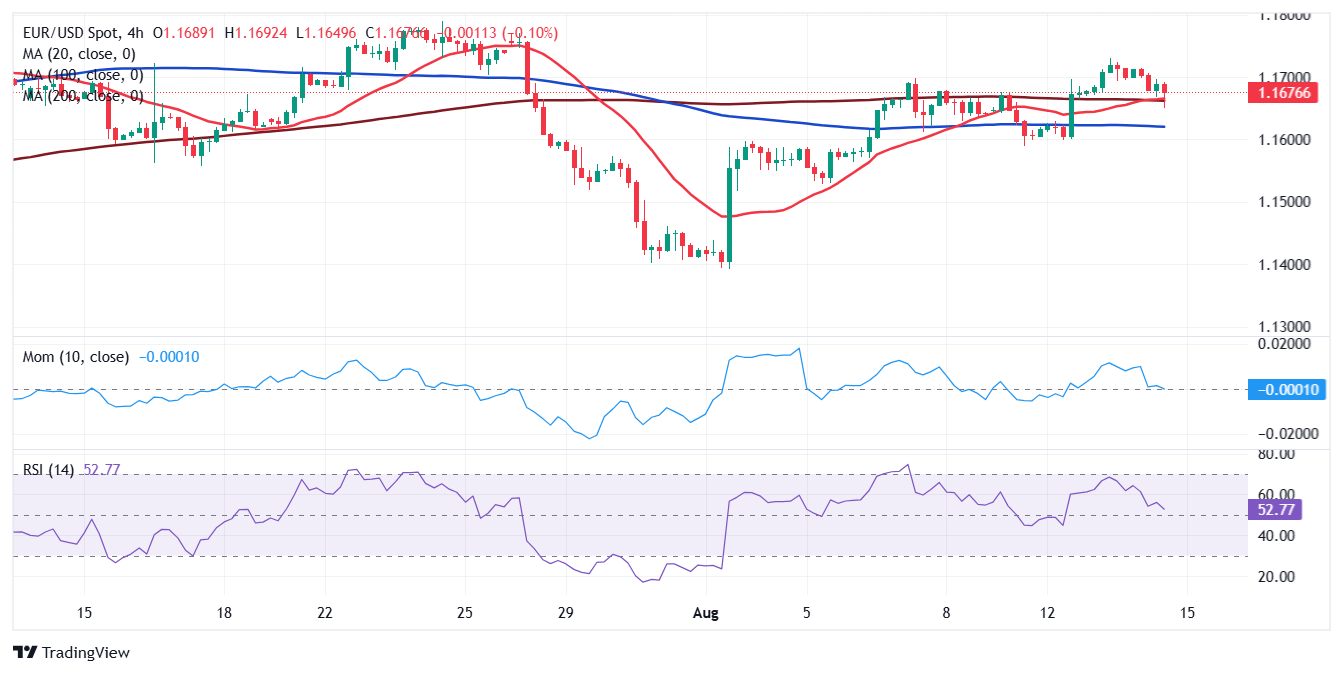
The EUR/USD pair traded with a softer tone throughout the first half of Thursday, although confined to a tight range. Market players paused ahead of the release of United States (US) inflation-related data, but remained overall optimistic.
Financial boards keep revolving around mounting speculation that the Federal Reserve (Fed) will deliver an interest rate cut when it meets in September. Hopes suffered a minor setback after Goldman Sachs called for heavier tariff-induced consumer inflation to be ahead. Many economist agree with the Fed in its perspective that widespread levies will push price pressures higher, although Goldman Sachs got the attention of President Donald Trump, who criticized harshly the investment group.
Other than that, US Treasury Secretary Scott Bessent hit the wires, stating a neutral rate would be 1.5% points lower than the current 4.25% - 4.50%. He also noted that he needs the next Fed Chair to “rationalise” the job, adding he believes there is room for a series of rate cuts.
On the data front, the Eurozone published a revision of the Q2 Gross Domestic Product (GDP), which matched the previous estimate and showed the economy grew a modest 0.1% in the three months to June. Also, Industrial Production in the EU contracted by 1.3% on a monthly basis in June, worse than the 1.1% advance posted in May or the 1% decline anticipated.
Across the pond, the US published Initial Jobless Claims for the week ended August 9, which resulted in 224K, better than the 228K expected or the previous 227K. Additionally, the country released the July Producer Price Index (PPI), which unexpectedly rose to 3.3% YoY from the previous 2.4% and much higher than the 2.5% expected. The core annual reading hit 3.7% vastly surpassing the expected 2.9% and the 2.6% posted in June.
The dismal inflation-related data triggered fresh market concerns, resulting in sharp slides between US indexes and a spike in USD demand, as hotter-than-anticipated inflation weighs on the Fed rate cut odds.
EUR/USD short-term technical outlook
The EUR/USD pair found buyers during European trading hours at 1.1667, but extended its slide to 1.1647 after the release of US data, now hovering around the 1.1670 mark. In the daily chart, EUR/USD keeps trading above all its moving averages, which limits the bearish potential of the pair. A directionless 20 Simple Moving Average (SMA) provides immediate support at 1.1630, while firmly bullish 100 and 200 SMAs continue advancing below the shorter one. Technical indicators, however, have turned marginally lower within neutral levels, hinting at easing buying interest.
The 4-hour chart shows that the EUR/USD pair is hovering around flat and converging 20 and 200 SMAs, while the 100 SMA also lacks directional strength, lying at around 1.1620. Given that the pair bounced from the mentioned low, but also that it remains within familiar levels, technical indicators have turned flat above their midlines. The pair would need to surpass its weekly peak at around 1.1730 to be able to extend its advance in the upcoming sessions.
Support levels: 1.1620 1.1585 1.1550
Resistance levels: 1.1700 1.1740 1.1785
Author
Valeria Bednarik
FXStreet
Valeria Bednarik was born and lives in Buenos Aires, Argentina. Her passion for math and numbers pushed her into studying economics in her younger years.

















