EUR/USD Price Forecast: Bulls hesitate amid fresh concerns about Fed’s independence

EUR/USD Current price: 1.1648
- US President Donald Trump messing with the Federal Reserve, tariffs.
- US Durable Goods Orders fell by less than anticipated in July.
- EUR/USD stabilizes around 1.1650, risk-off limits the upside.
The US Dollar (USD) trimmed most of its Federal Reserve (Fed) Chair Jerome Powell-inspired losses on Monday, resulting in EUR/USD falling towards the 1.1600 mark. Financial markets turned risk-averse late in the American session, as United States (US) President Donald Trump announced he was firing Fed Governor Lisa Cook, following allegations of mortgage application irregularities.
The Department of Justice opened an investigation into the issue, and given that Cook rejected Trump’s decision, the case will likely end up in court. However, it brought back to the table concerns about the central bank’s independence.
Also, Trump used social media to threaten fresh levies on countries that apply digital taxes on US tech companies. “I put all Countries with Digital Taxes, Legislation, Rules, or Regulations on notice that unless these discriminatory actions are removed, I, as President of the United States, will impose substantial additional Tariffs on that Country's Exports to the U.S.A.,” he said.
The Eurozone did not release relevant data, but the US just published July Durable Goods Orders, which were down 2.8%, better than the previous 9.3% and the expected -4%. Coming up next, investors will focus on the August CB Consumer Confidence survey and the Richmond Fed Manufacturing Index for the same month.
EUR/USD short-term technical outlook
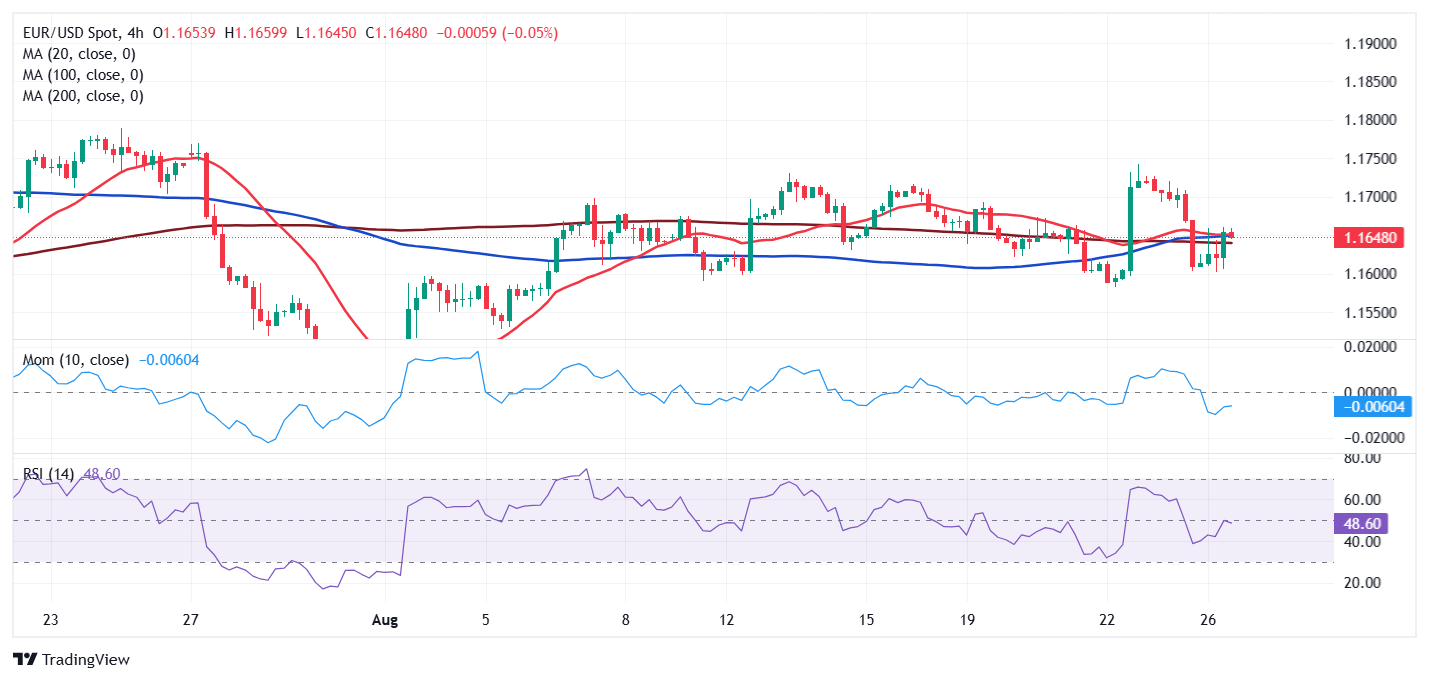
The EUR/USD pair bounced from its intraday low at 1.1602 and trades at around 1.1650 early in the American session, with a limited bullish potential. The daily chart shows that technical indicators lack directional strength within neutral levels, although the Momentum indicators maintain a modest downward slope. At the same time, the pair is developing above all its moving averages, with a flat 20 Simple Moving Average (SMA) providing support at around 1.1620.
The EUR/USD pair struggles to recover its bullish stance in the near term. The 4-hour chart shows it is trading just above a congestion of moving averages, which lack directional strength. Finally, technical indicators turned higher, yet the Relative Strength Index (RSI) indicator stands at around 48, while the Momentum indicator advances just above its 100 line, suggesting limited buying pressure.
Support levels: 1.1620 1.1570 1.1530
Resistance levels: 1.1700 1.1740 1.1785
Tariffs FAQs
Tariffs are customs duties levied on certain merchandise imports or a category of products. Tariffs are designed to help local producers and manufacturers be more competitive in the market by providing a price advantage over similar goods that can be imported. Tariffs are widely used as tools of protectionism, along with trade barriers and import quotas.
Although tariffs and taxes both generate government revenue to fund public goods and services, they have several distinctions. Tariffs are prepaid at the port of entry, while taxes are paid at the time of purchase. Taxes are imposed on individual taxpayers and businesses, while tariffs are paid by importers.
There are two schools of thought among economists regarding the usage of tariffs. While some argue that tariffs are necessary to protect domestic industries and address trade imbalances, others see them as a harmful tool that could potentially drive prices higher over the long term and lead to a damaging trade war by encouraging tit-for-tat tariffs.
During the run-up to the presidential election in November 2024, Donald Trump made it clear that he intends to use tariffs to support the US economy and American producers. In 2024, Mexico, China and Canada accounted for 42% of total US imports. In this period, Mexico stood out as the top exporter with $466.6 billion, according to the US Census Bureau. Hence, Trump wants to focus on these three nations when imposing tariffs. He also plans to use the revenue generated through tariffs to lower personal income taxes.
Author

Valeria Bednarik
FXStreet
Valeria Bednarik was born and lives in Buenos Aires, Argentina. Her passion for math and numbers pushed her into studying economics in her younger years.