EUR/USD Price Forecast: Attention now shifts to US NFP
- EUR/USD set aside two straight daily gains and drops below 1.0400.
- The US Dollar gathered some steam ahead of key US jobs report.
- The US Nonfarm Payrolls takes centre stage at the end of the week.

EUR/USD came under renewed selling pressure on Thursday, returning to the sub-1.0400 region on the back of an acceptable rebound in the Greenback. On the latter, the US Dollar Index (DXY) reclaimed the area above the 108.00 hurdle, although that bullish move lost impulse as the North American session drew to a close.
Tariff turbulence and Dollar dynamics
The recent weakening of the Greenback has coincided with fresh twists in United States (US) President Donald Trump’s tariff saga. Although the much-discussed 25% tariff on Canadian and Mexican imports has been delayed, the 10% duty on Chinese goods remains in effect.
This uncertainty and the lack of clear direction from the White House have spurred investors to offload long USD positions, intensifying the currency's slide.
Interestingly, while the current tariffs narrative has been pressuring the US Dollar, it is also expected to underpin its strength over the longer term, setting up a bullish outlook for the Greenback in the current year.
Central banks under the microscope
All eyes are now on central banks as market participants weigh their next moves. Last week, the Federal Reserve (Fed) opted to hold interest rates steady, leaving traders in suspense over when the next rate cut might materialize. Despite the US economy’s robust growth, persistent inflation and low unemployment, the Fed is treading carefully, shifting its tone from modest progress to describing price pressures as “elevated.” By maintaining its interest rates at 4.25%-4.50%, the bank has signalled a cautious wait-and-see approach amid uncertainties stirred by Trump’s trade and fiscal policies.
Across the Atlantic, the European Central Bank (ECB) met expectations by trimming rates by 25 basis points. With the eurozone grappling with sluggish growth and inflation still hovering above the bank’s 2% target, this measured easing was seen as a necessary step. During her press conference, President Christine Lagarde reiterated that future policy moves would be data-driven—ruling out drastic measures such as a 50 basis point cut—and expressed confidence that inflation could be tamed by 2025, even as rising global trade tensions pose near-term challenges.
Who stands to gain in a trade war?
The evolving tariff landscape poses a double-edged sword. On the one hand, prolonged tariffs could spark higher US inflation, potentially compelling the Fed to adopt a more hawkish stance—thereby strengthening the Greenback.
On the other hand, this scenario, coupled with more likely-than-not tariffs on the European Union (EU), could place additional headwinds on the Euro, nudging EUR/USD closer to parity sooner than expected.
A technical snapshot
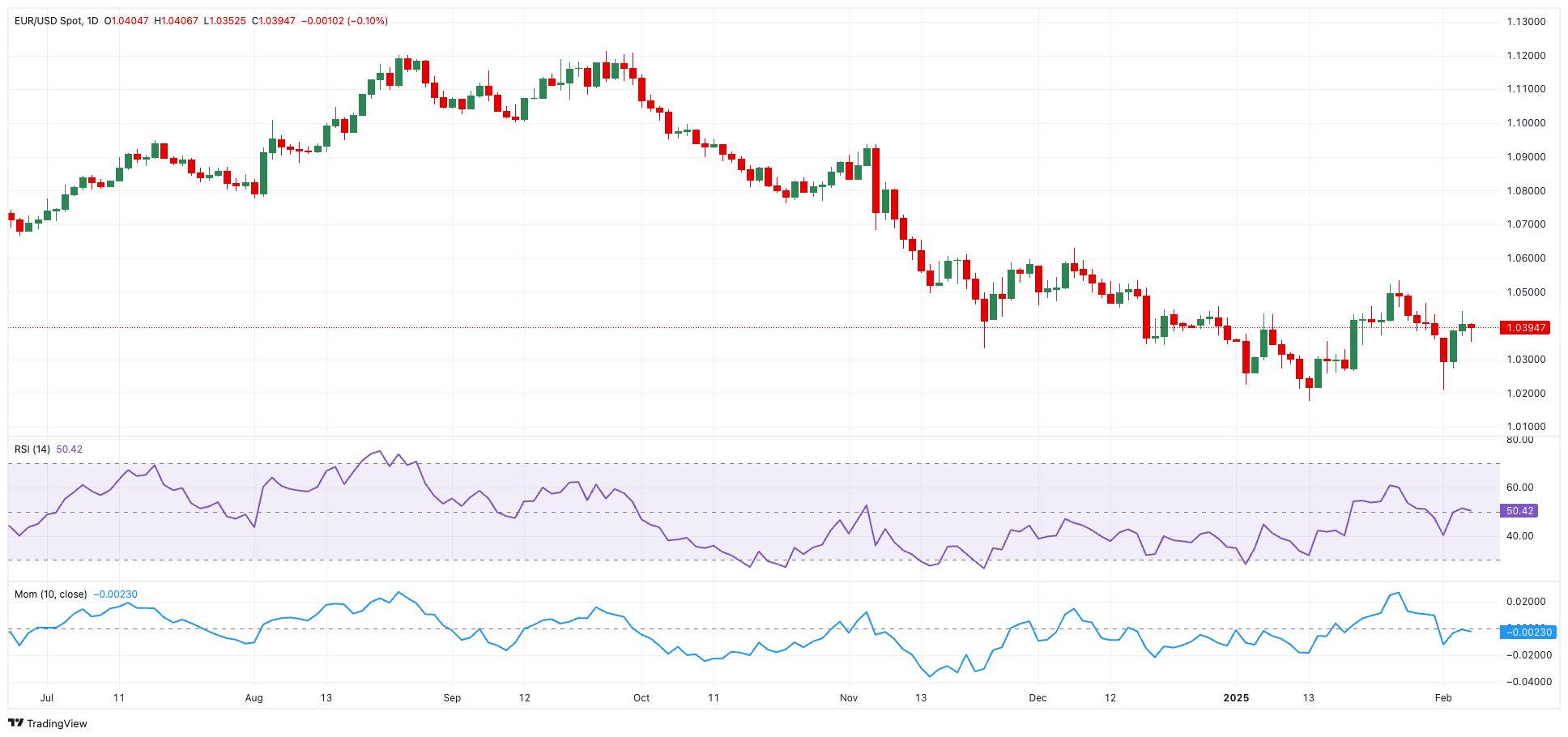
From a technical perspective, EUR/USD appears to have shaken off its recent lows around 1.0200. The pair found initial support at the weekly low of 1.0209 (recorded on February 3). A breach below this could pave the way for a slide toward 1.0176, the lowest level in 2025.
On the upside, resistance is spotted at 1.0532—the year-to-date high from January 27—with further obstacles at 1.0629 (the December peak) and the 100-day Simple Moving Average at 1.0630.
While momentum indicators offer a glimmer of hope—RSI has rebounded to around 49, suggesting strengthening momentum—the ADX lingers near 19, indicating that the current trend may be losing some of its steam.
EUR/USD daily chart
The road ahead for the Euro
Looking forward, the Euro (EUR) faces a challenging road. The resilient US Dollar, divergent monetary policies between the ECB and the Fed, and internal eurozone issues—like Germany’s slowing economy—could all work against sustained gains for the single currency. While short-term rallies are certainly on the cards, the overall outlook for the euro remains uncertain as market forces continue to evolve.
Author

Pablo Piovano
FXStreet
Born and bred in Argentina, Pablo has been carrying on with his passion for FX markets and trading since his first college years.

















