EUR/USD Price Forecast: A technical correction remains likely
- EUR/USD rose to new highs past the 1.1800 hurdle on Tuesday.
- The US Dollar rebounded from earlier multi-year troughs.
- ECB’s Lagarde said the bank needs to remain extremely vigilant on inflation.


The Euro (EUR) halted its eighth-day winning streak on Tuesday, as EUR/USD ended the day with marginal losses after reaching new 2025 highs near 1.1830 during early trade.
The rally faltered in response to the late bounce in the US Dollar (USD), reignited after the Senate passed President Trump’s sweeping tax-cut bill and data releases came in better than initially estimated.
Political pressure builds on Fed
Investors, in the meantime, remained wary after President Trump’s renewed criticism of Fed Chair Jerome Powell, arguing that interest rates should be “1% or lower” and accusing the central bank’s leadership of dereliction of duty.
Easing geopolitical jitters weighed on the US Dollar
Last week, Washington facilitated a fragile truce in the Middle East, igniting interest in risk-linked assets and bolstering the EUR and other risk-linked currencies.
Trade tensions resurfaced
On the trade front, investors remained wary of a possible shift in Washington’s stance as the July 9 deadline on the current US tariff pause approaches. Meanwhile, the European Union continues to engage on several trade fronts, including talks with the United Kingdom.
ECB-Fed policy divergence persists
The Fed held rates steady at 4.25%–4.50% in June but revised up its inflation and unemployment forecasts in light of tariff-related cost pressures. The latest dot plot still suggests 50 basis points of easing this year, though individual projections vary widely.
In his latest remarks, Fed Chair Powell reiterated that escalating tariffs could reignite inflation in the coming months, hence the steady prudence from the Fed.
In contrast, the European Central Bank (ECB) cut its deposit rate to 2.00% earlier this month. President Christine Lagarde signalled that further easing would depend on a clear deterioration in external demand, reinforcing the policy gap between Frankfurt and Washington.
Speculators raise EUR long exposure
The latest CFTC data for the week ending June 24 showed speculative net longs in the European currency rising to levels not seen since January 2024, exceeding 111.1K contracts. Meanwhile, commercial players increased their net shorts to 164.3K contracts, the highest since mid-December 2023. In addition, open interest increased to a two-week high around 762.6K contracts.
Key chart levels
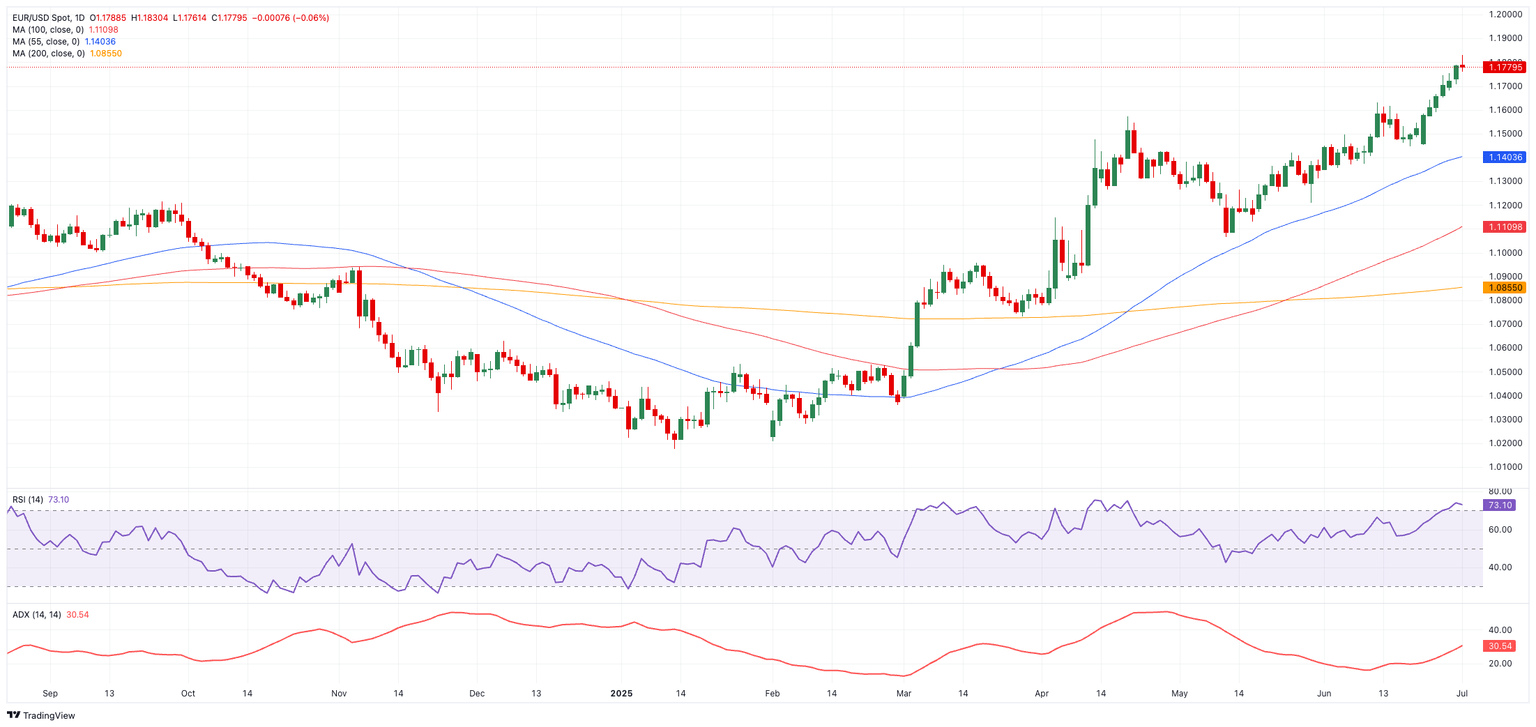
Immediate resistance stands at the 2025 ceiling of 1.1829 (July 1). A breakout above the latter would bring the September 2018 peak at 1.1815 (September 24) and the June 2018 high at 1.1852 (June 14) into play.
Initial support is seen at the 55-day simple moving average (SMA) at 1.1403, seconded by the weekly trough at 1.1210 (May 29) and the May floor at 1.1064 (May 12), all preceding the 1.1000 threshold.
Momentum indicators remain bullish. The Relative Strength Index (RSI) hovers above 73, suggesting stretched conditions that may prompt a short-term pullback. However, an Average Directional Index (ADX) of nearly 31 indicates that the underlying trend is becoming increasingly strong.
Outlook
Unless geopolitical or macroeconomic shocks re-emerge, the Euro’s upward trend looks set to continue, driven by fading risk aversion and growing conviction that the Fed may be forced to ease policy. Political pressure on the Fed and rising trade uncertainty could keep EUR/USD on a bullish trajectory in the near term.
ECB FAQs
The European Central Bank (ECB) in Frankfurt, Germany, is the reserve bank for the Eurozone. The ECB sets interest rates and manages monetary policy for the region. The ECB primary mandate is to maintain price stability, which means keeping inflation at around 2%. Its primary tool for achieving this is by raising or lowering interest rates. Relatively high interest rates will usually result in a stronger Euro and vice versa. The ECB Governing Council makes monetary policy decisions at meetings held eight times a year. Decisions are made by heads of the Eurozone national banks and six permanent members, including the President of the ECB, Christine Lagarde.
In extreme situations, the European Central Bank can enact a policy tool called Quantitative Easing. QE is the process by which the ECB prints Euros and uses them to buy assets – usually government or corporate bonds – from banks and other financial institutions. QE usually results in a weaker Euro. QE is a last resort when simply lowering interest rates is unlikely to achieve the objective of price stability. The ECB used it during the Great Financial Crisis in 2009-11, in 2015 when inflation remained stubbornly low, as well as during the covid pandemic.
Quantitative tightening (QT) is the reverse of QE. It is undertaken after QE when an economic recovery is underway and inflation starts rising. Whilst in QE the European Central Bank (ECB) purchases government and corporate bonds from financial institutions to provide them with liquidity, in QT the ECB stops buying more bonds, and stops reinvesting the principal maturing on the bonds it already holds. It is usually positive (or bullish) for the Euro.
Premium
You have reached your limit of 3 free articles for this month.
Start your subscription and get access to all our original articles.
Author
Pablo Piovano
FXStreet
Born and bred in Argentina, Pablo has been carrying on with his passion for FX markets and trading since his first college years.