EUR/USD Price Forecast: A breakout of 1.0850 should allow for further gains
- EUR/USD surged to multi-day tops near 1.0870 on Wednesday.
- The US Dollar faced renewed and marked downside pressure.
- The White House is expected to announce reciprocal tariffs later on Wednesday.

The Euro (EUR) is once again testing its resolve and surpassing the 1.0800 mark against the US Dollar (USD). That said, EUR/USD advanced to the 1.0870 region, or multi-day peaks, on the back of increasing selling interest hurting the Greenback, in turn sending the US Dollar Index (DXY) back below the 104.00 support, just ahead of the so-called “Liberation Day.”
Renewed tariff threats target the EU
President Trump has floated the idea of an additional 20% tariff on European goods, potentially set for announcement later on Wednesday. This move revives worries of a transatlantic trade spat, with auto and pharmaceutical sectors reportedly in the crosshairs. Any retaliatory measures from the EU could undermine global growth and apply fresh downward pressure on the Euro.
However, the strong rebound in the Euro (EUR) came precisely after the EU said it could also announce measures aimed at alleviating the expected Trump’s tariffs on imports from the old continent.
Ceasefire in Eastern Europe brings a glimmer of hope
On another front, geopolitical tensions in Eastern Europe have eased somewhat. Ukrainian President Volodymyr Zelenskiy recently announced a ceasefire covering critical energy infrastructure and Black Sea routes, brokered in part by the United States.
Adding to the optimism, President Trump signalled the possibility of a US-Ukraine mineral revenue-sharing deal, which could pave the way for more US investment in Ukraine’s energy sector.
Central banks: Balancing inflation and uncertainty
- Federal Reserve (Fed): The Fed kept rates steady at its last meeting but acknowledged that ongoing trade disputes could fuel inflation, potentially justifying a more hawkish tilt. At the same time, signs of slower economic growth suggest caution is warranted. Chair Jerome Powell reiterated a “data-dependent” approach, noting that up to 50 basis points of easing might still be on the table later this year if the economy deteriorates.
- European Central Bank (ECB): The ECB cut its key rate by 25 basis points and hinted at further easing if uncertainties linger. Updated projections suggest weaker growth and sticky near-term inflation, although policymakers see inflation moderating by 2026. President Christine Lagarde warned that a U.S.-EU tariff battle could shave 0.5% off Eurozone GDP, even as she commended Germany’s fiscal stimulus efforts.
With money markets pricing in an 80% chance of a rate cut this month, ECB officials voiced their opinions on Wednesday: President Christine Lagarde warned tariffs will have a negative global impact depending on their scope, duration, and the success of negotiations. Board member Isabel Schnabel emphasised that US policies significantly affect European economic decisions, while her colleague Robert Holzmann noted that with easing eurozone inflation and current rates no longer hindering growth, there was no need for further rate cuts. He also cautioned that a potential trade war following the new tariffs could force central banks to adopt unconventional measures.
Euro bulls tiptoe back
Speculative traders are beginning to warm to the Euro once again. Net long positions have climbed for three consecutive weeks, surpassing 65K contracts—the highest level since late September 2024. Hedge funds, however, continue to extend their short bets, pushing total contracts above 100K, according to the latest CFTC figures.
EUR/USD technical outlook
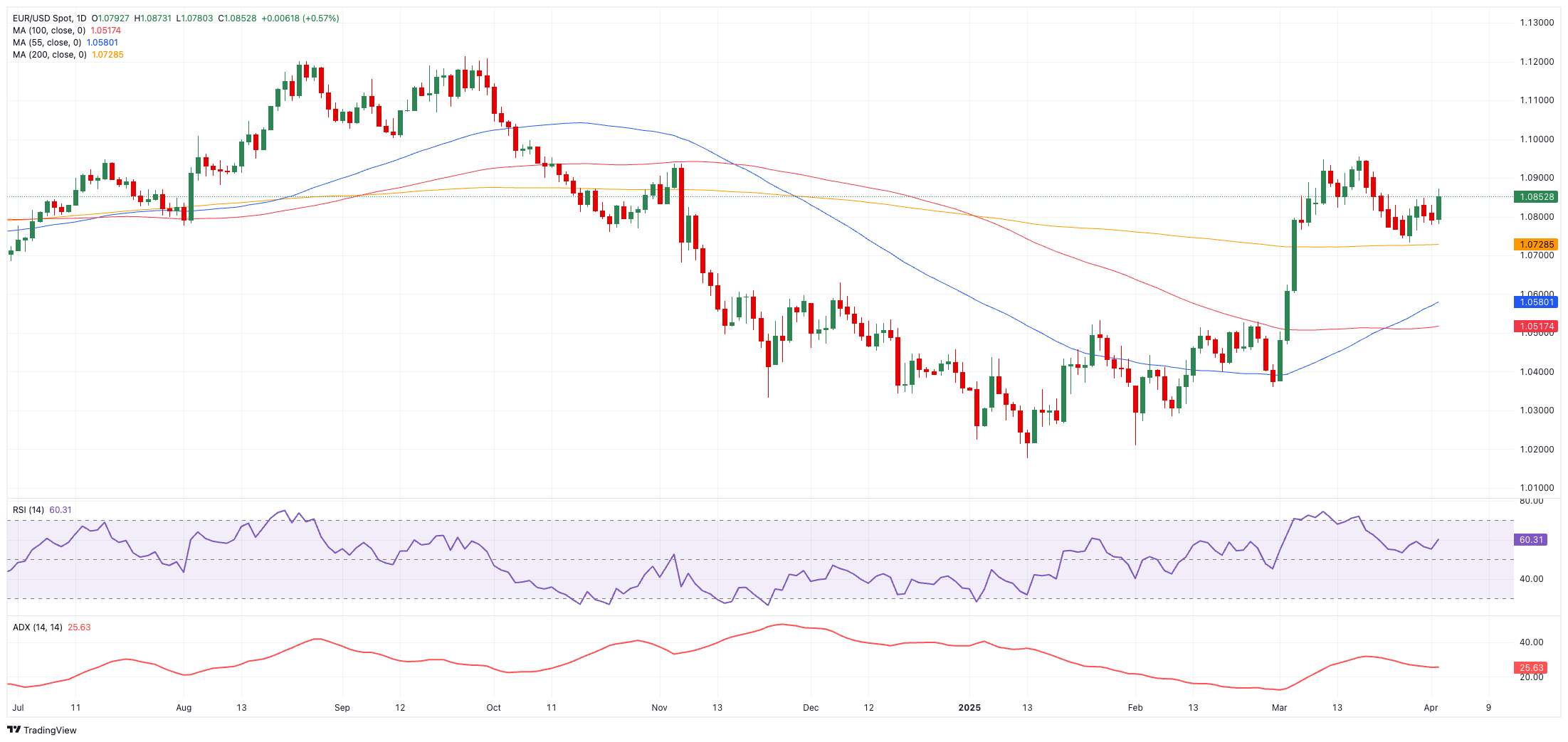
EUR/USD faces immediate resistance at the 2025 peak of 1.0954 (March 18), with the 23.6% Fibonacci retracement of the September-January sell-off at 1.0969 positioned just above. A clear break beyond this level could reignite bullish momentum and bring the psychological 1.1000 mark back into focus.
On the downside, the 200-day SMA at 1.0731 stands as key support, backed by the interim 55-day and 100-day SMAs at 1.0580 and 1.0521, respectively, and the weekly low at 1.0359 (February 28). If the pair slides further, the weekly low at 1.0282 (February 10) and the 2025 bottom at 1.0176 (January 13) may come into play.
Meanwhile, the RSI rose past the 60 level, hinting at some strengthening in bullish momentum, and an ADX reading near 26 points to a moderate overall trend strength.
EUR/USD daily chart
What to watch
Looking ahead, EUR/USD will remain highly sensitive to any announcements on US trade policy, evolving geopolitical developments in Eastern Europe, and fresh signals from both the Fed and ECB. With so many moving parts, traders will be closely watching Wednesday’s events and central bank commentary for clues on the pair’s next direction.
Author

Pablo Piovano
FXStreet
Born and bred in Argentina, Pablo has been carrying on with his passion for FX markets and trading since his first college years.