EUR/USD: No surprise from Draghi, he was dovish as always

Macroeconomic overview
Today the ECB left all its interest rates unchanged, in line with expectations. The press conference was fairly uneventful, with Draghi striking a dovish tone when addressing German concerns about accelerating inflation. The Governing Council’s risk assessment remains tilted to the downside, making speculations about a faster pace of QE reduction very premature.
Draghi elaborated on the meaning of “sustained inflation adjustment”: in order to satisfy this definition, the adjustment has to be durable, sustainable even when monetary support is withdrawn, it has to stretch to the medium term and to refer to the Eurozone as a whole.
Draghi said that rising inflation in the Eurozone is primarily being driven by fluctuating energy prices and there are no signs it is sustainable.
Draghi always uses dovish rhetoric and it was not a surprise when he shrugged off rising inflation pressure in the Eurozone at yesterday’s press conference. The EUR weakened just after his comments, but we think this move was short-lived as dovish Draghi is nothing new for investors. The market should focus now on further inflation developments in the Eurozone. Rising CPI and strengthening economic recovery will be important reasons to buy EUR.
U.S. homebuilding rebounded sharply in December as a firming economy boosts demand for rental housing.
Housing starts jumped 11.3% to a seasonally adjusted annual rate of 1.23 million units last month, the Commerce Department said. Starts were driven by a 57.3% surge in the construction of multi-family housing units, which offset a 4.0% drop in single-family starts. The market had forecast housing starts increasing to a 1.20 million-unit rate in December. Housing starts increased 4.9% in 2016.
Permits for future home construction slipped 0.2% to a 1.21 million-rate last month as approvals for the multi-family segment fell 9.0%. However, permits for single-family homes construction rose 4.7%.
In a separate report, the Labor Department said initial claims for state unemployment benefits fell 15k to a seasonally adjusted 234k for the week ended January 14. That was just shy of the 233k level touched in mid-November, which was the lowest since November 1973. The four-week average of claims fell 17k between the December and January survey periods, suggesting another month of solid job growth. Nonfarm payrolls increased by 156k jobs in December.
Fed Chair Yellen spoke at the Stanford Institute for Economic Policy Research in early Asian trading hours. She reiterated the U.S. central bank should continue to raise interest rates slowly to keep inflation low and jobs plentiful and avoid harming the recovery the Fed has sought to nurture.
Technical analysis
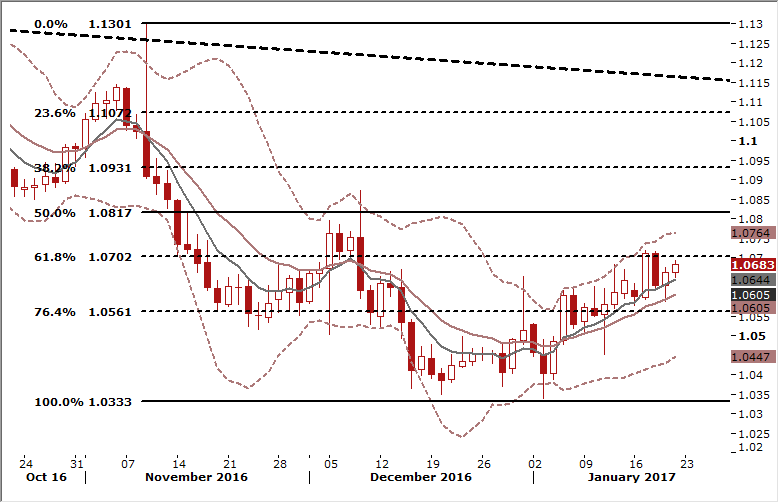
Yesterday’s EUR/USD fall was stopped at 14-day exponential moving average, which suggests that bullish trend remains intact. Long lower shadow of Thursday’s candlestick is another evidence that upward move is likely to be continued in the coming days.
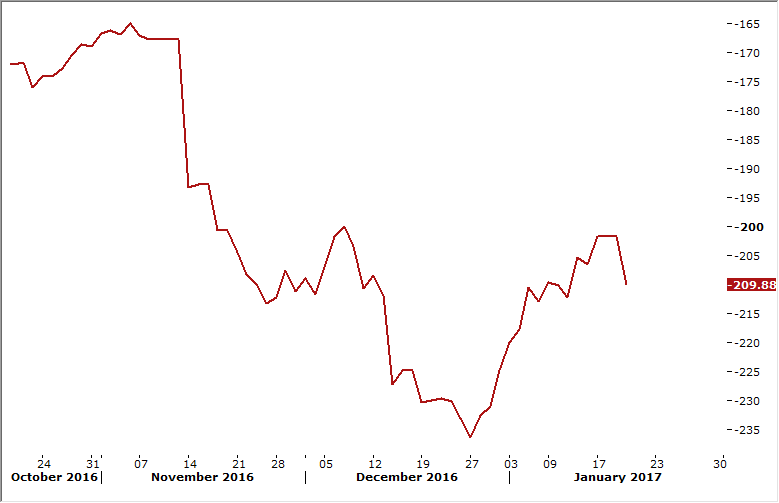
Yield spread between German and U.S. 10-year bonds
USD/CAD: Short again, inflation data ahead
Macroeconomic overview
The Canadian dollar weakened to a two-week low against its U.S. counterpart on Thursday, brushing off firm domestic data a day after the Bank of Canada left the door open to cutting interest rates. We do not believe in interests rate cuts and think that this was only an attempt to weaken the loonie.
Canadian manufacturing sales rebounded 1.5% in November from October. The market had expected a 1.0% rise.
Prices of oil, one of Canada's major exports, recovered from a one-week low as the International Energy Agency said oil markets were tightening even before cuts agreed by OPEC and other producers took effect.
Canadian inflation and retail sales data will be released today. We expect a rise in inflation to 1.7% yoy in December from 1.2% yoy in November. Core inflation is likely to increase to 1.7% yoy from 1.5% yoy. Retail sales is expected to grow by 0.5% mom in November after an increase by 1.1% mom in October. In our opinion this is not an environment where you can consider interest rates cuts, especially given monetary tightening in the U.S.
Technical analysis
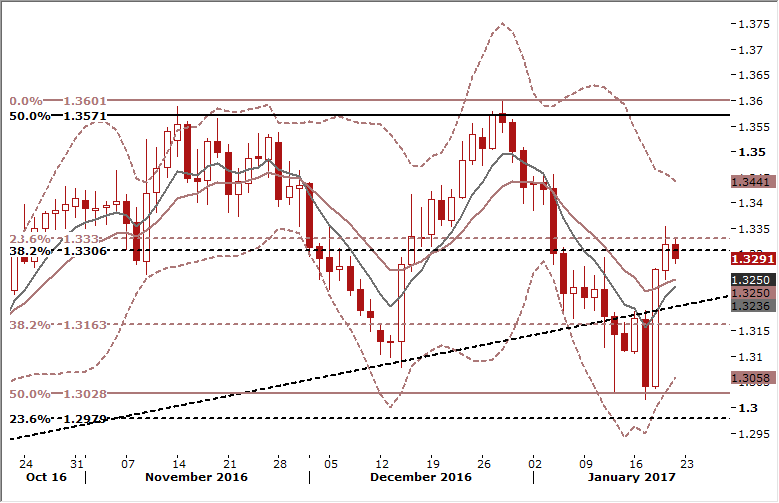
The USD/CAD broke above the resistance at 1.3330 yesterday, but did not manage to close above that level and today the rate is again below 1.3300. A close below 1.3300 will suggest that an upward move will not be continued. However, there is no clear outlook on the USD/CAD from the technical analysis point of view.
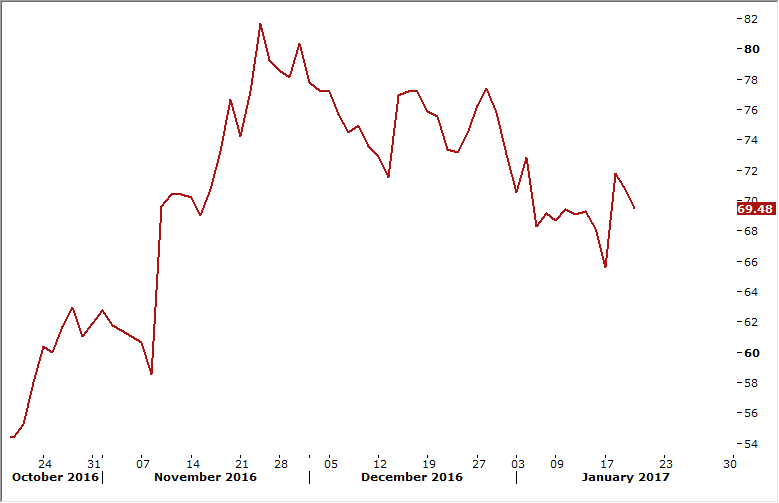
Yield spread between U.S. and Canadian 10-year bonds
Author

Growth Aces Research Team
Growth Aces
GrowthAces.com is an independent macroeconomic consultancy. They offer you daily forex analysis with forex signals for traders.

















