EUR/USD Forecast: Euro bulls stay on the sidelines for now
- EUR/USD has edged lower toward 1.0850 in the early European session.
- German GDP and Eurozone sentiment data will be looked upon for fresh impetus.
- The pair's near-term technical outlook points to a lack of buyer interest.


After having ended the previous week virtually unchanged, EUR/USD has declined to the 1.0850 area early Monday. The pair's near-term technical outlook suggests that buyers remain on the sidelines for the time being. In the second half of the day, risk perception could drive the pair's action in the absence of high-impact data releases from the US.
The cautious market tone at the beginning of the week seems to be helping the US Dollar hold its ground against its rivals with the US Dollar Index clinging to small daily gains at around 102.00. US stock index futures are down between 0.5% and 0.7% in the European morning, reflecting the risk-averse atmosphere.
Later in the session, Germany's Destatis will publish the Gross Domestic Product (GDP) data for the fourth quarter. The German economy is forecast to post an annualized growth of 1.3% in the last quarter of the year, matching the previous quarter. Ahead of the European Central Bank's (ECB) policy announcements later in the week, however, investors are unlikely to react to the German GDP figures.
The European economic docket will also feature the business and consumer sentiment data for January. The Economic Sentiment Indicator and the Consumer Confidence Index figures are both expected to improve modestly.
In the American session, the Federal Reserve Bank of Dallas will release the Texas Manufacturing Survey for January. Investors will also keep a close on the performance of Wall Street's main indexes. In case US stocks stage a deep correction following the previous week's rally, the US Dollar is likely to preserve its strength and force EUR/USD to stay on the back foot.
EUR/USD Technical Analysis
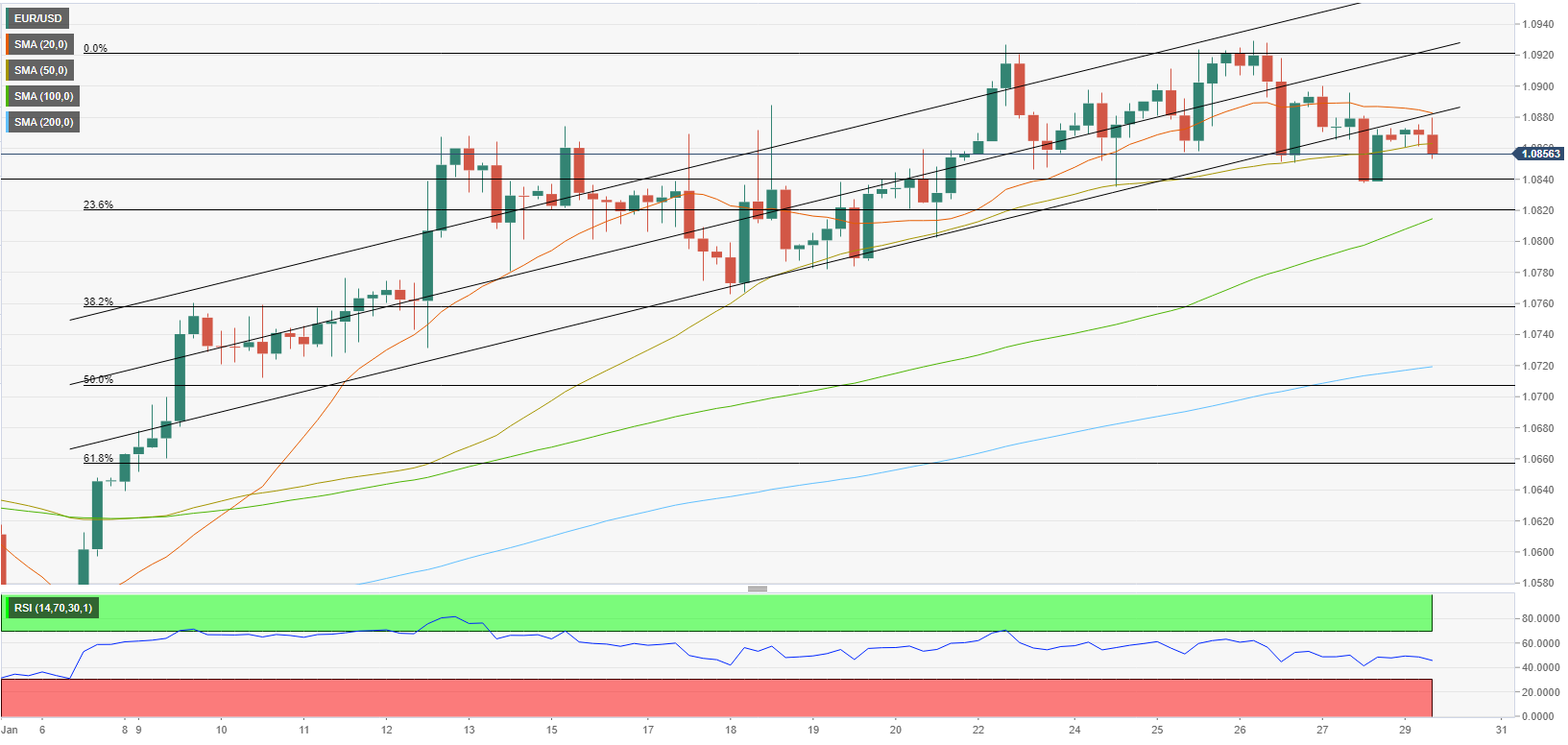
EUR/USD broke below the ascending regression channel coming from early January on Friday and started to use the lower limit of the channel as resistance. Additionally, the Relative Strength Index (RSI) indicator declined below 50, confirming the bearish tilt in the short-term outlook.
On the downside, static support seems to have formed at 1.0840. Below that level, 1.0820 (Fibonacci 23.6% retracement of the latest uptrend, 100-period Simple Moving Average) aligns as key support. In case sellers manage to flip that level into resistance, additional losses toward 1.0800 (psychological level) and 1.0760 (Fibonacci 38.2% retracement) could be witnessed.
On the upside, the pair needs to rise above 1.0880 (lower limit of the ascending channel, 20-period SMA) and stabilize there to attract buyers. In that scenario, resistances are located at 1.0900 (psychological level) and 1.0920/30 (static level, mid-point of the ascending channel).
Premium
You have reached your limit of 3 free articles for this month.
Start your subscription and get access to all our original articles.
Author
Eren Sengezer
FXStreet
As an economist at heart, Eren Sengezer specializes in the assessment of the short-term and long-term impacts of macroeconomic data, central bank policies and political developments on financial assets.