EUR/USD Forecast: Three reasons for the bounce and why it may not last
- EUR/USD has been rising after the US published weak jobs figures.
- Optimism about trade is weighing on the safe-haven greenback.
- The currency pair has escaped crashing below the uptrend support line.


Has the world's most popular currency pair bottomed out? While the common currency is enjoying the misery of the dollar, it has weak foundations to lean on.
Here are the reasons for the bounce:
1) Weak US Non-Farm Payrolls
The US economy gained only 145,000 jobs in December, worse than 164,000 that appeared on the calendar – and also below higher "whisper numbers. for the Non-Farm Payrolls. Estimates had been revised to the upside ahead of the publication. Moreover, the labor market's gains in 2019 were the worst since 2011.
Also, wage growth disappointed with 0.1% monthly and 2.9% yearly, showing that inflation – which the Federal Reserve also targets – is unlikely to pick up anytime soon.
2) Trade hopes
Liu He, China's Vice Premier, is heading to Washington to sign Phase One of the trade deal. Ahead of the ceremony, the world's largest economies expressed optimism – and the upbeat tone weighs on the safe-haven dollar.
Steven Mnuchin, the US Treasury Secretary, suggested that both countries should restart their strategic dialog. This mechanism for defusing tensions was last in use by President George W. Bush in 2006.
3) Escaping a break below support
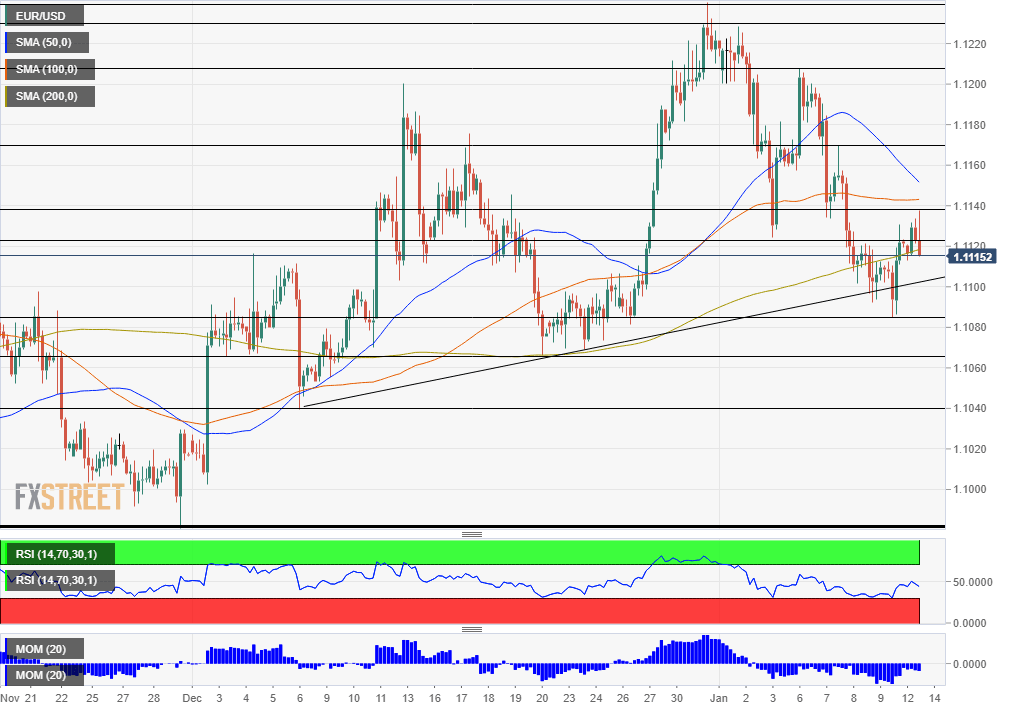
EUR/USD dipped below the uptrend support line that has accompanied it since mid-December but rebounded quickly. Such false breaks are common in the world's most popular currency pair, but the quick bounce is a positive sign.
Moreover, euro/dollar has recaptured the 200 Simple Moving Average on the four-hour chart. The upside levels to watch are 1.1140 (daily high), 1.1170 (a swing high from last week), and 1.1210 (a peak dating to early in the year).
Why the recovery could be limited
Starting from the technicals, the currency pair is still trading below the 50 and 100 SMAs and suffers downside momentum. Support is at Friday's low of 1.1085, followed by 1.1065 (supported the pair around Christmas) and 1.1040 (where the uptrend support line began).
Another potential downer stems from trade – the full details of the Sino-American accord are unknown. Beijing and Washington released on a 15-page summary and the full 86-page document will is still awaited.
Why have they guarded the rest of the agreement? Is there something they want to hide from markets? The revelation may weigh on markets, sending traders to the safety of the greenback.
And while there is no silver lining in the NFP, the old continent has economic issues of its own. Germany will reportedly release a budget that foresees a fiscal surplus – without any stimulus plan.
The reluctance of the eurozone's largest economy to open its purse strings – despite having extremely low borrowing rates – may weigh on the euro.
Overall, EUR/USD has had its reasons to rise, but may now turn south once again.
Author
Yohay Elam
FXStreet
Yohay is in Forex since 2008 when he founded Forex Crunch, a blog crafted in his free time that turned into a fully-fledged currency website later sold to Finixio.