EUR/USD forecast: The ECB meeting becomes the main driver for the Euro this week

EUR/USD trades near 1.1627 on Tuesday after a US jobs report that came in almost three times above forecast. The data supported the dollar and strengthened expectations of tighter Federal Reserve policy. Attention now shifts to the European Central Bank meeting on 10 September, where the rate increase is already fully priced in, and the guidance that follows will determine the euro's next move.
US jobs data put the Dollar back on the front foot
The US labour market delivered its strongest month since March. Nonfarm payrolls rose by 162,000 in August against a market forecast of around 56,000. The unemployment rate held at 4.1%, average hourly earnings rose 3.1% year-on-year, and the Bureau of Labor Statistics revised June and July higher by a combined 55,000, turning July's previously reported job loss into a gain.
Nonfarm payrolls measure how many paid jobs the US economy added during the month, excluding farm work. They provide one of the clearest monthly indications of how much room the Fed has to adjust interest rates.
A labour market this resilient takes the pressure off the Fed to support growth and leaves inflation as its main concern. After the release, money markets raised the probability of a September rate increase to around 58%, up from roughly 52% before the data. Higher expected US rates make dollar deposits more attractive, so the dollar gained ground and EUR/USD settled into a narrow range.
Why the ECB meeting matters more than the decision itself
All 65 economists polled by Reuters expect a 25-basis-point increase in the deposit rate to 2.50%. A basis point is one hundredth of a percentage point, so 25 basis points equal 0.25%. Money markets are pricing in the same outcome with near-full certainty and expect the deposit rate to rise further, reaching around 3.00% by June 2027. That implies two more increases after this week.
When an outcome is fully priced in, the decision itself rarely moves the market. The euro will take its cue from the press conference. Eurozone inflation accelerated to 3.3% in August, driven largely by energy costs, and Christine Lagarde has already identified the energy shock as an upside risk to prices.
That leaves one open question for Thursday. If Lagarde confirms that further tightening remains under discussion, the euro could gain support against a dollar that is also pricing in higher rates, with EUR/USD potentially testing 1.1655, the upper edge of its current range. If she delivers the rate increase and keeps every option open without committing to a path, the rate outlook remains in the dollar's favour, and the pair could move towards 1.1525.
German factory orders add a second layer
New orders in German manufacturing rose 2.5% in July after an upwardly revised 3.7% increase in June. The market expected 0.3%, and this was the third consecutive monthly increase.
The detail matters for anyone trading the euro. Excluding large-scale contracts, orders fell 1.4% from June. Domestic orders jumped 9.1% while foreign orders fell 2.1%, with demand from outside the euro area down 10.1% and demand from inside the bloc up 12.1%. Most of the headline strength came from shipbuilding, rail and aircraft contracts.
German industry is recovering, but that recovery currently relies on a small number of large contracts and on demand from within Europe. For the ECB, this supports the case that the economy can absorb higher rates.
EUR/USD technical analysis
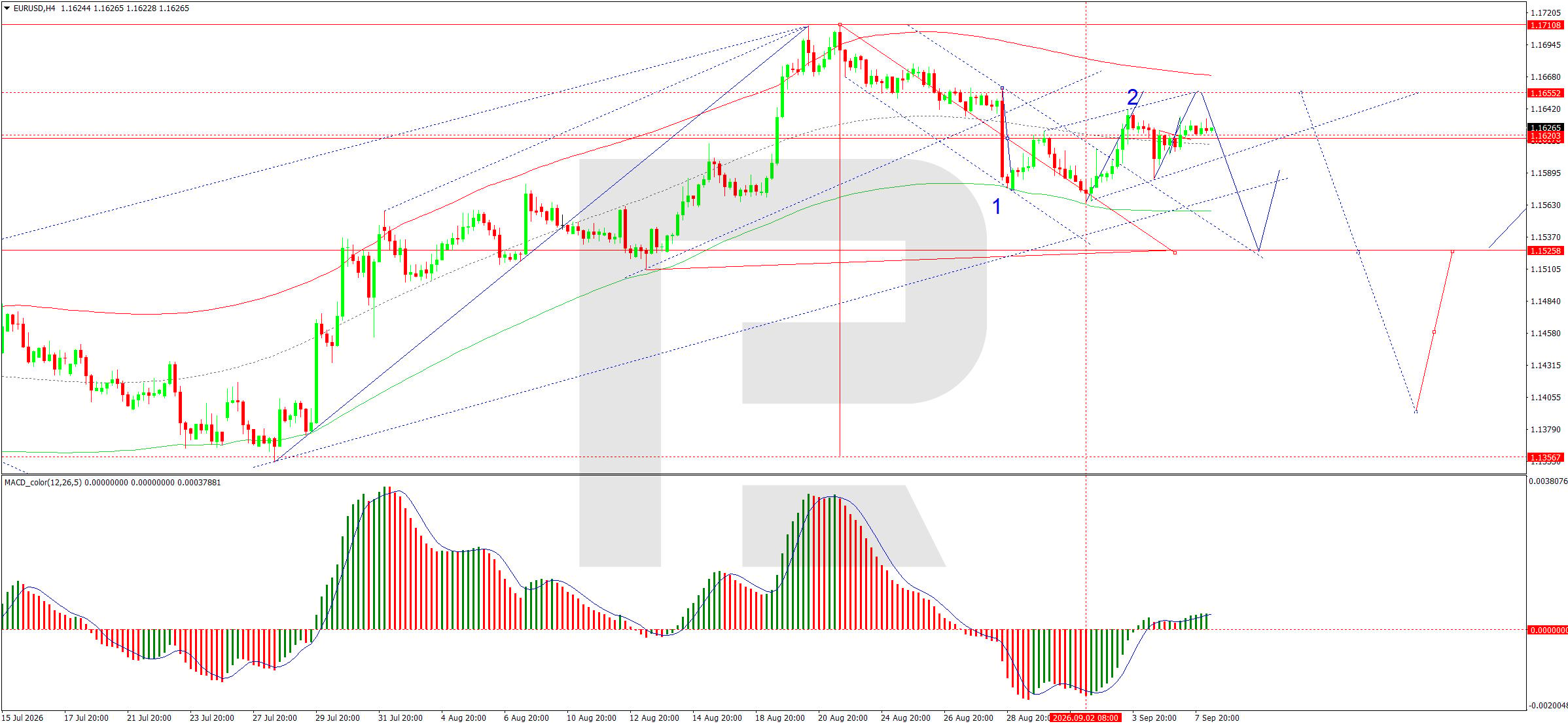
On the four-hour chart, EUR/USD is building a consolidation range around 1.1620. An upward move towards 1.1655 remains on the table, with a decline towards 1.1525 seen as the following stage.
The MACD indicator supports this reading. MACD compares two moving averages of price and shows whether momentum is building or fading. Its signal line sits above zero and points firmly upwards, reflecting bullish momentum with room for the move higher to continue in the near term.
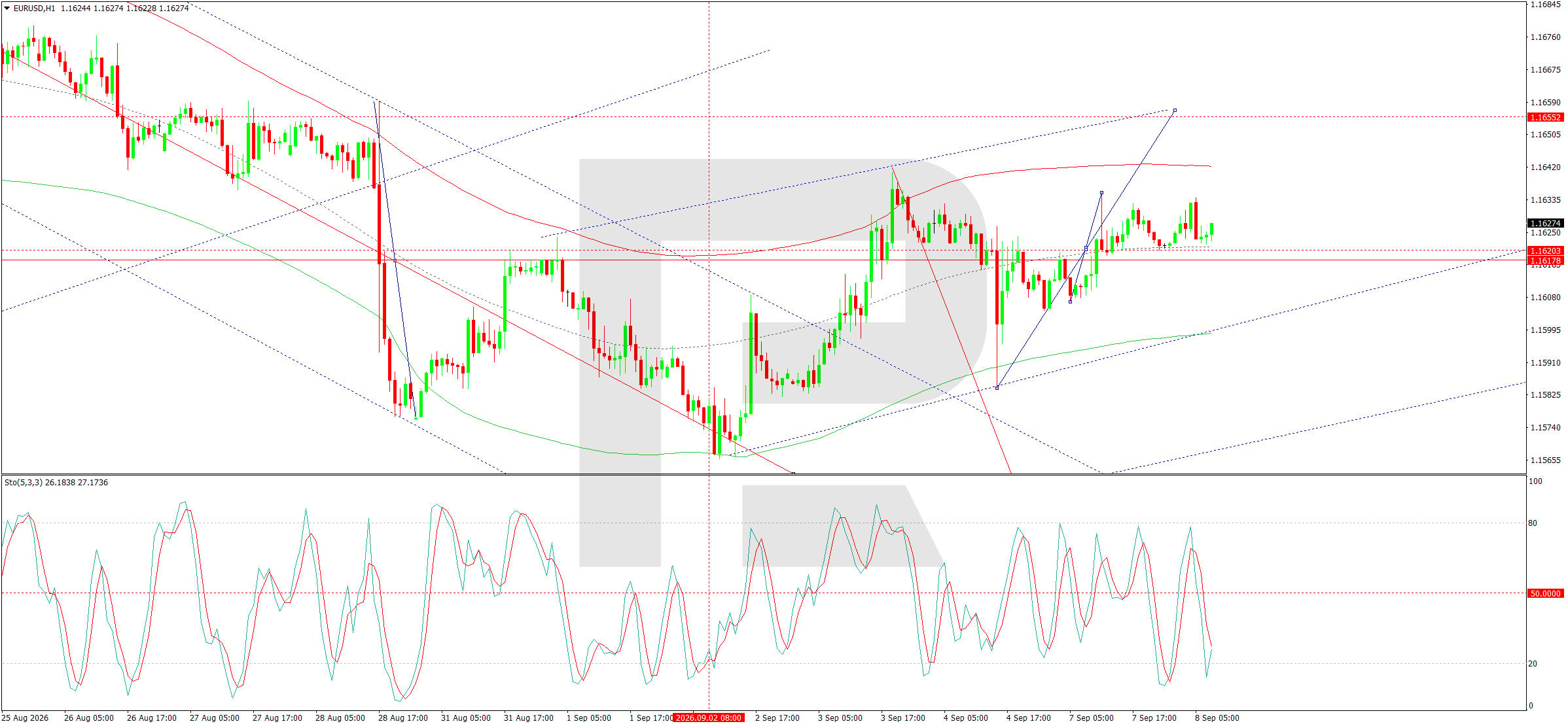
On the hourly chart, the market has completed a downward wave to 1.1620. The pair is now consolidating above that level. The working scenario for today is another upward leg towards 1.1655.
The Stochastic oscillator supports this view. The Stochastic oscillator shows where the current price sits within its recent trading range. Its signal line is above 20 and points upwards towards 80, indicating that the move higher still has room to develop.
Conclusion
EUR/USD enters the ECB week with the technical picture pointing towards 1.1655 in the near term, while the fundamental picture stays split between two central banks moving in the same direction. The rate increase to 2.50% is already priced in, so the euro's next move depends on the guidance that follows.
While the pair holds above 1.1620, the upside scenario remains the working one, with 1.1525 the level to watch further out should the move higher fail to hold. The US inflation report due next week will be the next catalyst on the dollar side of the pair, so the levels set this week are likely to be tested again quickly. Traders who want to follow the reaction in real time can place both levels on the chart in advance and watch how EUR/USD behaves around them during the decision.
Author

RoboForex Analysis Department
RoboForex
RoboForex Analysis Department provides timely market insights, expert technical analysis, and actionable forecasts across forex, commodities, indices, and equities.

















