EUR/USD Forecast: The constructive outlook remains in place so far
- EUR/USD rose to two-month highs near 1.0900.
- The US Dollar regained some ground post-US CPI sell-off.
- Fedspeak sounded cautious ahead of a potential September rate cut.


The US Dollar (USD) managed to leave behind part of its recent deep retracement and sparked a corrective decline in EUR/USD, although not before hitting new tops in levels just shy of 1.0900 the figure on Thursday.
The decent bounce in the Dollar coincided with a generally positive performance in US yields across different durations, as investors kept assessing the latest US inflation data and Thursday’s steady pace of weekly Initial Claims and the monthly pullback in the Philly Fed Manufacturing Index.
This situation continues to anticipate the Federal Reserve (Fed) beginning its easing cycle in September, in contrast to the possibility of the European Central Bank (ECB) initiating interest rate cuts potentially as early as June.
Regarding the latter, the CME Group’s FedWatch Tool suggests nearly 70% probability of lower interest rates by September.
This notion gained further support after Federal Reserve Chief Jerome Powell expressed his expectation of ongoing decrease in US inflation through 2024, echoing the trend from last year. He also suggested that further interest rate hikes by the Fed seemed unlikely.
Still around the Fed, Loretta Mester, President of the Federal Reserve Bank of Cleveland, stated that maintaining the current levels of Fed policy would aid in bringing still-elevated inflation back to the 2% target. Thomas Barkin, President of the Richmond Federal Reserve, highlighted that inflation has not yet reached the desired level for the Fed, with companies in the service sector still perceiving they have pricing power. Meanwhile, John Williams, President of the Federal Reserve Bank of New York, acknowledged the softer consumer inflation data, but cautioned that this alone does not justify an imminent interest rate cut by the central bank.
Meanwhile, the unchanged monetary policy landscape highlights the divergence between the Federal Reserve and other G10 central banks, particularly the European Central Bank (ECB).
Regarding the ECB, recent statements from policymakers indicate an increasing likelihood of the bank commencing its easing process in June, though uncertainties persist about the ECB’s decisions beyond the summer. In this context, Board member Hernandez de Cos stated on Thursday that given recent indicators suggesting a more controlled price evolution, the bank is poised to begin rate cuts in June. Additionally, his colleague Mario Centeno mentioned that inflation in the bloc is steadily decreasing towards 2%, indicating that ECB interest rates will inevitably begin to decrease, though he refrained from predicting whether this would occur at the upcoming June meeting. Finally, member Martin Kazaks remarked that while a rate cut in June is likely, the institution is not in a rush to ease policy, suggesting subsequent actions could be spaced out for proper assessment.
Looking forward, the relatively subdued economic fundamentals in the Eurozone, coupled with the resilience of the US economy, support the ongoing narrative of Fed-ECB policy divergence and lean towards a stronger Dollar in the longer run, especially considering the rising probability of the ECB reducing rates well before the Fed.
Given this perspective, the potential for further weakness in EUR/USD should be considered in the medium term.
EUR/USD daily chart
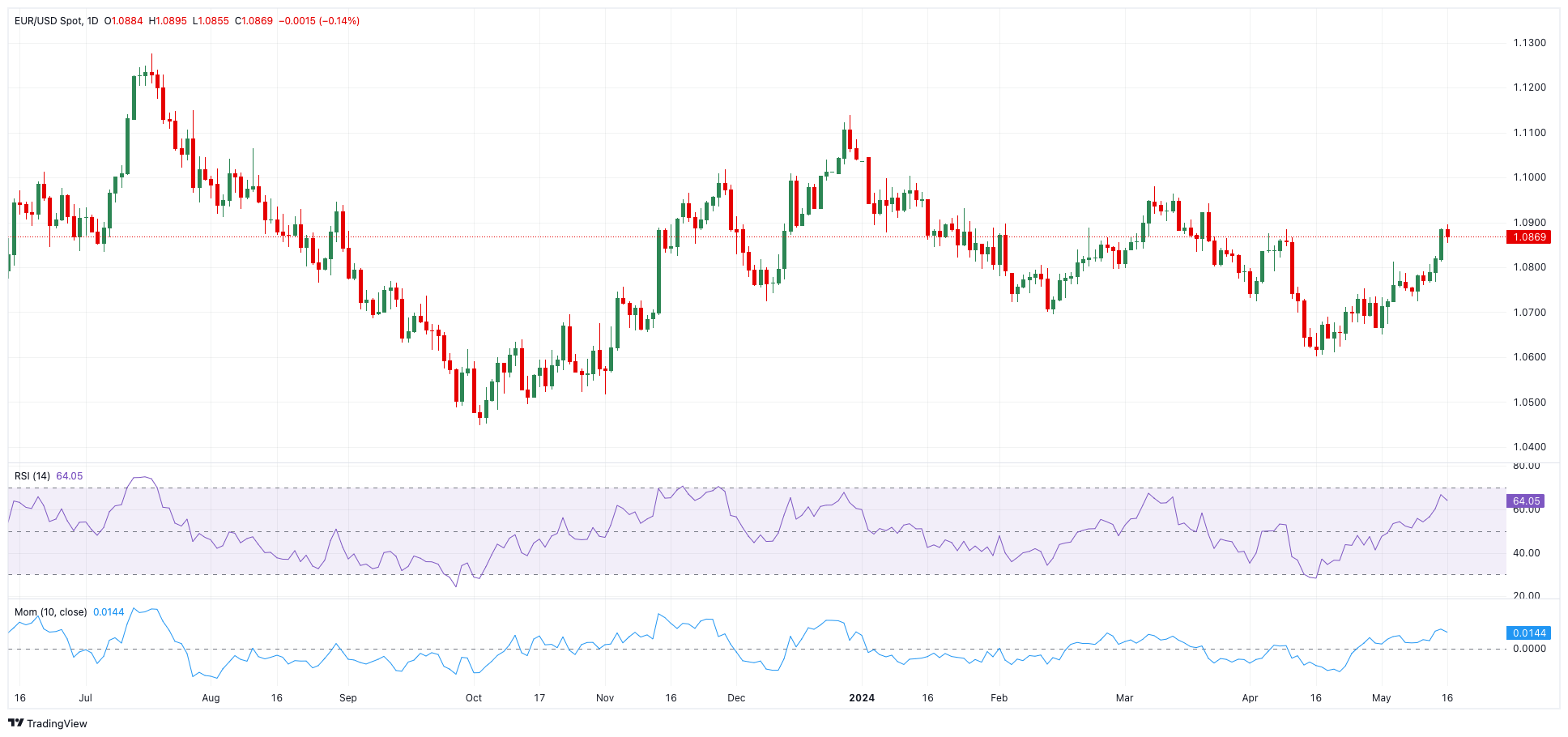
EUR/USD short-term technical outlook
On the upside, EUR/USD is expected to face first resistance at the May top of 1.0894 (May 16), seconded by the March peak of 1.0981 (March 8) and the weekly high of 1.0998 (January 11), all before reaching the critical 1.1000 mark.
In the other direction, a break below the 200-day SMA of 1.0789 could prompt the May low of 1.0649 (May 1) to emerge on the horizon ahead of the 2024 bottom of 1.0601 (April 16) and the November 2023 low of 1.0516 (November 1). Once this zone is cleared, the pair may go for the weekly low of 1.0495 (October 13, 2023), the 2023 bottom of 1.0448 (October 3), and the 1.0400 round milestone.
So far, the 4-hour chart indicates some correction from recent peaks. That said, there is an immediate uphill challenge at 1.0894, followed by 1.0942. Meanwhile, the initial contention is at 1.0790, followed by 1.0766. The relative strength index (RSI) dropped below 66.
Premium
You have reached your limit of 3 free articles for this month.
Start your subscription and get access to all our original articles.
Author
Pablo Piovano
FXStreet
Born and bred in Argentina, Pablo has been carrying on with his passion for FX markets and trading since his first college years.