|

EUR/USD Forecast: The big levels to watch after it lost the triple bottom

  • EUR/USD lost the all-important triple-bottom around 1.1270.
  • Economic divergence is behind the move.
  • Here are the big levels to watch on the daily chart.

Euro/dollar breached a level that supported it three times. 1.1270 was hit in November, then in December, and finally in February before the pair broke to lower ground. While the move awaits a definite confirmation, the downside trend is clear.
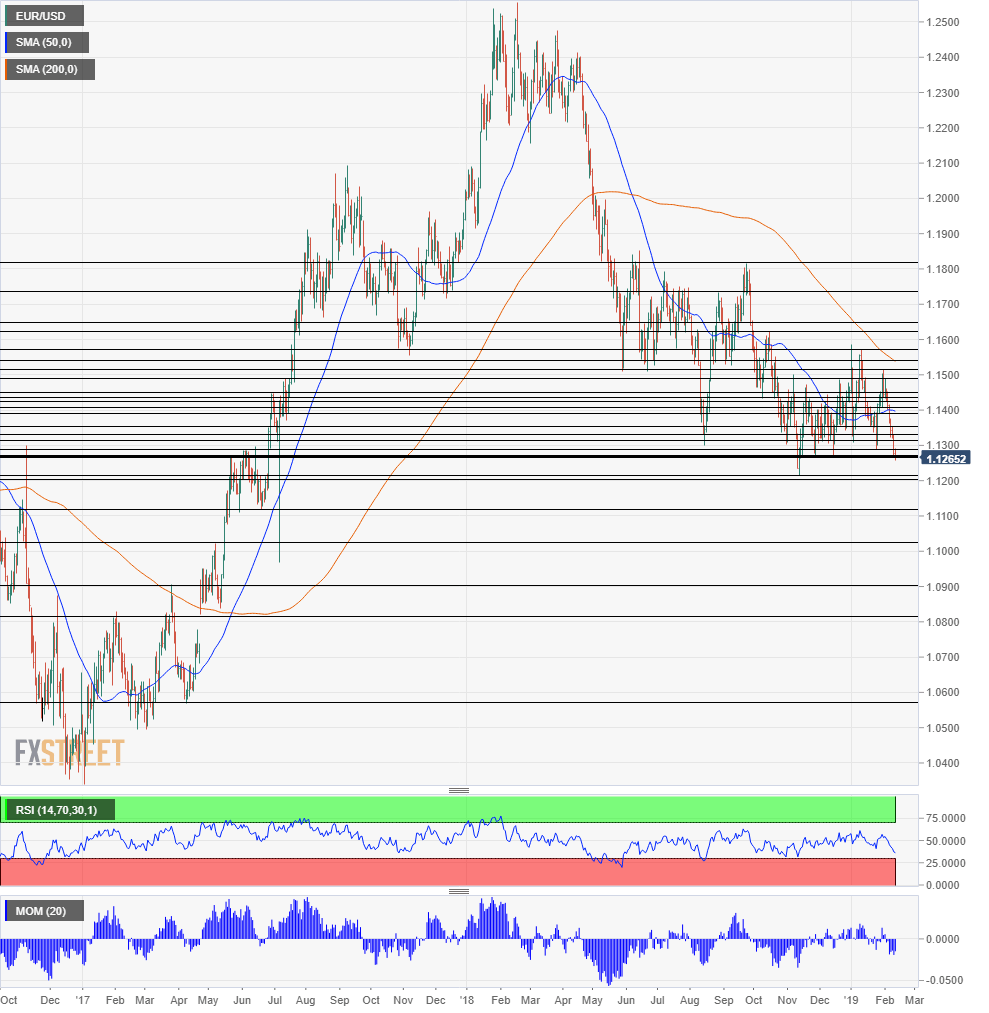
The slide in EUR/USD is also reflected in bond yields. While the 10-year US Treasuries remain stable, German bond yields are flirting with 0%. The demand for German bunds, which serve as safe-havens in the euro-zone, represents the worsening economic prospects for the currency bloc. US growth remains upbeat.

What's next for the pair?

EUR/USD levels

While the pair is stubborn, the break below the critical line opens the door to 1.1215, which was the lowest level recorded in 2018. 

A breach below 1.1215 already sends euro/dollar to levels last seen in June 2017, 20 months ago. Weak support may be found close by, at 1.1200 which is a round number. However, a considerable cushion awaits only at 1.1115, that provided support before the pair surged around that period.

Lower, the next support level is at 1.1025, just above the round number. It capped the pair in May 2017 and now switches to support. The round number of 1.09 held EUR/USD down back in March 2017 and is now support. The gap zone at 1.0820 is next.

Looking up, euro/dollar has quite a few resistance lines that date back from recent days. 1.1290, 1.1315, 1.1330, and 1.1350 may all cap attempts to recover. 

More: EUR/USD recovery? Not so fast – Confluence Detector

Author

Yohay Elam

Yohay Elam

FXStreet

Yohay is in Forex since 2008 when he founded Forex Crunch, a blog crafted in his free time that turned into a fully-fledged currency website later sold to Finixio.


More from Yohay Elam
Share:

Editor's Picks

EUR/USD gains traction to near 1.1800 as tariff uncertainty weighs on US Dollar

The EUR/USD pair holds positive ground around 1.1795 during the early Asian session on Tuesday. The US Dollar weakens against the Euro amid US tariff uncertainty. The release of the US January Producer Price Index report will be in the spotlight later on Friday. 

GBP/USD treads water near 1.3500 as BoE-Fed divergence debate stalls

GBP/USD spent Monday spinning in place as market participants await a fresh catalyst to break the pair out of its recent range. The BoE's February hold came with a surprisingly dovish 5-4 split, and UK Consumer Price Index data last week showed inflation easing to 3.0%, reinforcing the case for earlier rate cuts, with most economists now looking to April or March for the next move. 

Gold down but not out as key $5,140 support holds

Gold consolidates the advance to monthly top of $5,250 in Tuesday’s Asian trades. The US Dollar finds demand as liquidity returns and risk sentiment recovers, despite US tariffs uncertainty. Gold defends 61.8% Fibo resistance at $5,142 amid the pullback, daily RSI remains bullish.

Top Crypto Losers: BCH, HYPE, PUMP extend losses as Bitcoin drops below $64,000

Altcoins, including Bitcoin Cash, Hyperliquid, and Pump.fun, are leading losses over the last 24 hours as Bitcoin falls below $64,000 on Tuesday. The technical outlook for BCH, HYPE, and PUMP flags downside risk amid broader market selling.

Supreme Court nixes tariffs, Trump teases 15% global tariff

On February 20th, the Supreme Court ruled that Trump’s global tariffs under IEEPA authority were unconstitutional, effectively nullifying the framework. However, the relief was short-lived. Within hours, Trump floated a 15% blanket tariff under an alternative legal authority.

XRP recovers slightly as bearish sentiment dominates crypto market

Ripple is rising above $1.40 at the time of writing on Monday amid fresh tariff-triggered headwinds in the broader cryptocurrency market. The sell-off to $1.33, the token’s intraday low, can be attributed to macroeconomic uncertainty, geopolitical tensions and risk-averse sentiment among other factors.