EUR/USD Forecast: Sellers struggle to retain control despite soft EU inflation
- EUR/USD recovers toward 1.0700 despite soft Euro area inflation data.
- The pair needs to stabilize above 1.0700 to stretch higher.
- Markets still see a very strong probability of one more ECB rate hike this month.

EUR/USD has regained its footing and recovered toward 1.0700 during the European trading hours on Thursday. The pair's near-term technical outlook paints a mixed picture but buyers could show interest in case it stabilizes above 1.0700.
Monthly data published by Eurostat showed Thursday that inflation in the Eurozone, as measure by the change in the Harmonized Index of Consumer Prices (HICP), declined to 6.1% on a yearly basis in May from 7% in April. Similarly, the annual Core HICP declined to 5.3% from 5.6%. Both readings came in below analysts' forecasts but they were not really surprising given the soft inflation figures from large Euro Area economies, such as Spain, France and Germany, reported earlier in the week.
Hence, markets are still pricing a more than 80% probability of the European Central Bank (ECB) raising its key rates by 25 basis points at the upcoming meeting. On the same note, "we need to continue our hiking cycle until we are sufficiently confident that inflation is on track to return to our target in a timely manner," ECB President Christine Lagarde reiterated following the inflation report.
Meanwhile, dovish Federal Reserve bets made a comeback late Wednesday after Fed Governor Philip Jefferson and Philadelphia Fed President Patrick Harker said a pause in rate hikes in June could be appropriate. According to the CME Group FedWatch Tool, markets now see a less than 40% chance for the Fed raising its policy by 25 bps to the range of 5.25%-5.5% at the June 14-15 meeting.
From a fundamental analysis point of view, the market positioning supports a bullish view for EUR/USD, at least in the near term. Additionally, the positive shift seen in risk mood, as reflected by a more-than-1% increase in the Euro Stoxx 50, could weigh on the US Dollar (USD) in the second half of the day and help the pair push higher.
In the early American session, investors will pay close attention to private sector employment data published by the Automatic Data Processing (ADP), which is forecast to show an increase of 170,000 in payrolls in May. A disappointing print should hurt the USD and vice versa but the impact of this data on the USD's valuation could remain short-lived ahead of Friday's Nonfarm Payrolls (NFP) report.
EUR/USD Technical Analysis
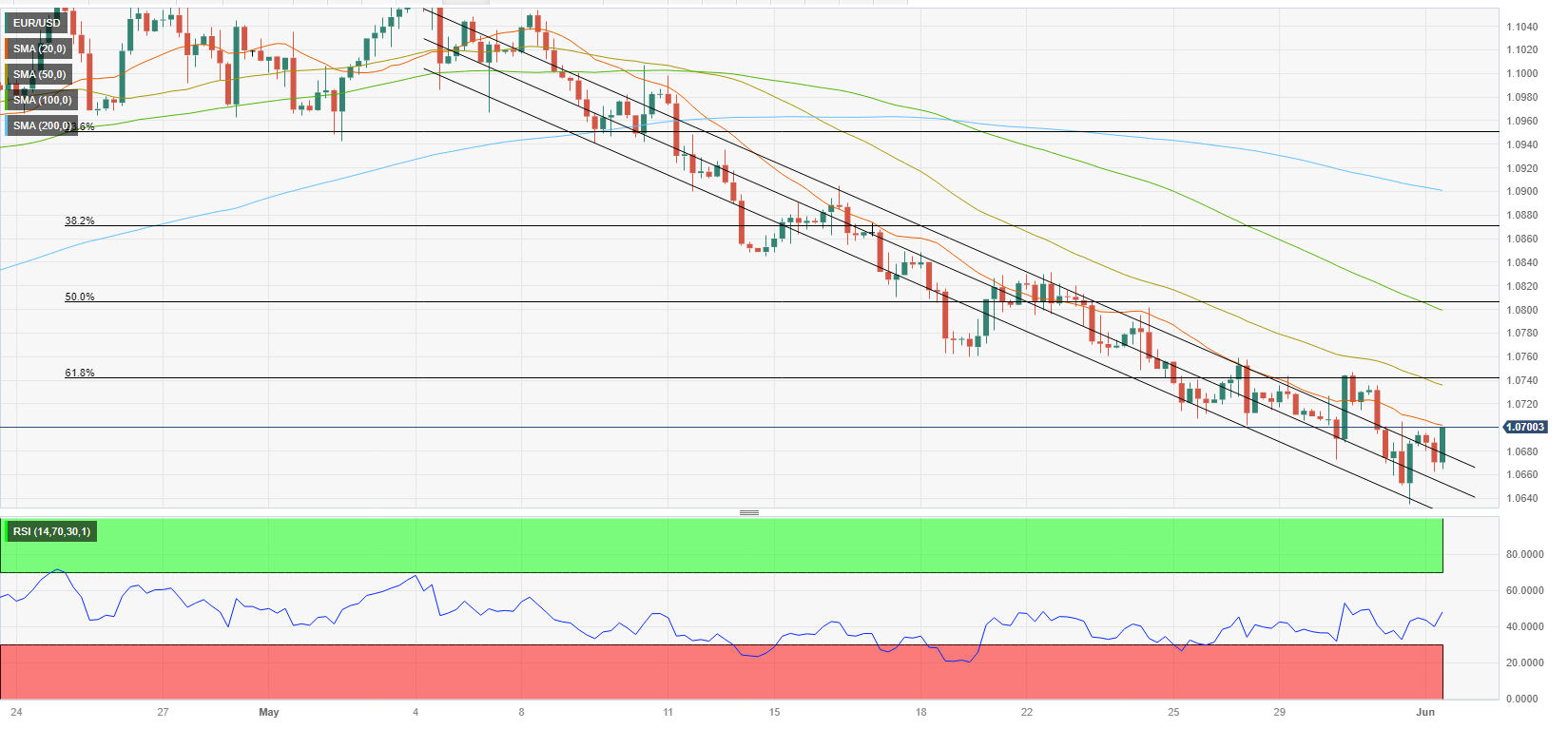
EUR/USD stays outside the descending regression but is yet to make a four-hour close above the 20-period Simple Moving Average (SMA), currently located at 1.0700. In case this level is confirmed as support, the pair could target 1.0740/50 (50-period SMA, Fibonacci 61.8% retracement level of the latest uptrend) and 1.0800 (100-period SMA, Fibonacci 50% retracement).
If EUR/USD drops below 1.0680 and returns within the descending channel, 1.0650 (mid-point of the descending channel) and 1.0630 (lower-limit of the descending channel) could be seen as next support levels.
Author

Eren Sengezer
FXStreet
As an economist at heart, Eren Sengezer specializes in the assessment of the short-term and long-term impacts of macroeconomic data, central bank policies and political developments on financial assets.
















