EUR/USD Forecast: Post-ECB bearish pressure eases a bit as focus shifts to NFP

The shared currency tumbled across the board on Thursday after the European Central Bank (ECB) turned more dovish and said to keep interest rates at present levels at least through the end of 2019 - an extension from summer of 2019 at the January meeting. The central bank also announced a new round of targeted longer-term refinancing operations – TLTROs and lowered its economic growth forecast/inflation projections. GDP growth was revised down substantially for 2019, now seen at 1.1% as compared to December projection of 1.7%., and slightly in 2020 at 1.6% vs. 1.7% forecasted previously. Meanwhile, the HICP inflation was projected to be at 1.2% in 2019, 1.5% in 2020 and 1.6% in 2021 as compared to December’s forecast of 1.6% in 2019, 1.7% in 2020 and 1.8% in 2021.
In the post-meeting press conference, the ECB President Mario Draghi said that the weakening in data points to a sizeable moderation in the pace of the economic expansion that will extend into the current year though saw a very low probability of a recession. Weaker than previously anticipated downbeat growth outlook prompted some intense selling pressure around the EUR/USD pair, which fell nearly 150-pips intraday and broke below the 1.1200 handle for the first time since June 2017. The post-ECB bearish pressure now seems to have abated, at least for the time being, with the pair finding some support during the Asian session on Friday.
Today's focus will be on the keenly watched US monthly jobs report for the month of February, popularly known as NFP, which could have a lasting effect on the near-term US Dollar price dynamics and hence, should provide a fresh impetus to the major. The US economy is expected to have added 180K new jobs in February and the unemployment rate is anticipated to have ticked lower to 3.9% from 4.0% previous. Meanwhile, Average hourly earnings, which have gained traction in the recent past, are expected to have risen by 0.3% m/m and by 3.3% y/y. Any positive surprise would be enough to give a strong lift to the greenback and exert some additional downward pressure on the already weaker common currency.
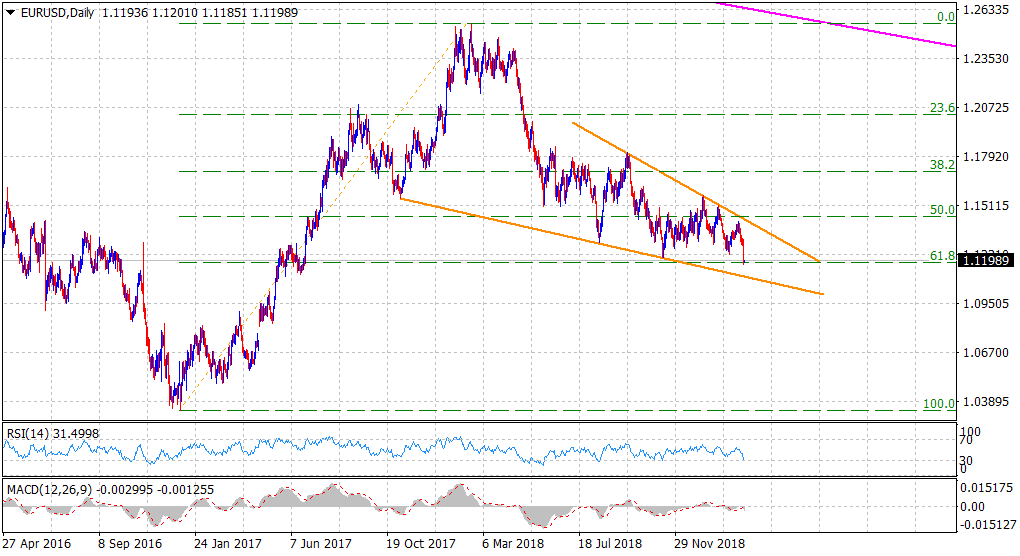
From a technical perspective, the pair seems to have found some support at 61.8% Fibonacci retracement level of the 1.0341-1.2556 up-move, though hasn't been able to register any meaningful recovery. Hence, any subsequent slide might turn the pair vulnerable to slide further towards challenging the 1.1100 round figure mark. The mentioned handle marks a descending trend-line support, extending from lows set in Nov. 2017 through August 2018 and Nov. 2018 swing lows, and should be a tough nut to crack for bearish traders.
On the flip side, any meaningful recovery attempt might now confront some fresh supply near the 1.1230-40 region, above which a bout of short-covering could assist the pair to aim back towards reclaiming the 1.1300 handle. However, given the reemergence of the bearish pressure, the recovery move seems more likely to meet with some fresh supply at higher levels and thus, should remain capped.
Author

Haresh Menghani
FXStreet
Haresh Menghani is a detail-oriented professional with 10+ years of extensive experience in analysing the global financial markets.

















