EUR/USD Forecast: Overnight slump leads to a bearish bias ahead of EU's response to Italy

The EUR/USD pair stalled its recent recovery move from YTD lows and witnessed a sharp retracement on Tuesday, reversing over 100-pips from 1-1/2 week high level of 1.1472. Escalating clash between Rome and Brussels, especially after Italy's Deputy Prime Minister Luigi di Maio said that the main measures in the outline should be left intact, was seen as one of the key factors weighing heavily on the shared currency. Market concerns were evident from widening Italy-German bond yield spread, which rose to 327 basis points - the highest level since April 4, 2013.
Adding to this, growing worries about slowing global growth, led by the US-China trade tensions triggered a fresh wave of a sell-off across global equity markets. Risk-averse traders boosted the US Dollar's perceived safe-haven status against its European counterpart and further collaborated towards aggravating the selling pressure during the US trading session. The pair ended the day just a few pips above session low and now seems to have entered a bearish consolidation phase.
Investors seemed reluctant to place any aggressive bets ahead of the EU's official response to Italy's revised 2019 budget, due today. The European Union is expected to initiate disciplinary procedures and issue sanctions against Italy in response to the country's refusal to respect EU financial rules. This might continue to dent sentiment surrounding the common currency and keep exerting downward pressure on the major amid absent relevant market moving economic releases from the Euro-zone.
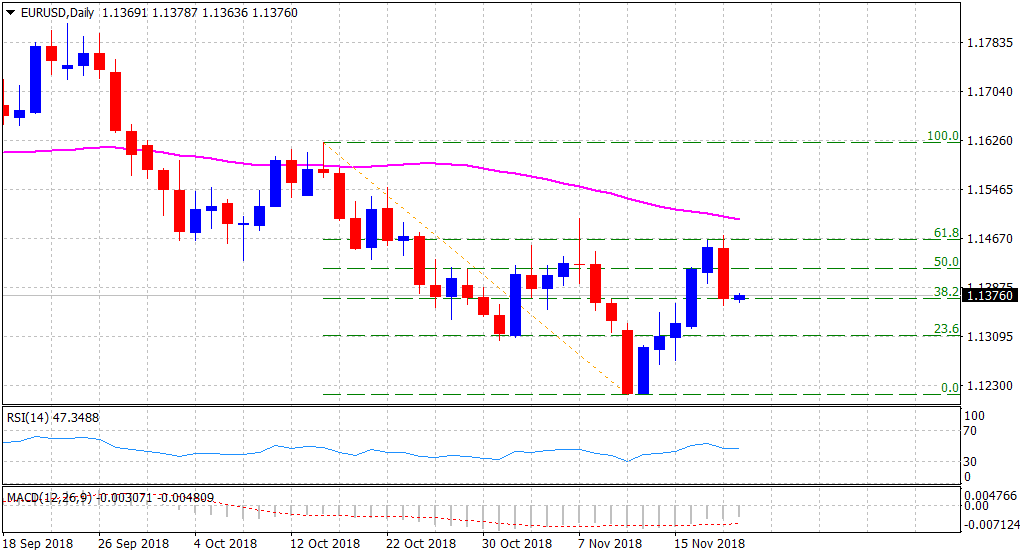
From a technical perspective, overnight rejection from the 61.8% Fibonacci retracement level of Nov.-Dec. decline and a subsequent break below the 1.1400 handle suggest that the near-term corrective bounce might have already ended. A follow-through selling below mid-1.1300s will reaffirm the expectations and accelerate the slide back towards the 1.1300 round figure mark, marking 23.6% Fibonacci retracement level. The downfall could further get extended back towards challenging YTD lows, around the 1.1215 region.
On the flip side, any attempted recovery back above the 1.1400 mark now seems to confront some fresh supply near 50% Fibonacci retracement level, around the 1.1420 region, which is followed by resistance near the 1.1450 region. A convincing move beyond the mentioned hurdles might now negate any near-term bearish bias and assist the pair to make a fresh attempt towards reclaiming the key 1.1500 psychological mark, coinciding with 50-day SMA.
Author

Haresh Menghani
FXStreet
Haresh Menghani is a detail-oriented professional with 10+ years of extensive experience in analysing the global financial markets.

















