MacroStructure weekly wrap: DXY, yields, Gold and Crude at key gates

Markets are compressing at key structure levels. This weekly wrap maps decision zones across US index futures, DXY, 10Y/30Y yields, Gold and crude, with week-ahead event scenarios.
Opening dashboard read
This week’s dashboard is a reminder that multiple markets are now at line-in-the-sand levels simultaneously. Index futures are tightening at key pivots, bonds continue to take heat into lower-structure decision zones, the US Dollar is pinned under resistance, and Gold has already pushed into its upper-gate test. In this environment, the next move is less about opinion and more about acceptance vs rejection at the gates — once these levels break, the follow-through can strike immediately.
Asset-by-asset status board
- MNQ: Lower gate holding; CP rejection continues (two-way/defensive while below CP)
- ES: Compressing between CP and upper gate; tightening structure (decision phase)
- YM: Defending the lower gate; tightening structure leaning on support
- DXY: Pressure building under upper gate; still unconfirmed until acceptance
- US 10Y: Broke below long-term trend line; now at lower-gate “line of defence”
- US 30Y: Rotation deeper into lower structure; ~4.580 is the near-term decision
- Gold: Recovery advanced into the upper gate; “resistance must turn into support”
- Crude Oil: Recovery constructive since Jan trend-line break; now at first gate (66.40–69.33), with geopolitics adding risk premium sensitivity
Individual asset structure review
Nasdaq Futures (MNQ) — Weekly structure wrap (Feb 27, 2026 - Mar 2026 contract)

Weekly price behaviour
Nasdaq March futures (MNQ) started the week below the daily central pivot (25405), trading from the lower gate zone at 25051–24774 and continuing the same defensive posture from the prior week. The lower gate held early, preventing further deterioration in structure.
By mid-week, MNQ made another push back toward the central pivot (25405), but once again failed to reclaim it — a recurring theme since early February that has capped progress into the upper structure. By the end of the week, MNQ closed back near the upper end of the lower gate, around 25051.
The weekly close leaves MNQ in a familiar position: supported at the lower gate, but rejected again at the central pivot.
Structure read
MNQ remains in a longer-term two-way structure, with this week delivering another failed attempt at the central pivot. The lower gate did its job and prevented a deeper breakdown, but the inability to reclaim the CP keeps the structure in a responsive/rotational phase rather than a confirmed upside expansion.
This week confirmed the current framework clearly: the lower gate remains the active support, while 25405 continues to cap upside rotations.
State: Two-way/rotational — defensive while below the CP.
Priority next week: 25405 is the main decision level; 25051–24774 remains the key support zone.
In MacroStructure terms, the sequence remains intact:
lower gate defence → rotation attempt to CP → decision at CP.
Key levels/decision zones
- Control level: 25405 (daily CP)
- Support decision zone: 25051–24774 (lower gate)
- Lower structure if gate fails: 24579 / 24384 / 24142
- Upside decision zone if CP is reclaimed: 25794–26036 (upper gate)
What to watch next week
- Holding above 25051–24774: keeps the path open for another retest of 25405
- Reclaim and hold above 25405: improves structure and shifts focus toward 25794–26036
- Failure below 24774: increases downside pressure toward 24579 / 24384 / 24142
The weekly wrap focuses on the higher-timeframe structure. Internal micro references and intraday execution levels will be updated in the daily desk reports.
S&P 500 Futures (ES) — Weekly structure wrap (Feb 27, 2026 - Mar 2026 contract)
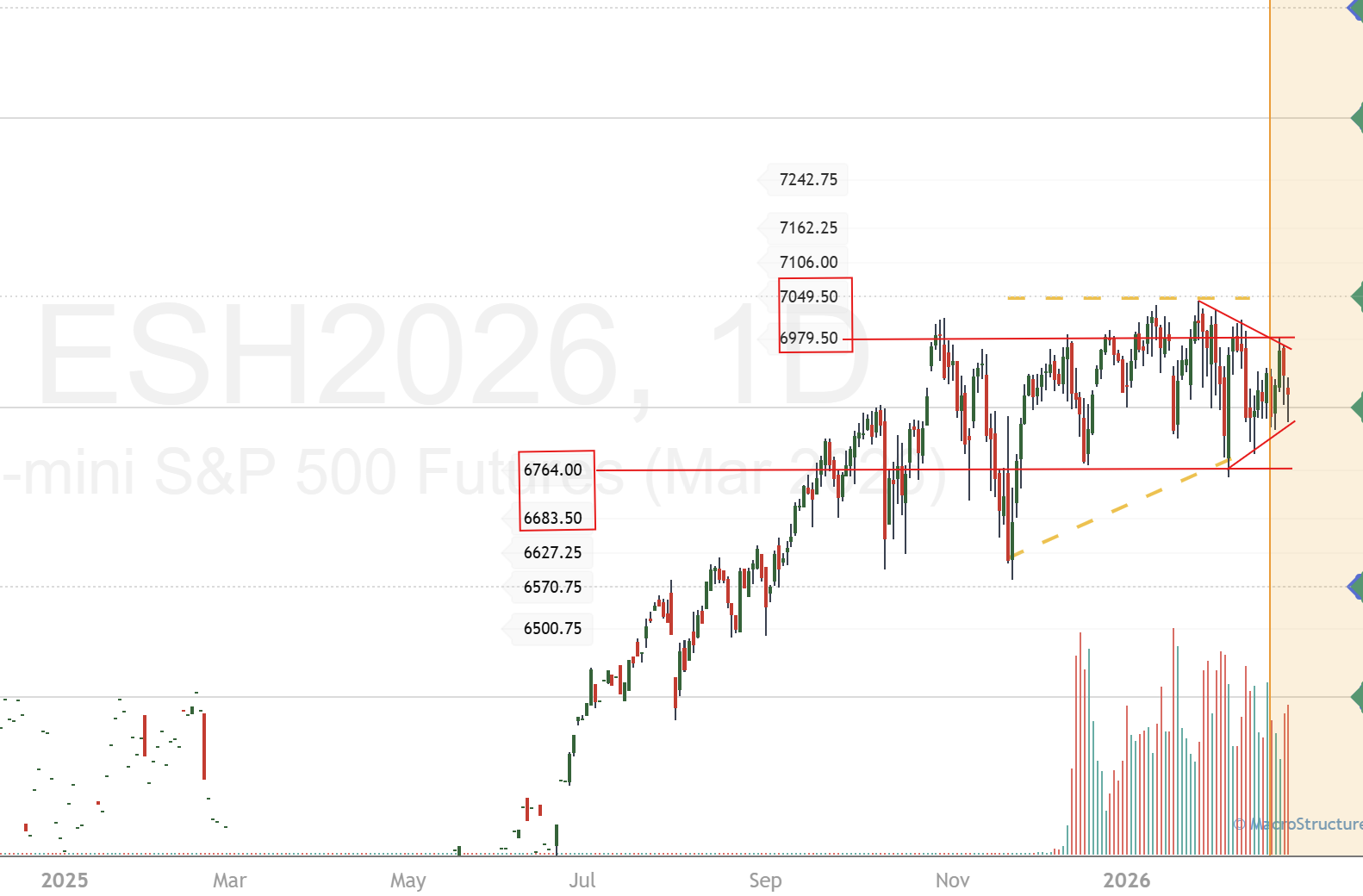
Weekly price behaviour
S&P 500 Futures (ES) spent the early part of the week working to regain and hold the daily central pivot (6866.50), continuing the same theme from the prior week. By mid-week, ES pushed higher into the upper gate at 6979, but that breakout attempt ran out of steam and price rotated back to defend the central pivot once again — a familiar pattern now for the past two weeks.
The weekly close back above the CP matters. It keeps this key area defended and reduces the risk of a deeper rotation toward the lower gate, a move we saw develop earlier in February.
Structure read
Repeated failures at the upper gate continue to reinforce its importance as the main ceiling preventing a rotation into the upper range. At the same time, the chart is beginning to show a tightening structure — lower highs and higher lows — suggesting the market may be approaching a clearer break in either direction.
ES is now compressing between the CP and the upper gate, and the next break will likely become clearer once price shows acceptance above or below the CP.
Above 6866.50 = keep pressing 6979–7049. Below 6866.50 = rotation risk toward 6764–6683.
State: Two-way / compression phase — tightening structure around the CP.
Priority next week: 6866.50 remains the control level; 6979–7049 is the cap until proven otherwise.
Key levels/decision zones
- Control level: 6866.50 (daily CP)
- Upside decision zone: 6979–7049 (upper gate)
- Support decision zone: 6764–6683 (lower gate)
What to watch next week
- Holding above 6866.50: supports continued repair toward the 6979–7049 upper gate
- Reaction at 6979–7049: key test of continuation vs another cap
- Failure back below the CP: shifts focus back toward the lower structure and 6764–6683
The weekly wrap focuses on the higher-timeframe structure. Internal micro references and intraday execution levels will be updated in the daily desk reports.
Dow Futures (YM) — Weekly structure wrap (Feb 27, 2026 - Mar 2026 contract)
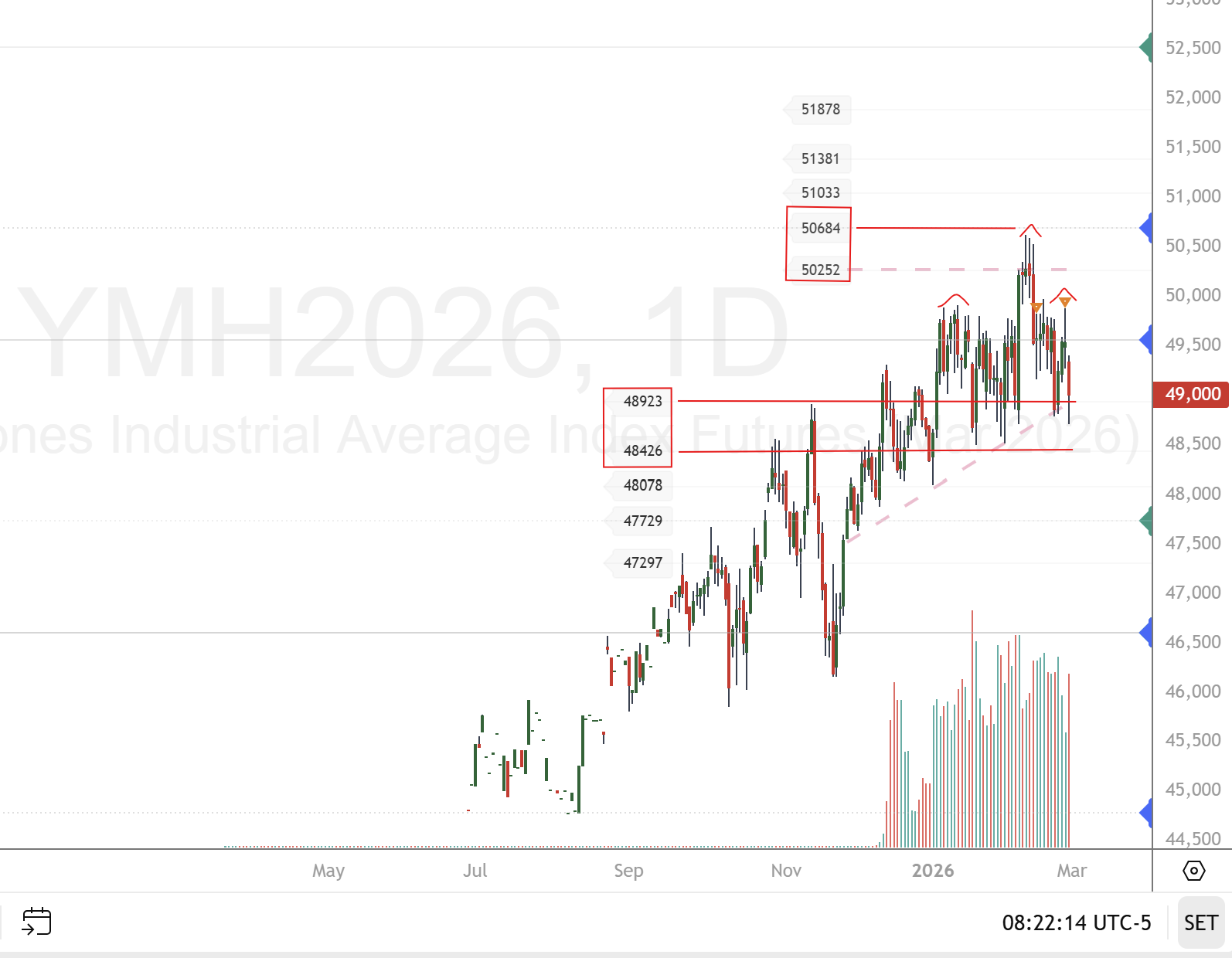
Weekly price behaviour
Dow Futures (YM) delivered another classic MacroStructure sequence this week: central pivot → lower gate → attempt back to CP → back to the lower gate.
The week started with a failure to hold the daily central pivot (49555), which triggered a rotation down into the lower gate zone (48923–48426). Mid-week, the Dow attempted to reclaim the CP but failed again, and by the end of the week price was back down at the lower gate.
Structure read
The Dow’s weekly action confirms a clear rotation away from the CP, with repeated failed attempts to break and hold above 49555 leading to continuous pullbacks into the lower gate.
Since the rejection at the upper gate on Feb 12, the Dow has been printing lower highs and higher lows, showing a tightening structure. Importantly, that tightening is happening while price is leaning on the lower gate, which suggests pressure is building around this support zone.
State: Two-way / compression phase — tightening structure leaning on the lower gate.
Priority next week: 48923–48426 is the decision zone; 49555 remains the upside reclaim level.
Key levels/decision zones
- Control level: 49555 (daily CP)
- Upside decision zone: 50252–50684 (upper gate)
- Support decision zone: 48923–48426 (lower gate zone)
What to watch next week
- Holding above 48923–48426: keeps the path open for another rotation attempt back to 49555
- Failure at 48923: increases risk of a test down into 48426
- Failure below 48426: raises the risk of rotation into the lower range
The weekly wrap focuses on the higher-timeframe structure. Internal micro references and intraday execution levels will be updated in the daily desk reports.
US Dollar Index (DXY) — Weekly structure wrap (Feb 27, 2026)
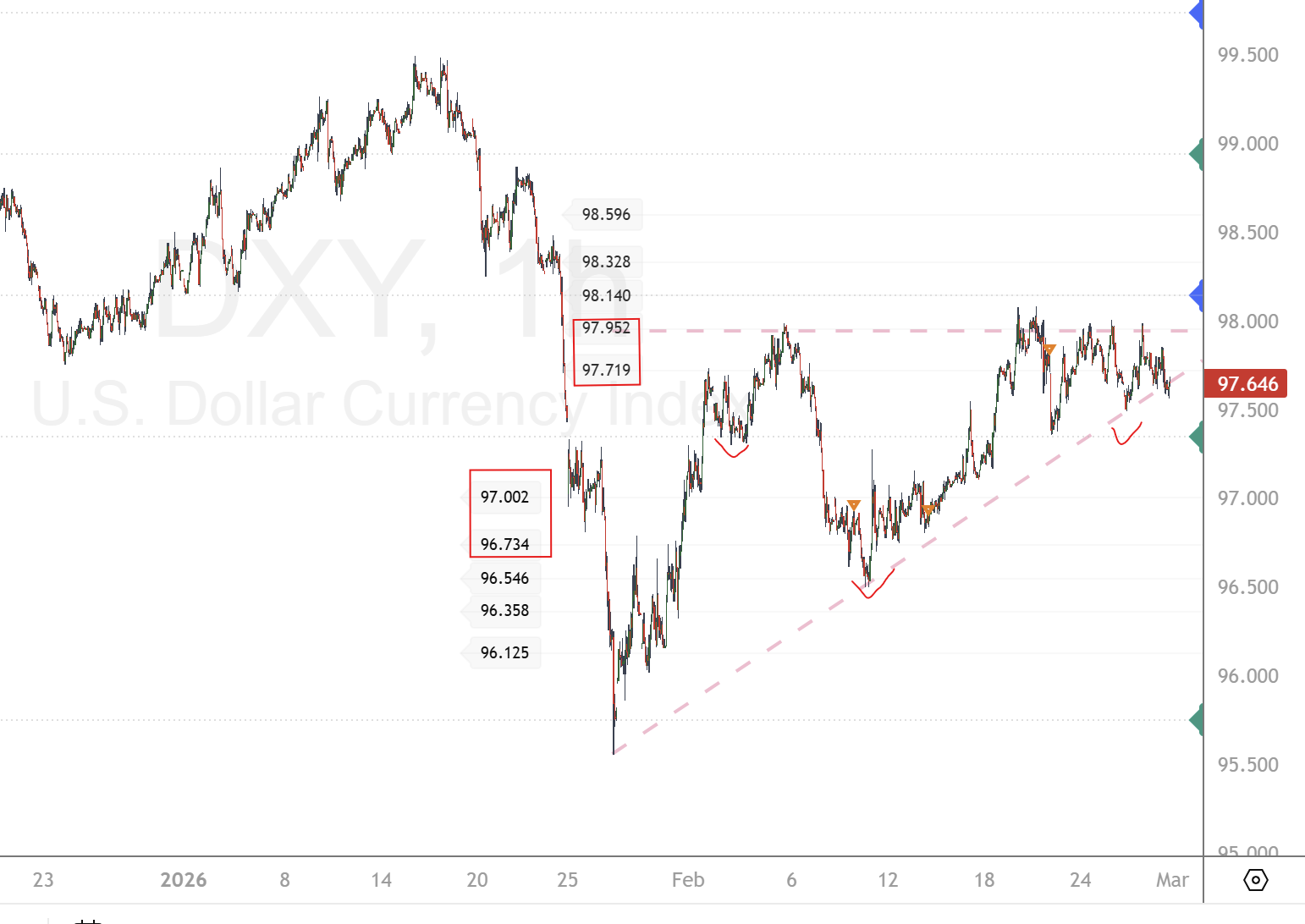
Weekly price behaviour
DXY started the week rotating down from the upper gate (97.71–97.95) toward the intraday central pivot (97.34), before recovering back into the upper-gate zone. Mid-week, the dollar spent time pressing and probing the upper gate, attempting to break through the same ceiling that has capped upside progress since early February.
By the end of the week, DXY closed back below the upper gate, reinforcing the idea that this zone remains the primary barrier to any extension into the upper range.
Structure read
After four straight weeks of probing the upper gate, DXY is now compressing under 97.71–97.95, which suggests pressure is building at that resistance. The only confirmation, however, is acceptance above the gate — until then, the base case remains rotation back through the CP.
State: Two-way/rotational — pressure building at the upper gate, anchored by the CP.
Priority next week: 97.34 is the control level; 97.71–97.95 remains the main breakout barrier.
Key levels/decision zones
- Control level: 97.34 (intraday CP)
- Upside decision zone: 97.71–97.95 (upper gate)
- Next upside levels if accepted: 98.14 / 98.32 / 98.59
- Support decision zone: 97.00–96.73 (lower gate)
What to watch next week
- Hold above 97.34 (CP): keeps the rotation path to the upper gate active
- Acceptance above 97.71–97.95: increases the chance of extension toward 98.14 / 98.32 / 98.59
- Failure below 97.34: brings the 97.00–96.73 lower gate back into focus
US 10-year treasury yield — Weekly structure wrap (Feb 27, 2026)

Weekly price behaviour
The US 10-Year Treasury yield broke down below the longer-term resistance trend line that has guided the market since September 2024. Early in the week, yields held the upper edge of the lower gate near 4.018%, but weakened into the back half and shifted focus to the lower edge of the lower gate at 3.907%.
Structure read
The MacroStructure picture is tightening at the lower gate. Defending 3.907% is now the key near-term task. Holding keeps the “stabilise and rotate” framework alive; losing it and staying below increases the odds of a deeper move into the lower range of the broader two-way structure.
Cross-asset dashboard note (DXY, Gold, Indices)
This breakdown also highlights the divergence across the dashboard: DXY is capped at resistance, Gold is advancing, and the index complex is leaning defensive — with Dow defending the lower gate and MNQ still struggling below its CP. The next step is to see whether yields stabilise and recover, or whether continued weakness keeps supporting Gold while indices remain under pressure.
State: Decision phase — pressure building at the lower gate after a trend-line breakdown.
Priority next week: 3.907% is the line of defence; 4.160% remains the recovery/control zone.
Key levels/decision zones
- Near-term support decision level: 3.907%
- Upper edge of the lower gate: 4.018%
- Control zone: 4.160% (CP)
What to watch next week
- 3.907% = last line of defence: holding it keeps rotation potential alive
- Hold above 3.907% and recover 4.018%: supports a rotation attempt back toward 4.160%
- Lose 3.907% and staying below opens the door to the lower range of the broader two-way structure
US 30-year treasury yield — Weekly structure wrap (Feb 27, 2026)
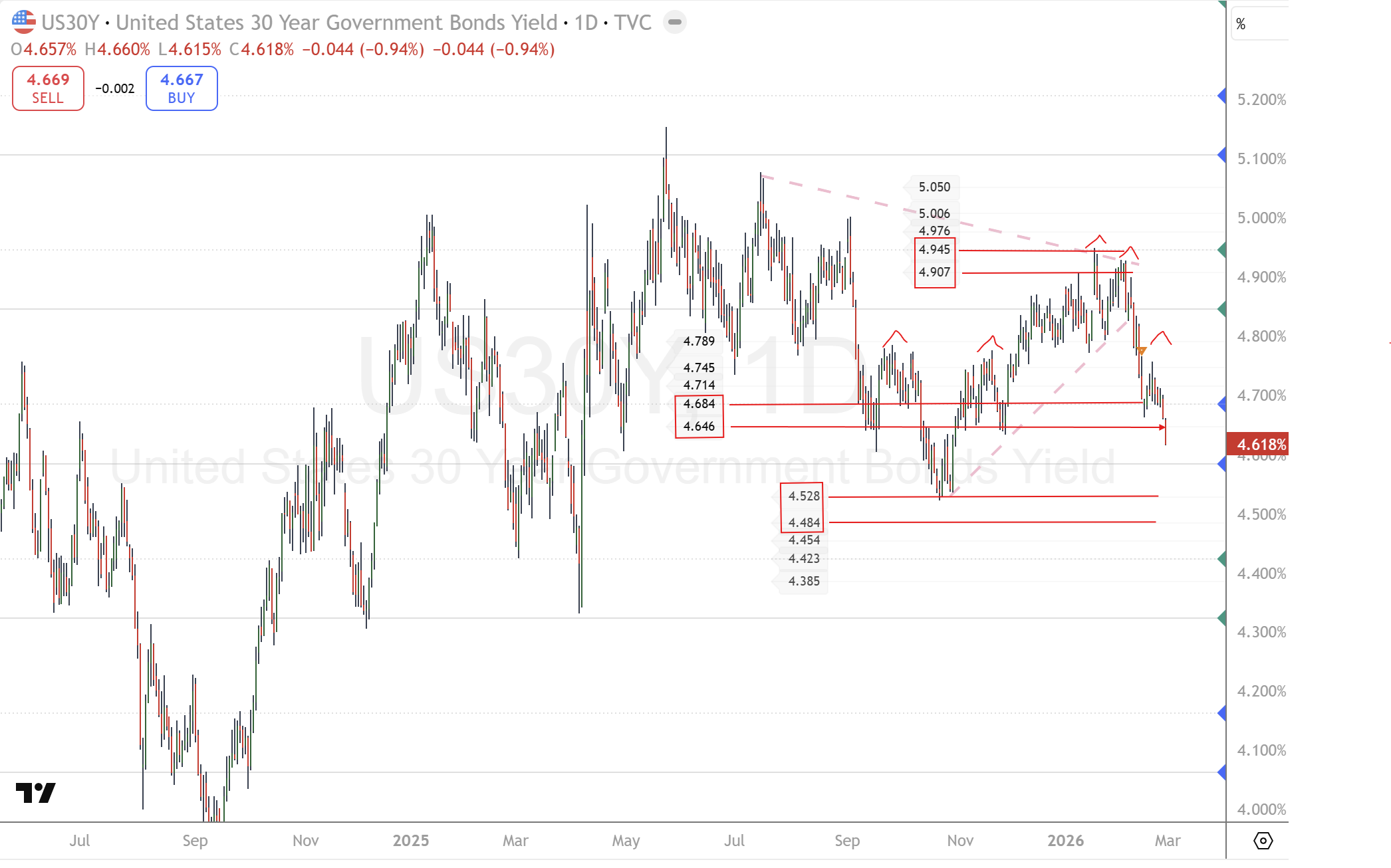
Weekly price behaviour
The US 30-Year Treasury yield extended its downside trend this week after the collapse from the central pivot (4.845%) earlier in February. The week opened still defending 4.684%, but pressure built and gave way into Thursday. By Friday, yields closed below 4.646%, confirming that the prior support band has weakened.
Structure read
With price now below 4.646%–4.684%, that former support band becomes the first resistance zone on any bounce. The next decision is the lower range area around ~4.580%. Hold that, and repair remains possible; lose it, and the map opens to the next gate at 4.528%–4.484% (a zone last active around October 2025).
The rates complex is aligned: 10Y is testing its lower-gate defence while 30Y is now leaning into the lower range, which matters for the wider dashboard (DXY/Gold/risk assets).
State: Transition phase — rotation into lower structure progressing, support now being tested.
Priority next week: ~4.580% is the decision level; recovery requires reclaiming 4.646%–4.684%.
Key levels/decision zones
- Lower range / current decision area: ~4.580%
- Recovery path (repair band): 4.646%–4.684%
- Next gate if lower range fails: 4.528%–4.484%
- Below that: 4.454%–4.385%
What to watch next week
- Hold ~4.580%: keeps the lower structure from slipping into the next gate
- Reclaim 4.646%–4.684%: improves structure and re-opens the recovery path
- Lose ~4.580% and stay below: increases odds of a test toward 4.528%–4.484%
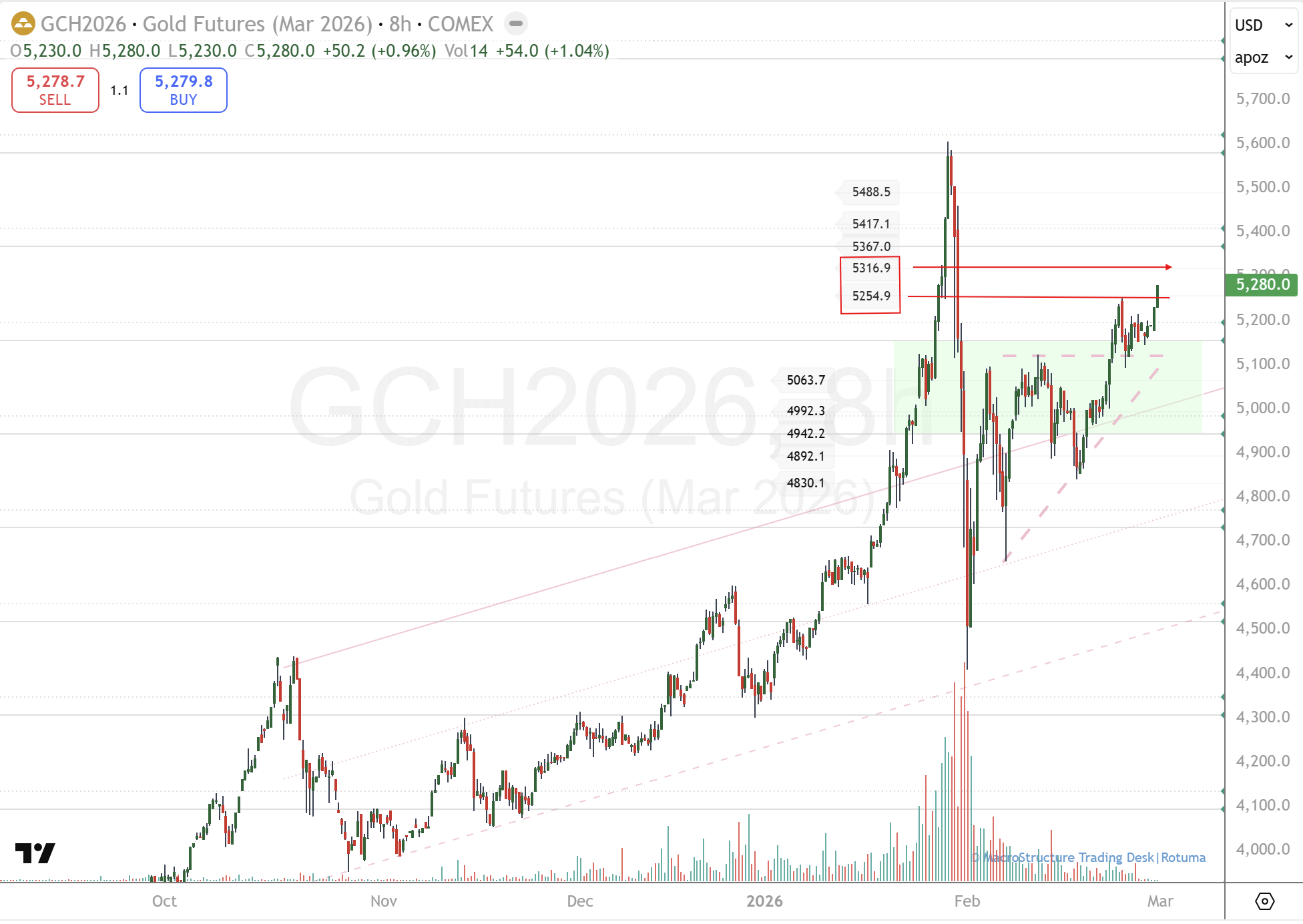
Gold Futures (COMEX) — Weekly structure wrap (Feb 27, 2026 - Mar 2026 contract)
Weekly price behaviour
COMEX Gold started the week defending the 5154–5195 internal micro gate and extended the recovery into the upper-gate band at 5254–5316, finishing the week holding in that zone.
Structure read
Gold is now at the point where resistance must turn into support:
Above 5316 = continuation window toward 5367–5488. Back below 5254 = rotation risk toward 5195–5154.
This remains a key divergence on the dashboard: Gold is pressing higher while yields are leaning lower, and index futures remain defensive.
State: Recovery/expansion attempt — now in the upper-gate decision zone.
Priority next week: hold 5254–5316 to keep the upper-range rotation in play.
Key levels/decision zones
- Support decision band: 5195–5154
- Decision zone: 5254–5316
- Upper range if accepted: 5367–5488
What to watch next week
- Hold above 5254–5316: keeps the recovery progressing toward 5367–5488
- Failure to hold the upper gate: favours rotation back toward 5195–5154
- Acceptance vs rejection: the tell is whether Gold builds acceptance above the gate, not just tags it
NYMEX Crude Oil (CL) — Weekly structure wrap (Feb 27, 2026)

Weekly price behaviour
Crude is ending another month in positive territory, extending the recovery that followed the August–December 2025 decline. The five-month resistance trend line was cleared in January 2026, and the strong support response around ~55.00 keeps the recovery framework constructive as price tests the first gate at 66.40–69.33.
Structure read
The key question now is whether crude can reclaim and hold the 66.40–69.33 gate. If reclaimed, that gate needs to act as support — that’s the confirmation. A successful break and hold above the central pivot near ~73.00 shifts focus to the next gate at 77.16–79.70.
Cross-asset note: crude is testing its first gate while yields are leaning on lower-structure decision zones, and Gold is holding firm — a mix worth tracking into next week for inflation/risk sensitivity.
State: Recovery / early-stage repair — now at the first major gate.
Priority next week: reclaim 66.40–69.33, then target ~73.00.
Key levels/decision zones
- Lower range/base: ~55.00
- First gate (current decision zone): 66.40–69.33
- Consolidation band if rejected: 64.35–62.30
- Central pivot: ~73.00
- Next gate if CP is accepted: 77.16–79.70
- Upper structure reference: ~90.00
What to watch next week
- Reclaim and hold 66.40–69.33: keeps the recovery progressing toward ~73.00
- Break and hold above ~73.00: shifts focus to 77.16–79.70
- Failure to reclaim 66.40–69.33: favours consolidation/rotation toward 64.35–62.30
Macro events review
This week’s tape still carried the after-effects of last week’s bigger releases (policy tone + growth), with only a handful of fresh catalysts adding incremental pressure.
Prior-week data still influencing this week
- FOMC minutes / Fed tone kept markets sensitive to inflation and growth surprises.
- GDP growth reinforced the slower-growth narrative and kept risk assets reactive.
- Core PCE + personal income/outlays continued to anchor rate expectations and the USD/Gold relationship.
- Housing activity (building permits/housing starts) stayed in the background and supported the “growth cooling” theme.
This week’s lighter data (but still impactful)
- Jobless claims kept labour conditions in focus without flipping the bigger narrative.
- PPI kept inflation sensitivity elevated, aligning with the ongoing pressure in bonds.
Geopolitical risk update (Middle East)
This week and the coming weeks, also add a clear geopolitical risk layer. Reuters reported an EU naval mission official saying Iran’s Revolutionary Guards issued VHF transmissions warning that “no ship is allowed to pass the Strait of Hormuz”, a critical corridor for global energy flows. Reuters also reported Iran temporarily shut parts of the Strait for a few hours earlier in February, highlighting that the risk is not just theoretical.
In MacroStructure terms, headlines can create short-term displacement, but confirmation still comes from acceptance/rejection at the gates:
- Crude: 66.40–69.33 becomes even more important in a risk-premium environment
- Gold: 5254–5316 remains the “hold vs fail” zone
- Rates/FX: expect whipsaw potential — focus on whether DXY accepts above its upper gate and whether yields stabilise or continue to break down
(For context on escalation framing, AP reported Russia condemned joint U.S.-Israeli strikes on Iran as an act of armed aggression.)
Week ahead economic calendar (week of March 2, 2026)
Next week has a clear rhythm and a major risk cluster on Friday.
- ISM Manufacturing PMI — Monday, March 2 (first business day of the month).
- ISM Services PMI — Wednesday, March 4 (third business day of the month).
- Friday risk cluster — March 6: Non-Farm Payrolls + Unemployment Rate + Retail Sales.
Week-ahead event impact map (MacroStructure scenarios)
These are scenario guides, not predictions — confirmation comes from acceptance or rejection at the key levels.
1) ISM Manufacturing PMI (Mon, Mar 2)
If PMI is stronger than expected (growth surprise):
- First check: yields and DXY
- DXY: watch for acceptance above 97.71–97.95
- Gold: higher risk of stalling at 5254–5316 or rotating toward 5195–5154
- Indices: look for repair attempts (ES holding 6866.50, MNQ rotating back toward 25405)
If PMI is weaker than expected (growth cooling):
- First check: yields (downside pressure) and whether DXY stays capped
- Gold: better odds of holding the gate and continuing toward 5367–5488
- Indices: higher odds of defensive rotation (Dow must defend 48923–48426, MNQ lower gate must hold)
2) ISM Services PMI (Wed, Mar 4)
If services are strong and prices are hot:
- DXY: increased chance of a breakout attempt above 97.95
- 10Y: watch whether it stabilises at 3.907% and recovers toward 4.018 → 4.160
- Gold: higher odds of stalling unless it builds acceptance above the gate
If services soften:
- Yields: downside pressure risk remains
- Gold: improved odds of holding the gate and pushing higher
- Indices: defensive structure is more likely to persist unless CP reclaims occur
3) Friday risk cluster (Mar 6): NFP, unemployment rate and retail sales
This is the type of day that can turn an intraday move into a weekly structure shift.
If jobs + retail are strong (growth firm):
- DXY: higher odds of acceptance above 97.71–97.95
- Gold: higher odds of rotation toward 5195–5154 unless it holds above 5316
- Indices: potential relief attempt, but structure still decides (ES needs acceptance above 6979–7049 to shift tone)
If jobs weaken and/or retail disappoints (growth risk-off):
- 10Y: losing 3.907% becomes critical
- Gold: tends to remain supported; acceptance above 5254–5316 becomes more likely
- Indices: increased risk of losing key supports (Dow lower gate and MNQ lower gate become “must hold” levels)
Mixed outcome:
- Expect whipsaw; treat the first move as displacement
- Let acceptance/rejection at the gates decide what’s real
Key decision zones for next week
- MNQ: CP 25405 vs lower gate 25051–24774
- ES: CP 6866.50 vs upper gate 6979–7049
- YM: lower gate 48923–48426 vs CP 49555
- DXY: upper gate 97.71–97.95 vs CP 97.34
- US 10Y: 3.907% line of defence; recovery path 4.018 → 4.160
- US 30Y: ~4.580 decision; repair band 4.646–4.684
- Gold: hold 5254–5316 to open 5367–5488; failure rotates to 5195–5154
- Crude: reclaim 66.40–69.33, then ~73.00, then 77.16–79.70
Glossary
MacroStructure glossary (reader guide)
- Central Pivot (CP): The main “control level.” Above it = constructive/repair conditions; below it = defensive/rotation risk (context-dependent).
- Gate (Upper/Lower Gate): A predefined decision zone where price often flips between acceptance (continuation) and rejection (rotation).
- Micro Gate / Micro Levels: Smaller intraday decision bands inside the larger structure (execution detail covered in daily desk reports).
- Upper Range / Lower Range: Outer zones of the current structure where rejection or acceptance often decides whether the move extends.
- Two-Way Structure: A market condition where price rotates between defined zones rather than trending cleanly.
- Acceptance: Price holds beyond a level and builds structure there (follow-through, not just a spike).
- Rejection: Price fails to hold above a level and rotates back into the prior structure.
- Rotation: A move from one structure zone to another (e.g., lower gate → CP → upper gate).
- Repair: A recovery phase where price rebuilds structure through prior levels before a true expansion is confirmed.
This dashboard is urgent for one reason: too many assets are sitting in major decision zones simultaneously. The job for next week is straightforward — track the gates, watch acceptance vs rejection, and let the structure confirm the next leg.
Structure defines context; price reveals response.
Author

Denis Joeli Fatiaki
Independent Analyst
Denis Joeli Fatiaki possesses over a decade of extensive experience as a multi-asset trader and Market Strategist.