EUR/USD Forecast: No convincing recovery in sight for euro
- EUR/USD has slumped to its weakest level in more than a year.
- Euro could fall toward 1.1000 if 1.1100 support fails.
- Investors await EU sentiment and US inflation data.

EUR/USD has failed to shake off the bearish pressure and touched its weakest level since June 2020 below 1.1130 Friday. Although the near-term technical outlook shows that the pair remains extremely oversold, buyers are unlikely to take action with the Fed's hawkish policy outlook favouring the dollar.
The dollar rally that started late Wednesday on FOMC Chairman Jerome Powell's hawkish comments on the policy outlook stayed intact on Thursday. The US Dollar Index broke above 97.00 for the first time in 19 months and was last seen posting small gains above 97.30. On a weekly basis, the index is up nearly 2% and remains on track to post its largest one-week gain in seven months.
Meanwhile, Germany's Economy Adviser in a statement called upon the European Central Bank (ECB) on Friday to act in inflation in the euro is persistent while noting that there was no reason for a rate hike yet.
Later in the session, the European Commission will release the Consumer Confidence, Industrial Confidence, Services Sentiment, Business Climate and Economic Sentiment indexes for January. Even if these data point to an improvement in consumer and business confidence in the euro area, the shared currency is unlikely to stage a convincing recovery against the greenback.
In the second half of the day, the US Bureau of Economic Analysis' Personal Consumption Expenditures (PCE) Price Index, the Fed's preferred gauge of inflation, will be watched closely by market participants.
The Fed's policy statement showed earlier in the week that policymakers grow increasingly concerned about the inflation outlook. The Core PCE Price Index is expected to rise to 4.8% in December from 4.7% in November and a stronger-than-forecast print should allow the dollar to continue to outperform its rivals heading into the weekend. On the flip side, a soft inflation reading could cause the greenback to lose some interest but such a market reaction is likely to remain short-lived.
EUR/USD Technical Analysis
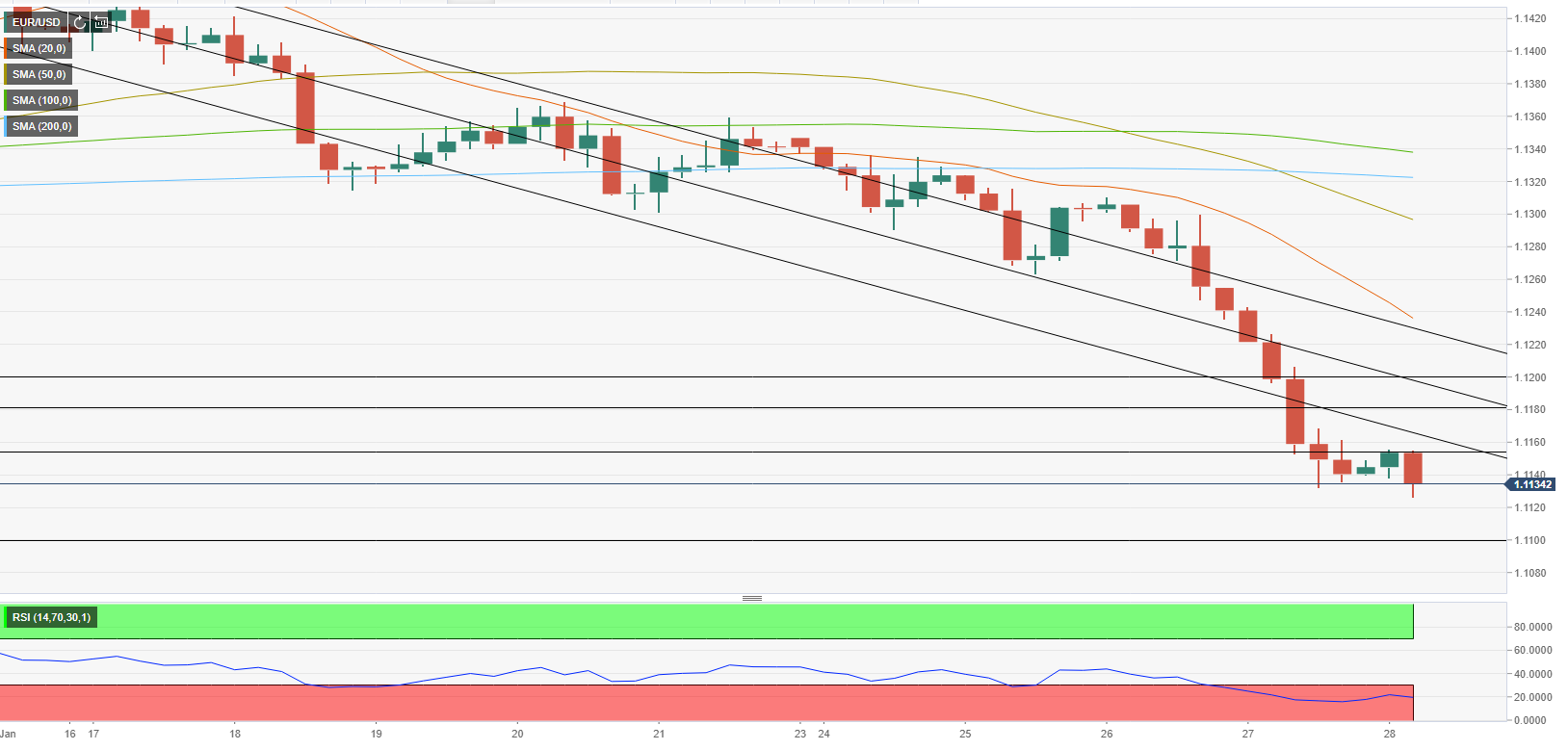
After seven consecutive four-hour candles closed in the negative territory, EUR/USD staged a technical correction but lost its bullish momentum near 1.1150, suggesting an interim resistance has formed at that level.
In the meantime, the pair continues to show extremely oversold conditions with the Relative Strength Index (RSI) staying way below 40. Furthermore, EUR/USD is trading below the descending regression channel coming from mid-January.
Even if the pair were rise above 1.1150 and return within the descending channel, sellers are likely to remain in control as long as the 1.1220 (upper limit of the descending channel) resistance holds.
On the downside, 1.1100 (psychological level) aligns as the next support. Back in January 2020, EUR/USD extended its decline to 1.1000 after it broke below 1.1100 and a similar action could be expected in the short term.
Author

Eren Sengezer
FXStreet
As an economist at heart, Eren Sengezer specializes in the assessment of the short-term and long-term impacts of macroeconomic data, central bank policies and political developments on financial assets.