EUR/USD Forecast: Next line of defense forms at 1.0570
- EUR/USD has extended its slide to fresh multi-year lows amid broad dollar strength.
- EU prepares to respond to Russia's decision to halt gas exports to Bulgaria and Poland.
- 1.0570 aligns as the next critical support for the pair.


EUR/USD has recovered modestly after having plunged to its weakest level in five years below 1.0600 early Wednesday. With safe-haven flows looking to continue to dominate the financial markets, however, the pair might find it difficult to gain traction and eye 1.0570 as the next bearish target.
Russia announced on Tuesday that they halted gas exports to Bulgaria and Poland over their refusal to pay in roubles. Commenting on Russia's decision, "the unilaterally stopping delivery of gas to customers in Europe is unjustified and unacceptable," said European Commission President Ursula von der Leyen and added that they are mapping out a coordinated response. On the other hand, Russian parliament speaker Vyacheslav Volodin urged Moscow to suspend gas supplies to "unfriendly" countries.
Meanwhile, German Economy Minister Robert Habeck noted on Tuesday that they are looking to find a way to replace the Russian oil with other suppliers so they can be on board when the European Union (EU) decides to embargo Russian oil imports.
The Euro Stoxx 600 Index started the day deep in negative territory on Wednesday before staging a modest rebound and turning positive on the day. Meanwhile, US stock index futures are up between 0.45% and 0.6%. Nevertheless, investors might remain reluctant to bet on a risk rally amid escalating geopolitical tensions and renewed fears over a global economic slowdown, not allowing EUR/USD to stage a convincing recovery.
European Central Bank (ECB) President Christine Lagarde is scheduled to deliver a speech later in the day. The US economic docket will feature March Trade Balance and Pending Home Sales data but the risk perception should continue to drive the market action.
EUR/USD Technical Analysis
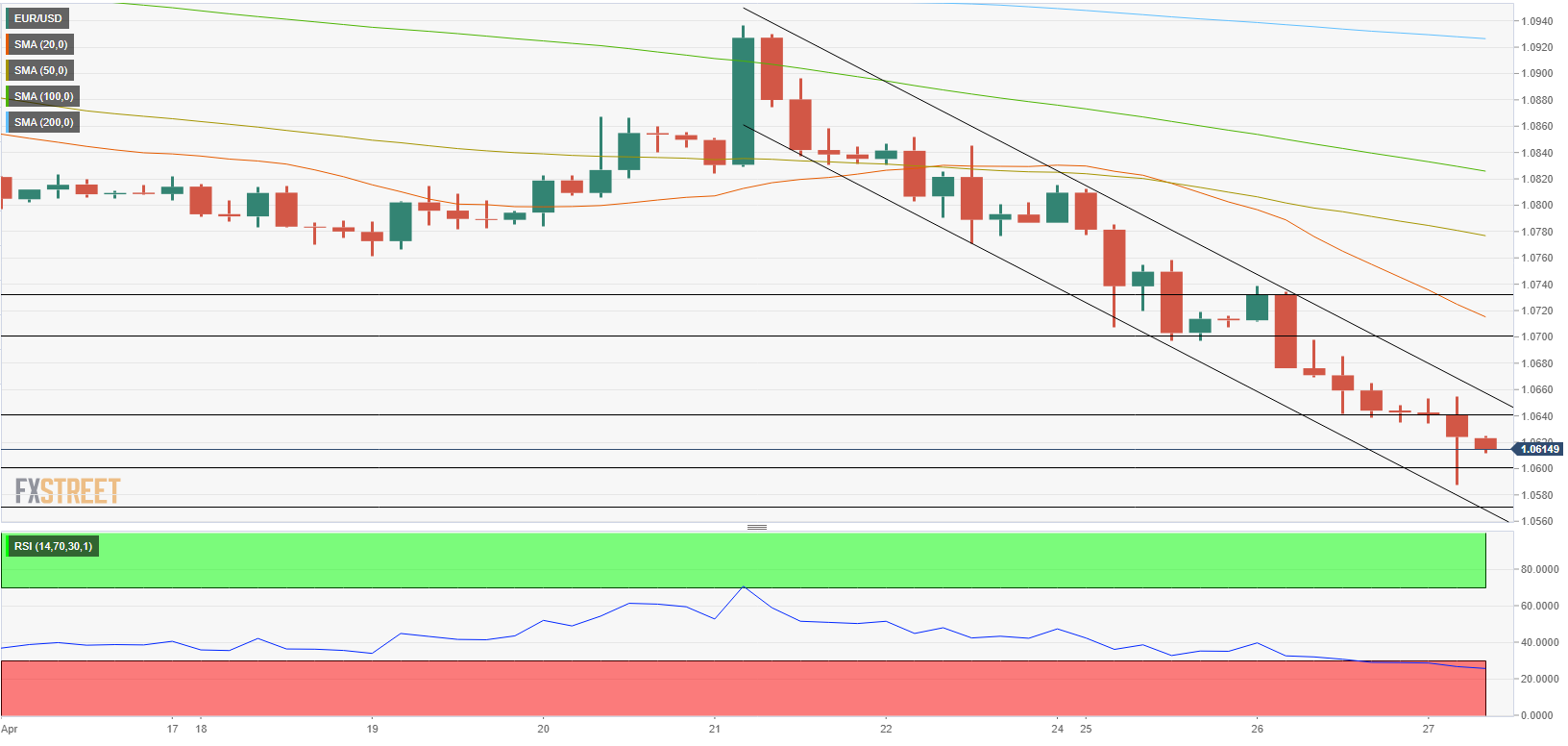
EUR/USD fell below 1.0600 but quickly recovered. In case the pair makes a four-hour close below that level, it could target 1.0570 (static level) and 1.0525 (Mar. 9, 2017, low). It's worth noting, however, that the Relative Strength Index (RSI) indicator on the four-hour chart stays below 30, suggesting that the pair might need to make a correction before the next lower.
On the upside, 1.0640 (former support, static level) aligns as the first resistance before 1.0660 (descending trend line) and 1.0700 (psychological level).
Premium
You have reached your limit of 3 free articles for this month.
Start your subscription and get access to all our original articles.
Author
Eren Sengezer
FXStreet
As an economist at heart, Eren Sengezer specializes in the assessment of the short-term and long-term impacts of macroeconomic data, central bank policies and political developments on financial assets.

















