EUR/USD Forecast: How low can the euro go? US stimulus and ECB action likely to sink it further
- EUR/USD has been extending its falls to last seen in November 2020.
- US stimulus progress in Congress, robust NFP and ECB bond data may exacerbate the pair's losses.
- Monday's four-hour chart is showing oversold conditions, implying a temporary bounce.

Rejected at resistance – but where is support? EUR/USD has been falling sharply after failing to breach the critical 1.2110 level – a critical confluence of levels – and it has been downhill ever since. The main downside driver for the pair has been the rise in US yields, which has been boosting the dollar.
US Treasuries have suffered a sell-off on expectations of more robust growth and a reluctance by the Federal Reserve to intervene by buying bonds and pushing long-term borrowing costs lower. Chair Jerome Powell only said that the move "caught my attention," but offered no help.
Since that speech on Thursday, the greenback received two additional shots in the arm. First, February's Nonfarm Payrolls beat estimates with an increase of 379,000 jobs – and on top of upward revisions to previous months. While the quicker return of people to the workforce is encouraging, there are some 9.5 million Americans that have yet to return to work since the pandemic.
Another boost to growth prospects, yields, and the dollar came from the Senate, which approved a modified version of President Joe Biden's coronavirus relief package. While the White House ceded some ground to moderate Democrats, the legislation's scope remains around $1.9 trillion, a substantial stimulus to the economy. The bill returns to the House, which is set to approve it on Tuesday.
On the vaccine front, the US has continued enlarging its gap from Europe, with America now expected to reach 50% of its population by late May. This development contrasts with Italy's desperate confiscation of AstraZeneca jabs that were sent to Australia.
Some solace to the common currency comes from the Sentix Investor Confidence gauge for March, which beat estimates with a score of 5 points. On the other hand, German industrial output missed estimates with a fall of 2.5% in January.
Later in the day, the European Central Bank releases its weekly bond-buying figures. Did the Frankfurt-based institution ramp up its purchases to keep European bonds down? Last week, the ECB's figures surprised with a slowdown. A big boost to buying now would weigh on the common currency – and perhaps hint at a change of policy in the bank's decision due on Thursday.
All in all, there are reasons to expect further falls for EUR/USD, but at least technicals point to a bounce.
EUR/USD Technical Analysis
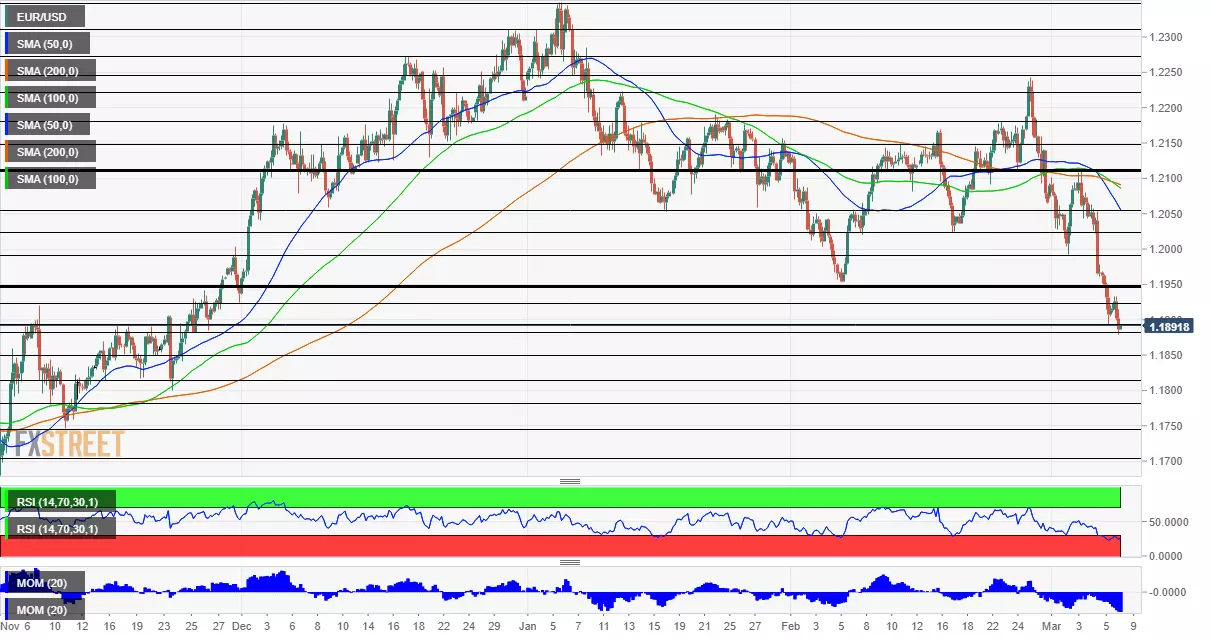
Euro/dollar has plunged to levels last seen in November 2020, and the pace of the fall sent the Relative Strength Index below – indicating oversold conditions. That indicates a minor rise is likely. However, momentum remains to the downside and the currency pair is trading well below the 50, 100 and 200 Simple Moving Averages.
Support awaits at 1.1850, which provided support in November, followed by 1.1820 and 1.1750, the latter being a cushion in October.
Some resistance is at 1.1895, Friday's low, followed by 1.1920 and 1.1950.
EUR/USD Price Forecast 2021: Euro-dollar long-term bullish breakout points to 1.2750
Author

Yohay Elam
FXStreet
Yohay is in Forex since 2008 when he founded Forex Crunch, a blog crafted in his free time that turned into a fully-fledged currency website later sold to Finixio.