EUR/USD Forecast: Flying above 1.18 with the Fed? Why dollar weakness outweighs overbought conditions
- EUR/USD has been firmly holding onto its massive gains ahead of the Federal Reserve's decision.
- A dovish message from the Fed and US politicians' struggles could send it higher.
- Wednesday's four-hour chart is showing that overbought conditions are coming closer.

Overbought, so what? That seems to be the mantra for EUR/USD in the past week – pushing the pair to the highest since September 2018 with little pause for thought. It could happen again, this time fueled by the Federal Reserve.
The Fed is set to leave its policy unchanged – but has ample room to move markets. Back in June, the world's most powerful central bank signaled it would keep interest rates low for at least two years and stabilized its bond-buying scheme at a high level – and may now have to do more, or at least make promises.
Since that June meeting, coronavirus cases have leaped, consumer confidence dropped, and jobless claims began rising once again. While the Fed ruled out setting negative rates, it may now be warming up to Yield Curve Control (YCC) – depressing long-term borrowing costs. The benchmark ten-year Treasury yield is already low, under 0.60%, but it can always extend its losses toward 0%.
Jerome Powell, Chairman of the Federal Reserve, will address the press and YCC will probably top the agenda for journalists. Any hint about additional action could further weaken the dollar, while reluctance to act could push it higher.
See:
- Fed Preview: Warming up to controlling the yield curve, nudging lawmakers, keeping markets happy
- US FOMC July Preview: The advent of yield curve control?
It is essential to note that Powell and his colleagues have urged elected officials to do more, and may prefer adding pressure and waiting for them to act. Democrats are clashing with Republicans and the GOP is battling within itself over extending emergency support. The most urgent issue is federal unemployment benefits which expire at the end of the month. Both sides acknowledge talks will take time despite the potential hit to consumption.
The Conference Board's Consumer Confidence gauge fell to 92.6 points in July, below expectations – and reflecting rising COVID-19 cases and new restrictions. The number of US infections tops 4.3 million and the death toll is near 150,000.
Reports about negotiations on Capitol Hill and updated coronavirus cases are set to shape trading ahead of the Fed.
In the old continent, the overall picture remains positive. IFO's German business confidence figures have risen beyond estimates in July, while the euro continues benefiting from the historic agreement on the EU fund.
Flareups of the diseases in parts of Spain, France, and Germany are seen as localized events for now. Keeping coronavirus under control is key to the recovery and to euro strength.
Overall, the Fed holds the keys to the next moves, but the virus also has a substantial influence on the currency pair.
EUR/USD Technical Analysis
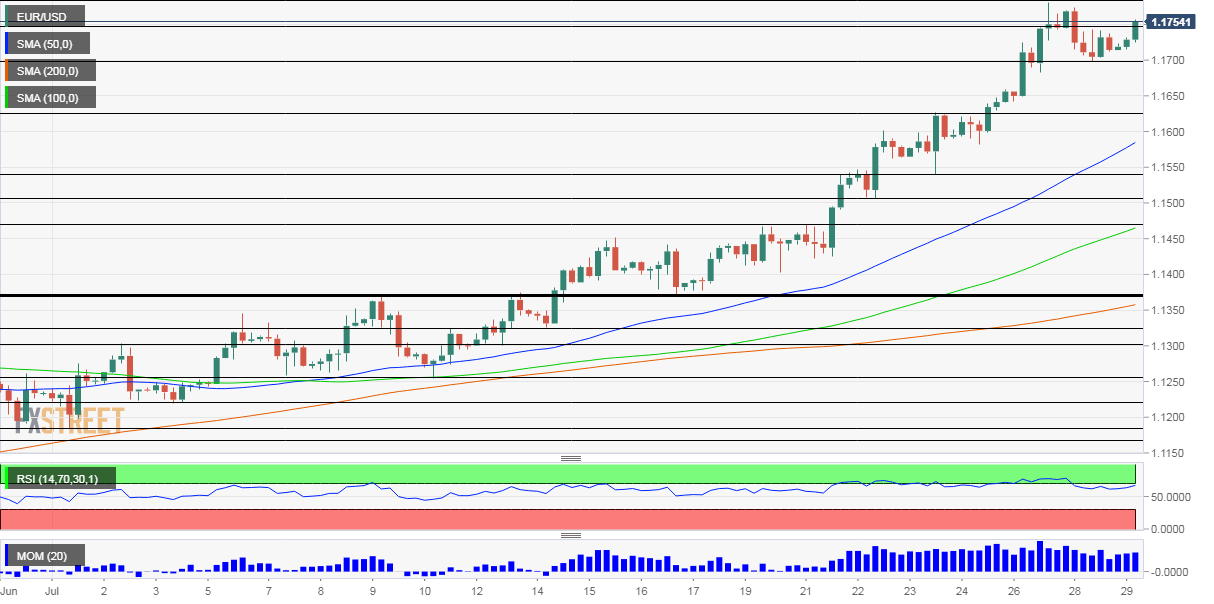
The Relative Strength Index on the four-hour chart is just 70 – on the verge of entering overbought territory. Another near-term move higher – to the recent peak of 1.1781 – will likely send the RSI above that line. Momentum remains to the upside and euro/dollar is trading well above the 50, 100, and 200 Simple Moving Averages.
Above 1.1781, the next resistance is 1.1815, a peak in September 2018, followed by 1.1850, a high point in June that year.
Support awaits at the round 1.17 level, then at 1.1625, and further down at 1.1540.
More Hot Summer In Markets: Gold, silver, euro, and dollar volatility explained
Author

Yohay Elam
FXStreet
Yohay is in Forex since 2008 when he founded Forex Crunch, a blog crafted in his free time that turned into a fully-fledged currency website later sold to Finixio.