EUR/USD Forecast: Extra gains appear likely in the short term
- EUR/USD climbed to two-week highs above 1.0870.
- Data-driven weakness in the Greenback helps the pair’s upside.
- Investors remain focused on Powell, ECB and Payrolls.

The weaker-than-expected release of the US ISM Services PMI hurt the Greenback and propelled EUR/USD to the area of two-week tops near 1.0880 on Tuesday, although that initial uptick fizzled out afterwards.
In the meantime, the USD Index (DXY) managed to shrug off a drop below 103.60, although it remained under pressure and trapped within the usual pre-NFP lull, which this time appeared exacerbated ahead of Chief Powell’s testimonies and the ECB interest rate decision.
The pair’s price action was accompanied by the continuation of the leg lower in yields on both sides of the Atlantic, despite speculations about a rate hike by the Fed and the European Central Bank (ECB) at some point in the summer, which remained steady.
Recent statements from Federal Reserve policymakers bolstered this expectation: Atlanta Fed President Raphael Bostic raised the possibility of reducing the policy rate in the summer, linking the timing of rate cuts to economic indicators. However, Chicago Fed President Austan Goolsbee opposed the idea of waiting for core inflation to reach 2% on a 12-month basis before contemplating rate cuts. Instead, Goolsbee advocated for rate adjustments to be guided by confidence in progress towards the target rate. In contrast, Richmond Fed President Thomas Barkin expressed hesitance towards swiftly lowering rates, even suggesting that the Fed might refrain from reducing rates at all this year.
As indicated by CME Group's FedWatch Tool, anticipations of a rate cut in June were approximately at the 55% mark.
Conversely, the ECB echoed the sentiment that the commencement of an easing cycle could take place in the next few months. ECB Board member Peter Kazimir voiced a preference for initiating the bank's easing cycle in June, a sentiment further strengthened following the softening of headline inflation figures in Germany and the broader Eurozone during last month, in contrast to consistently sticky core inflation figures.
All in all, stagnant fundamentals in the euro area in contrast to the solid resilience of the US economy seem to prop up the idea of a stronger Dollar on the relatively short-term horizon, always factoring in a nearly simultaneous start of the easing cycle by both the ECB and the Fed. Given that scenario, EUR/USD carries the potential to embark on a deeper correction to, initially, its so-far YTD low around 1.0700 prior to lows recorded in the latter part of October 2023/early November in the 1.0500 neighbourhood.
EUR/USD daily chart
EUR/USD short-term technical outlook
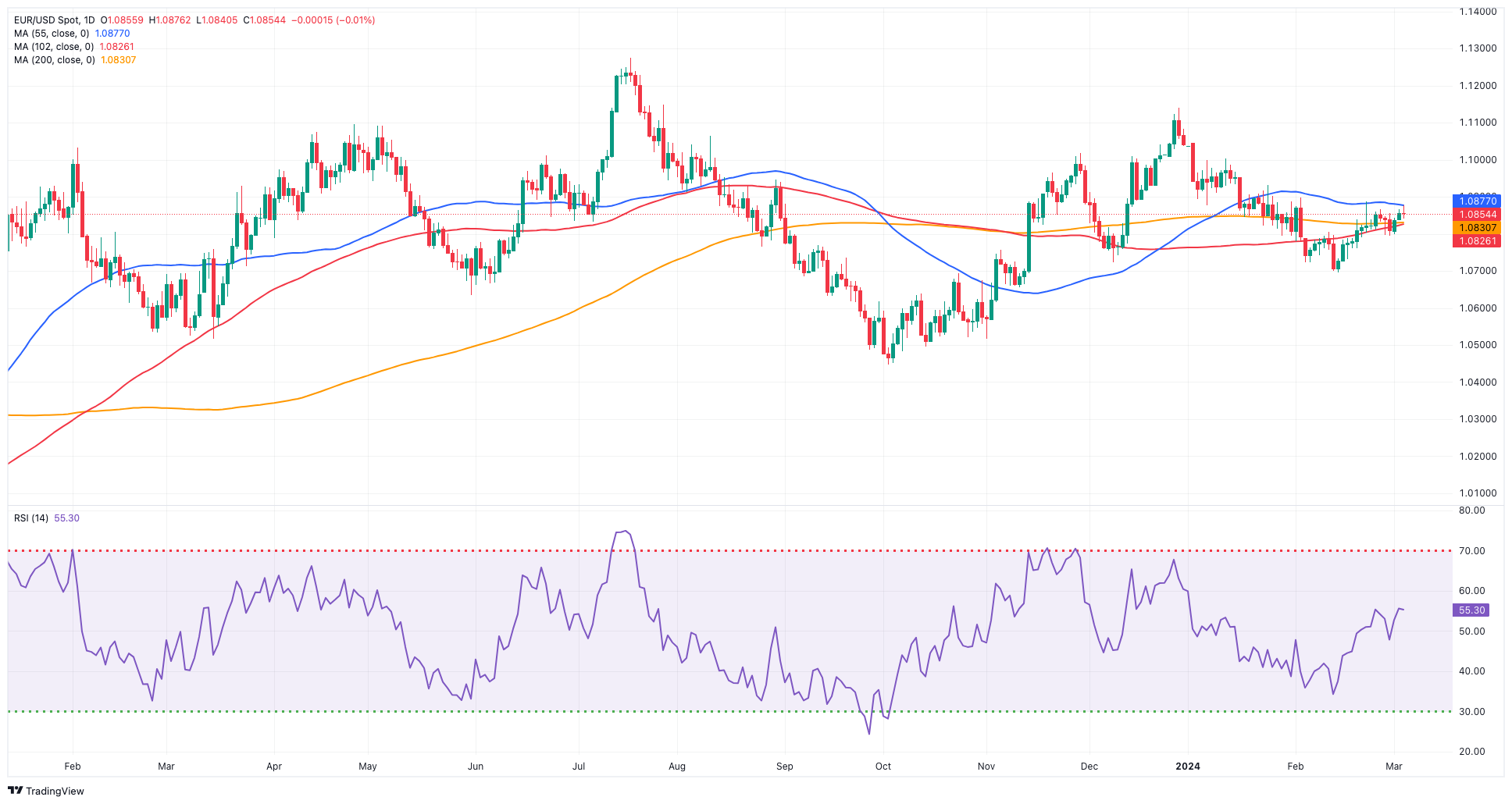
The intermediate 55-day SMA at 1.0877 looks to be the immediate target for EUR/USD before the weekly top of 1.0888 (February 22). The pair may see consecutive weekly peaks at 1.0932 (January 24) and 1.0998 (January 11), all before the psychological barrier of 1.1000 and ahead of the December 2023 high of 1.1139 (December 28).
On the downside, if the pair breaks the 2024 low of 1.0694 (February 14), it may initially target the November 2023 low of 1.0516 (November 1). The loss of the latter might lead to a move to the weekly low of 1.0495 (October 13, 2023), ahead of the 2023 low of 1.0448 (October 3) and the round level of 1.0400.
As long as the EUR/USD trades above the 200-day Simple Moving Average (SMA) of 1.0829, the outlook is favourable.
Looking at the 4-hour chart, spot seems to be attempting to breakout the consolidative phase. The next upward barrier is 1.0888, which comes before 1.0897 and 1.0932. The initial support is at 1.0796, followed by 1.0761, 1.0732, and 1.0694. The Moving Average Convergence Divergence (MACD) stayed positive, but the Relative Strength Index (RSI) advanced north of the 61 level.
Premium
You have reached your limit of 3 free articles for this month.
Start your subscription and get access to all our original articles.
Author
Pablo Piovano
FXStreet
Born and bred in Argentina, Pablo has been carrying on with his passion for FX markets and trading since his first college years.