EUR/USD Forecast: Euro needs to clear 1.1380 to push higher
- EUR/USD trades in positive territory above 1.1300 in the European session on Tuesday.
- The pair could face a strong resistance level at 1.1380.
- Investors could opt to stay on the sidelines ahead of the Fed policy decisions.

EUR/USD trades marginally higher on the day above 1.1300 in the European session on Tuesday but struggles to gather momentum. Investors could refrain from taking large positions ahead of the Federal Reserve's (Fed) monetary policy announcements on Wednesday, given the lack of high-tier macroeconomic data releases.
Euro PRICE This week
The table below shows the percentage change of Euro (EUR) against listed major currencies this week. Euro was the strongest against the Canadian Dollar.
| USD | EUR | GBP | JPY | CAD | AUD | NZD | CHF | |
|---|---|---|---|---|---|---|---|---|
| USD | 0.07% | -0.40% | -1.07% | 0.16% | 0.05% | -0.49% | -0.20% | |
| EUR | -0.07% | -0.20% | -0.88% | 0.35% | 0.25% | -0.29% | -0.01% | |
| GBP | 0.40% | 0.20% | -0.90% | 0.55% | 0.45% | -0.09% | 0.20% | |
| JPY | 1.07% | 0.88% | 0.90% | 1.24% | 1.14% | 0.67% | 0.99% | |
| CAD | -0.16% | -0.35% | -0.55% | -1.24% | -0.40% | -0.64% | -0.36% | |
| AUD | -0.05% | -0.25% | -0.45% | -1.14% | 0.40% | -0.54% | -0.25% | |
| NZD | 0.49% | 0.29% | 0.09% | -0.67% | 0.64% | 0.54% | 0.28% | |
| CHF | 0.20% | 0.00% | -0.20% | -0.99% | 0.36% | 0.25% | -0.28% |
The heat map shows percentage changes of major currencies against each other. The base currency is picked from the left column, while the quote currency is picked from the top row. For example, if you pick the Euro from the left column and move along the horizontal line to the US Dollar, the percentage change displayed in the box will represent EUR (base)/USD (quote).
After starting the week on a weak note, the US Dollar (USD) held its ground in the second half of the day, supported by upbeat data and some encouraging remarks on US trade negotiations.
The data from the US showed that the ISM Services Purchasing Managers Index (PMI) improved to 51.6 in April from 50.8 in March. This reading came in better than the market expectation of 50.6 and pointed to an ongoing expansion in the service sector's economic activity at an accelerating pace.
US Commerce Secretary Howard Lutnick told Fox Business that they are hoping to announce trade deals soon, adding that the first deal is likely to be a with a top-10 economy. Additionally, US Treasury Scott Bessent said that they are very close to reaching some agreements on trade.
Meanwhile, German conservative leader Friedrich Merz failed to secure a majority needed to form the coalition government and become chancellor on Tuesday in the initial voting in the lower House. This development seems to be making it difficult for the Euro (EUR) to outperform the USD.
EUR/USD Technical Analysis
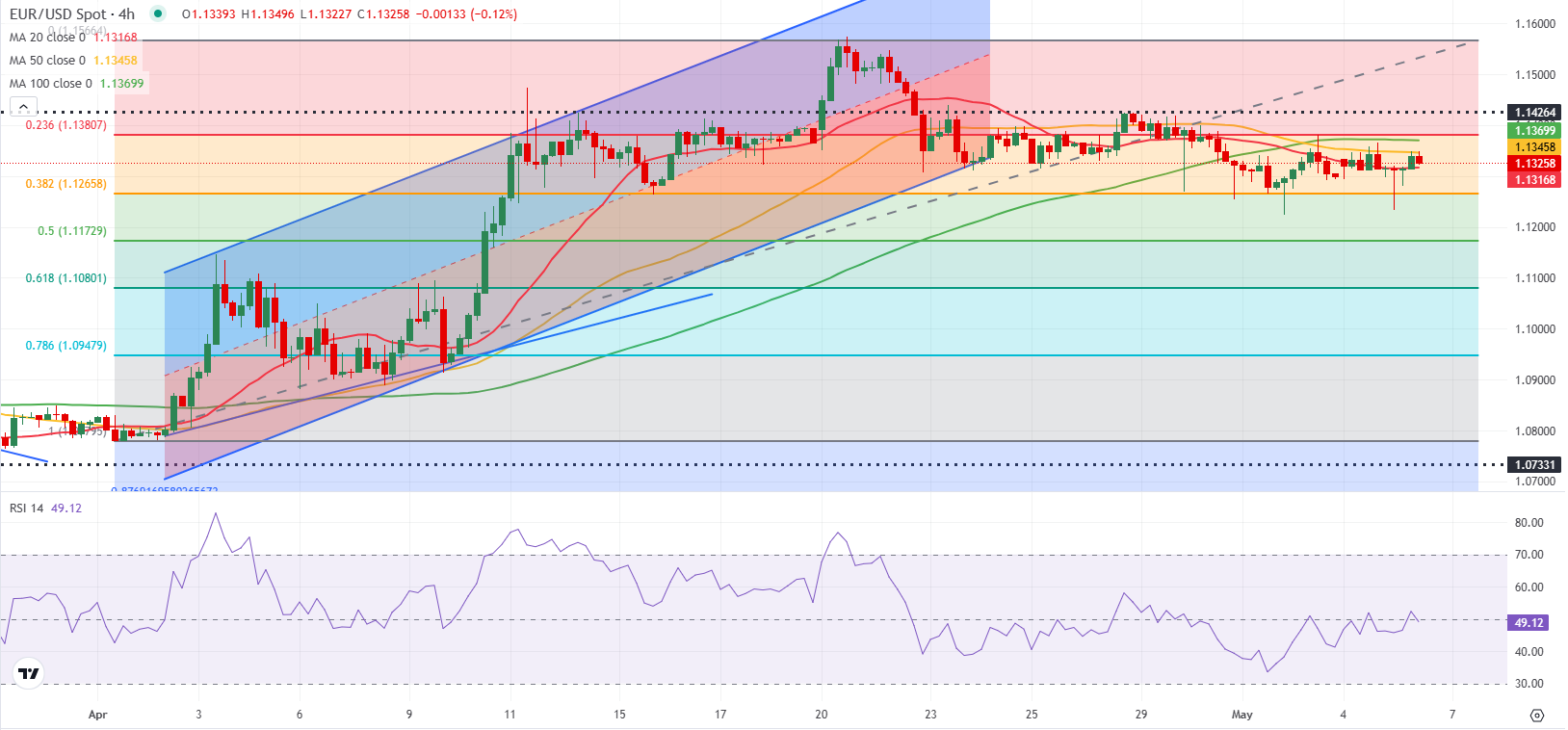
The Relative Strength Index (RSI) indicator on the 4-hour chart stays near 50 and EUR/USD continues to fluctuate at around the 20-period Simple Moving Average (SMA), highlighting a lack of directional momentum.
On the upside, the 100-period SMA and the Fibonacci 23.6% retracement of the latest uptrend form a strong resistance at 1.1380 ahead of 1.1430 (static level) and 1.1500 (static level, round level). Looking south, supports could be located at 1.1270 (Fibonacci 38.2% retracement), 1.1175 (Fibonacci 50% retracement) and 1.1080 (Fibonacci 61.8% retracement).
Euro FAQs
The Euro is the currency for the 19 European Union countries that belong to the Eurozone. It is the second most heavily traded currency in the world behind the US Dollar. In 2022, it accounted for 31% of all foreign exchange transactions, with an average daily turnover of over $2.2 trillion a day. EUR/USD is the most heavily traded currency pair in the world, accounting for an estimated 30% off all transactions, followed by EUR/JPY (4%), EUR/GBP (3%) and EUR/AUD (2%).
The European Central Bank (ECB) in Frankfurt, Germany, is the reserve bank for the Eurozone. The ECB sets interest rates and manages monetary policy. The ECB’s primary mandate is to maintain price stability, which means either controlling inflation or stimulating growth. Its primary tool is the raising or lowering of interest rates. Relatively high interest rates – or the expectation of higher rates – will usually benefit the Euro and vice versa. The ECB Governing Council makes monetary policy decisions at meetings held eight times a year. Decisions are made by heads of the Eurozone national banks and six permanent members, including the President of the ECB, Christine Lagarde.
Eurozone inflation data, measured by the Harmonized Index of Consumer Prices (HICP), is an important econometric for the Euro. If inflation rises more than expected, especially if above the ECB’s 2% target, it obliges the ECB to raise interest rates to bring it back under control. Relatively high interest rates compared to its counterparts will usually benefit the Euro, as it makes the region more attractive as a place for global investors to park their money.
Data releases gauge the health of the economy and can impact on the Euro. Indicators such as GDP, Manufacturing and Services PMIs, employment, and consumer sentiment surveys can all influence the direction of the single currency. A strong economy is good for the Euro. Not only does it attract more foreign investment but it may encourage the ECB to put up interest rates, which will directly strengthen the Euro. Otherwise, if economic data is weak, the Euro is likely to fall. Economic data for the four largest economies in the euro area (Germany, France, Italy and Spain) are especially significant, as they account for 75% of the Eurozone’s economy.
Another significant data release for the Euro is the Trade Balance. This indicator measures the difference between what a country earns from its exports and what it spends on imports over a given period. If a country produces highly sought after exports then its currency will gain in value purely from the extra demand created from foreign buyers seeking to purchase these goods. Therefore, a positive net Trade Balance strengthens a currency and vice versa for a negative balance.
Author

Eren Sengezer
FXStreet
As an economist at heart, Eren Sengezer specializes in the assessment of the short-term and long-term impacts of macroeconomic data, central bank policies and political developments on financial assets.