EUR/USD Forecast: Euro could find it hard to rebound amid risk aversion
- EUR/USD has lost its traction after having failed to stabilize above 1.0700.
- S&P will release flash February PMIs for Germany, the Eurozone and the US.
- Escalating geopolitical tensions could make it difficult for the Euro to find demand.


EUR/USD has started to stretch lower after having failed to reclaim 1.0700 on Monday. The near-term technical outlook points to a bearish tilt and the pair could have a difficult time gaining traction amid mounting geopolitical tensions.
Markets remained relatively quiet at the beginning of the week as American investors enjoyed a long weekend. Early Tuesday, US stock index futures trade in negative territory, pointing to a risk-averse market environment.
Following his unannounced visit to Kyiv, US President Joe Biden will visit Poland on Tuesday. Biden will reportedly discuss reinforcing Poland's security by increasing the Nato presence in the country. Meanwhile, Russian President Vladimir Putin is scheduled to deliver his state of the nation address to Russia’s Federal Assembly and provide an update on the "special military operation."
Additionally, China’s top diplomat, Wang Yi, will reportedly visit Moscow on Tuesday after US Secretary of State Antony Blinken accused China of planning to provide military support to Russia at the Munich Security Conference.
In Germany, S&P Global Services PMI is expected to stay in expansion territory above 50 in early February while the Manufacturing PMI is forecast to improve modestly to 47.8 from 47.3 in January. On Monday, Bundesbank said in its monthly report that Germany's economic outlook was 'somewhat brighter' but noted that high inflationary pressures were persistent.
Similarly, both the headline Manufacturing and Services PMIs in the Eurozone are expected to rise modestly in February's flash estimate.
In case PMI surveys suggest that the business activity in the private sector stayed relatively healthy, this could be seen as a development that can allow the European Central Bank (ECB) to continue to tighten its policy rate after March and help the Euro. In that scenario, however, EUR/USD's upside is likely to remain capped due to risk aversion. On Monday, ECB Governing Council member Olli Rehn told Börsen-Zeitung that the ECB could continue to hike its key rates after March and reach the terminal rate later in the summer.
On the other hand, a significant decline in headline PMIs could put additional weight on the Euro and open the door for an extended slide in EUR/USD.
In the second half of the day, S&P Global will release the PMI surveys for the US as well. Comments regarding input inflation and wage situation in the private sector could impact the US Dollar's (USD) valuation in the late American session. In case surveys' findings reveal that higher wages are driving the input costs higher, the USD is likely to hold its ground against its rivals and vice versa.
EUR/USD Technical Analysis
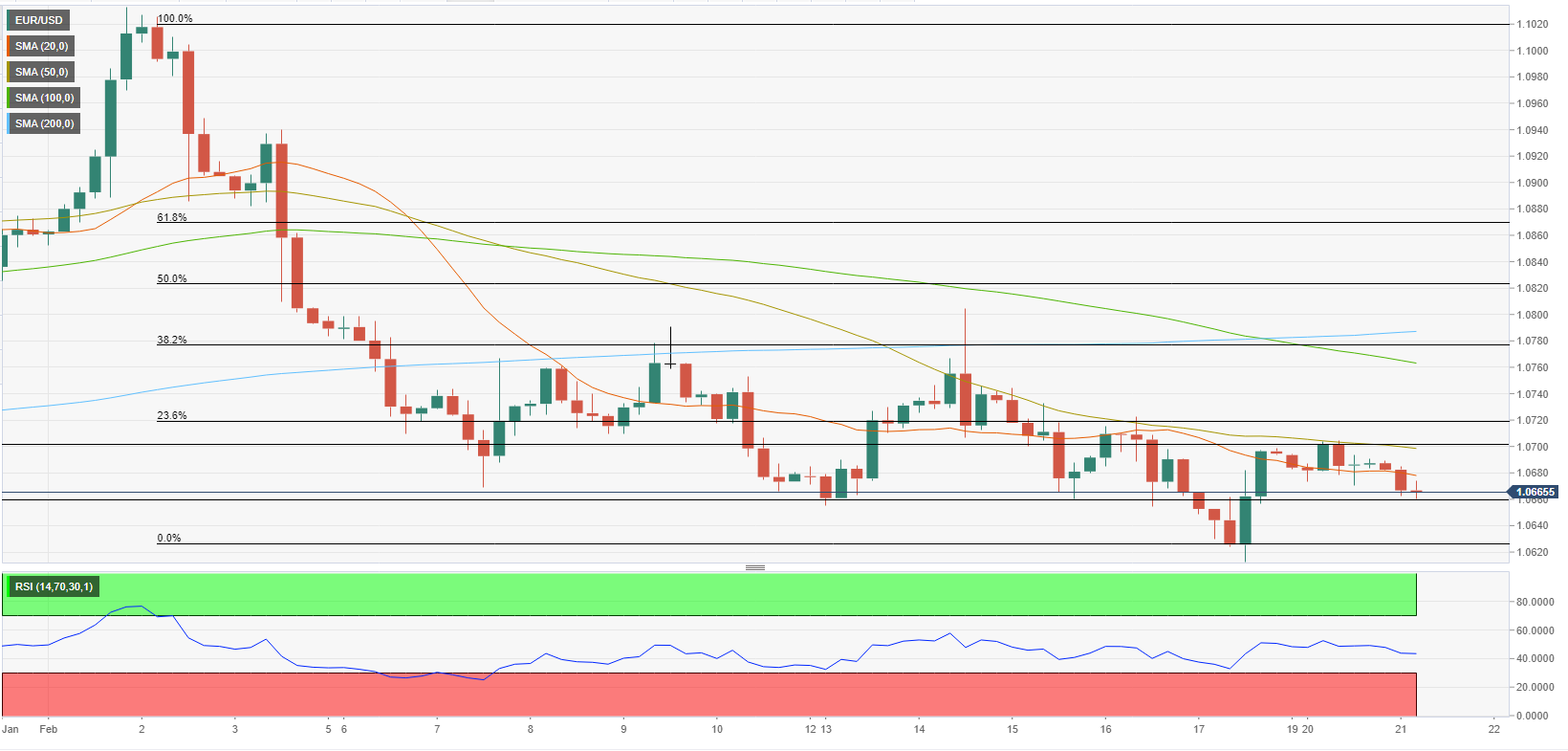
EUR/USD's last four-hour candle closed below the 20-period Simple Moving Average (SMA) and the Relative Strength Index (RSI) indicator declined below 50, pointing to a bearish shift in the short-term technical outlook.
At the time of press, EUR/USD was testing the interim support that seems to have formed at 1.0660. Below that level, 1.0630 (end-point of the latest downtrend) aligns as next support before 1.0600 (psychological level).
1.0680 (20-period SMA) aligns as initial resistance before 1.0700 (psychological level, static level, 50-peirod SMA). With a four-hour close above that latter hurdle, the pair could extend its recovery toward 1.0720 (static level) and 1.0760 (100-period SMA).
Premium
You have reached your limit of 3 free articles for this month.
Start your subscription and get access to all our original articles.
Author
Eren Sengezer
FXStreet
As an economist at heart, Eren Sengezer specializes in the assessment of the short-term and long-term impacts of macroeconomic data, central bank policies and political developments on financial assets.

















