EUR/USD Forecast: Euro could extend rebound once it clears 1.1650
- EUR/USD trades comfortably above 1.1600 in the European session on Friday.
- The technical outlook highlights sellers' hesitancy in the near term.
- The improving risk mood could help the pair stretch higher heading into the weekend.


EUR/USD gathers bullish momentum and rises toward 1.1650 in the European session on Friday after touching its lowest level since June 23 near 1.1550 on Thursday. The technical outlook suggests that the pair could extend its recovery in case it manages to clear 1.1650.
Euro PRICE Today
The table below shows the percentage change of Euro (EUR) against listed major currencies today. Euro was the strongest against the Japanese Yen.
| USD | EUR | GBP | JPY | CAD | AUD | NZD | CHF | |
|---|---|---|---|---|---|---|---|---|
| USD | -0.33% | -0.16% | 0.00% | -0.19% | -0.46% | -0.46% | -0.32% | |
| EUR | 0.33% | 0.19% | 0.35% | 0.14% | -0.13% | -0.25% | 0.01% | |
| GBP | 0.16% | -0.19% | 0.16% | -0.03% | -0.31% | -0.39% | -0.16% | |
| JPY | 0.00% | -0.35% | -0.16% | -0.17% | -0.46% | -0.57% | -0.23% | |
| CAD | 0.19% | -0.14% | 0.03% | 0.17% | -0.29% | -0.36% | -0.13% | |
| AUD | 0.46% | 0.13% | 0.31% | 0.46% | 0.29% | -0.08% | 0.12% | |
| NZD | 0.46% | 0.25% | 0.39% | 0.57% | 0.36% | 0.08% | 0.23% | |
| CHF | 0.32% | -0.01% | 0.16% | 0.23% | 0.13% | -0.12% | -0.23% |
The heat map shows percentage changes of major currencies against each other. The base currency is picked from the left column, while the quote currency is picked from the top row. For example, if you pick the Euro from the left column and move along the horizontal line to the US Dollar, the percentage change displayed in the box will represent EUR (base)/USD (quote).
The US Dollar (USD) benefited from upbeat macroeconomic data releases on Thursday and caused EUR/USD to stretch lower. Retail Sales rose by 0.6% on a monthly basis in June, beating the market expectation for an increase of 0.1% by a wide margin, and weekly Initial Jobless Claims declined to 221,000 from 228,000 in the previous week.
Later in the day, the bullish action in Wall Street made it difficult for the USD to preserve its strength and helped EUR/USD stage a rebound.
Early Friday, US stock index futures rise about 0.2% on the day. In case risk flows continue to dominate the action heading into the weekend, EUR/USD could hold its ground.
The US economic calendar will feature the University of Michigan's (UoM) preliminary Consumer Sentiment Index for July. A noticeable improvement in consumer confidence and an uptick in the 1-year Consumer Inflation Expectations component of the survey could support the USD and cap EUR/USD's upside.
EUR/USD Technical Analysis
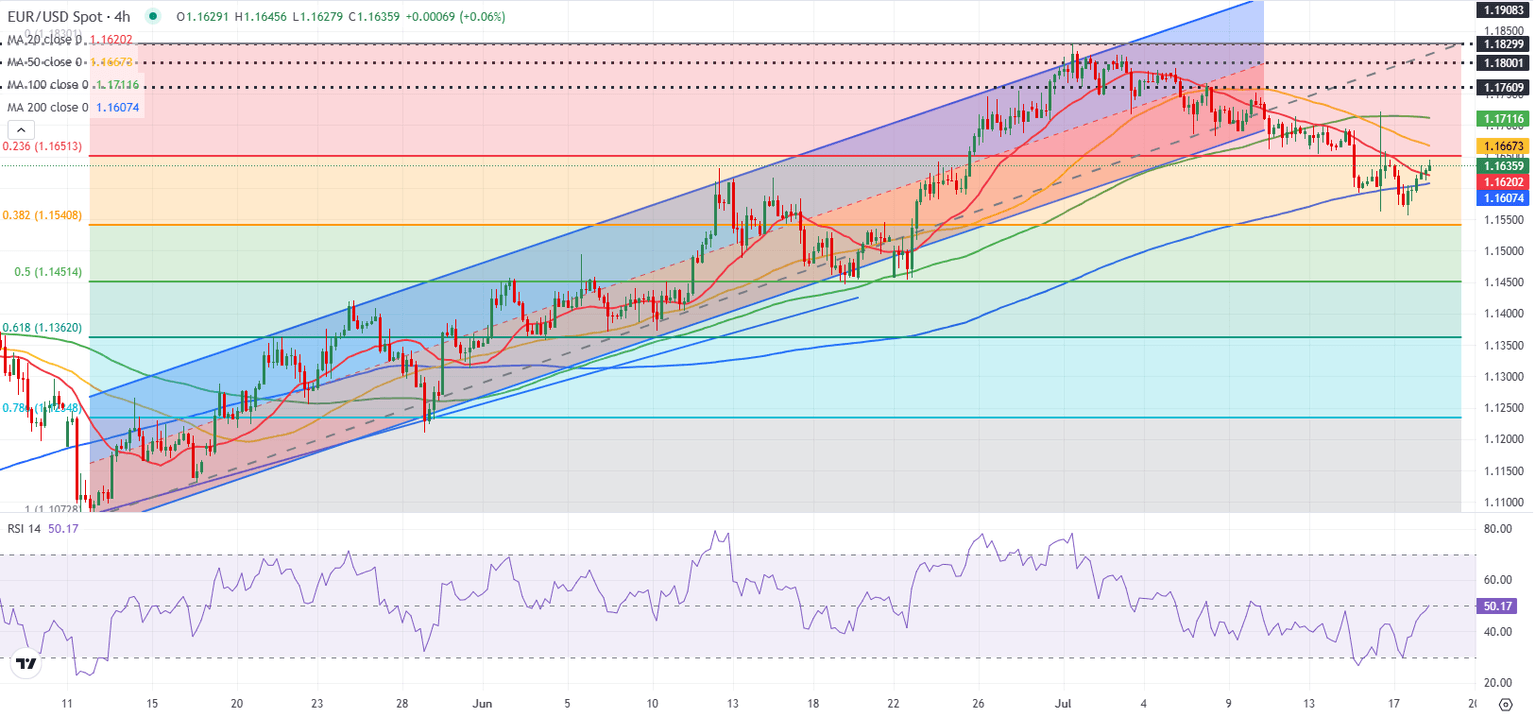
The Relative Strength Index (RSI) indicator on the 4-hour chart climbed above 50 for the first time in a week and EUR/USD stabilized above the 200-period Simple Moving Average (SMA), currently located at 1.1610, after dropping below this level on Thursday.
In case EUR/USD rises above 1.1650 (Fibonacci 23.6% retracement of the latest uptrend) and starts using this level as support, 1.1710 (100-period SMA) could be seen as the next resistance level ahead of 1.1760 (static level). Looking south, support levels could be seen at 1.1610 (200-period SMA), 1.1540 (Fibonacci 38.2% retracement) and 1.1500 (static level, round level).
Euro FAQs
The Euro is the currency for the 19 European Union countries that belong to the Eurozone. It is the second most heavily traded currency in the world behind the US Dollar. In 2022, it accounted for 31% of all foreign exchange transactions, with an average daily turnover of over $2.2 trillion a day. EUR/USD is the most heavily traded currency pair in the world, accounting for an estimated 30% off all transactions, followed by EUR/JPY (4%), EUR/GBP (3%) and EUR/AUD (2%).
The European Central Bank (ECB) in Frankfurt, Germany, is the reserve bank for the Eurozone. The ECB sets interest rates and manages monetary policy. The ECB’s primary mandate is to maintain price stability, which means either controlling inflation or stimulating growth. Its primary tool is the raising or lowering of interest rates. Relatively high interest rates – or the expectation of higher rates – will usually benefit the Euro and vice versa. The ECB Governing Council makes monetary policy decisions at meetings held eight times a year. Decisions are made by heads of the Eurozone national banks and six permanent members, including the President of the ECB, Christine Lagarde.
Eurozone inflation data, measured by the Harmonized Index of Consumer Prices (HICP), is an important econometric for the Euro. If inflation rises more than expected, especially if above the ECB’s 2% target, it obliges the ECB to raise interest rates to bring it back under control. Relatively high interest rates compared to its counterparts will usually benefit the Euro, as it makes the region more attractive as a place for global investors to park their money.
Data releases gauge the health of the economy and can impact on the Euro. Indicators such as GDP, Manufacturing and Services PMIs, employment, and consumer sentiment surveys can all influence the direction of the single currency. A strong economy is good for the Euro. Not only does it attract more foreign investment but it may encourage the ECB to put up interest rates, which will directly strengthen the Euro. Otherwise, if economic data is weak, the Euro is likely to fall. Economic data for the four largest economies in the euro area (Germany, France, Italy and Spain) are especially significant, as they account for 75% of the Eurozone’s economy.
Another significant data release for the Euro is the Trade Balance. This indicator measures the difference between what a country earns from its exports and what it spends on imports over a given period. If a country produces highly sought after exports then its currency will gain in value purely from the extra demand created from foreign buyers seeking to purchase these goods. Therefore, a positive net Trade Balance strengthens a currency and vice versa for a negative balance.
Premium
You have reached your limit of 3 free articles for this month.
Start your subscription and get access to all our original articles.
Author
Eren Sengezer
FXStreet
As an economist at heart, Eren Sengezer specializes in the assessment of the short-term and long-term impacts of macroeconomic data, central bank policies and political developments on financial assets.