EUR/USD Forecast: Euro bulls to regain control on a hawkish ECB
- EUR/USD declines modestly but manages to hold above 1.0800.
- ECB is widely expected to raise key interest rates by 25 bps.
- US Dollar holds its ground following Fed policy announcements.

EUR/USD climbed to a fresh monthly-high above 1.0860 late Wednesday but lost traction afterwards as the US Dollar regathered its strength. Still, the pair holds comfortably above 1.0800 early Thursday as markets await the European Central Bank's (ECB) policy decisions.
The Federal Reserve (Fed) left its policy rate unchanged at the 5%-5.25% range as expected following the June policy meeting. The terminal rate forecast in the dot plot, however, got revised higher to 5.6% from 5.1% in March, implying two more 25 basis points (bps) rate hikes in 2023. Although FOMC Chairman Jerome Powell refrained from committing to a rate increase in July when asked about it, US Treasury bond yields turned north, helping the USD outperform its rivals.
The ECB is widely anticipated to raise key rates by 25 bps. Markets also nearly fully price in another 25 bps hike in July. At this point, the rate hike itself and a commitment to a July increase might not be enough to provide a boost to the Euro. Instead, market participants will pay close attention to the ECB's revised economic projections.
An upward revision to core inflation for 2023 should suggest that the ECB is unlikely to pause the tightening cycle in July. Currently, the deposit rate stands at 3.25%. If markets start to price in a terminal rate projection of 4% or higher on a hawkish ECB rhetoric, EUR/USD is likely to gather bullish momentum.
On the other hand, an acknowledgement of softening inflationary pressures with downward revisions to inflation forecasts could trigger a Euro sell-off and send the EUR/USD pair lower.
In case ECB President Christine Lagarde adopts a neutral tone and avoids giving any clues regarding future policy actions, the USD valuation could drive EUR/USD's action in the second half of the day.
EUR/USD Technical Analysis
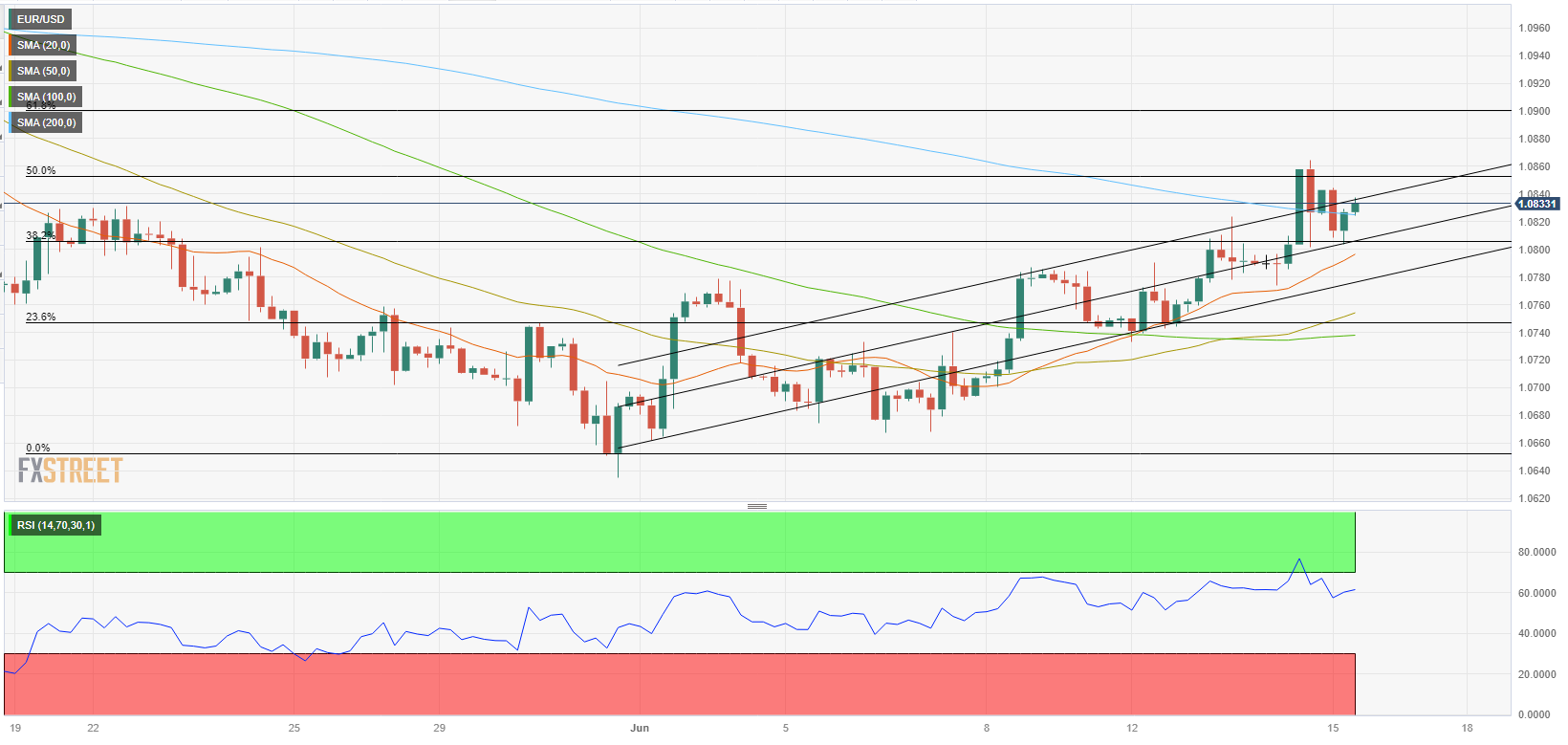
Following the sharp decline seen late Wednesday, EUR/USD returned within the ascending regression channel and the Relative Strength Index (RSI) indicator on the four-hour chart dropped below 70, suggesting that the latest pullback was a technical correction.
At the time of writing, EUR/USD was trading slightly above the 200-period Simple Moving Average (SMA) located at 1.0820. Below that level, 1.0800 (mid-point of the ascending channel, Fibonacci 38.2% retracement of the latest downtrend) aligns as an important support. A four-hour close below this level could be seen as a significant bearish development and cause the pair to stretch lower to 1.0770 (lower-limit of the ascending channel).
On the upside, EUR/USD could target 1.0900 (Fibonacci 61.8% retracement) and 1.0940 (static level) once it flips 1.0860/70 (Fibonacci 50% retracement, static level) area into support.
Author

Eren Sengezer
FXStreet
As an economist at heart, Eren Sengezer specializes in the assessment of the short-term and long-term impacts of macroeconomic data, central bank policies and political developments on financial assets.