EUR/USD Forecast: Buyers pause ahead of US Consumer Price Index data

EUR/USD Current price: 1.0940
- ECB Governing Council member Peter Kazimir hinted at June rate cuts.
- Investors await the US Consumer Price Index scheduled for February.
- EUR/USD stable around 1.0940 with the risk skewed to the upside.
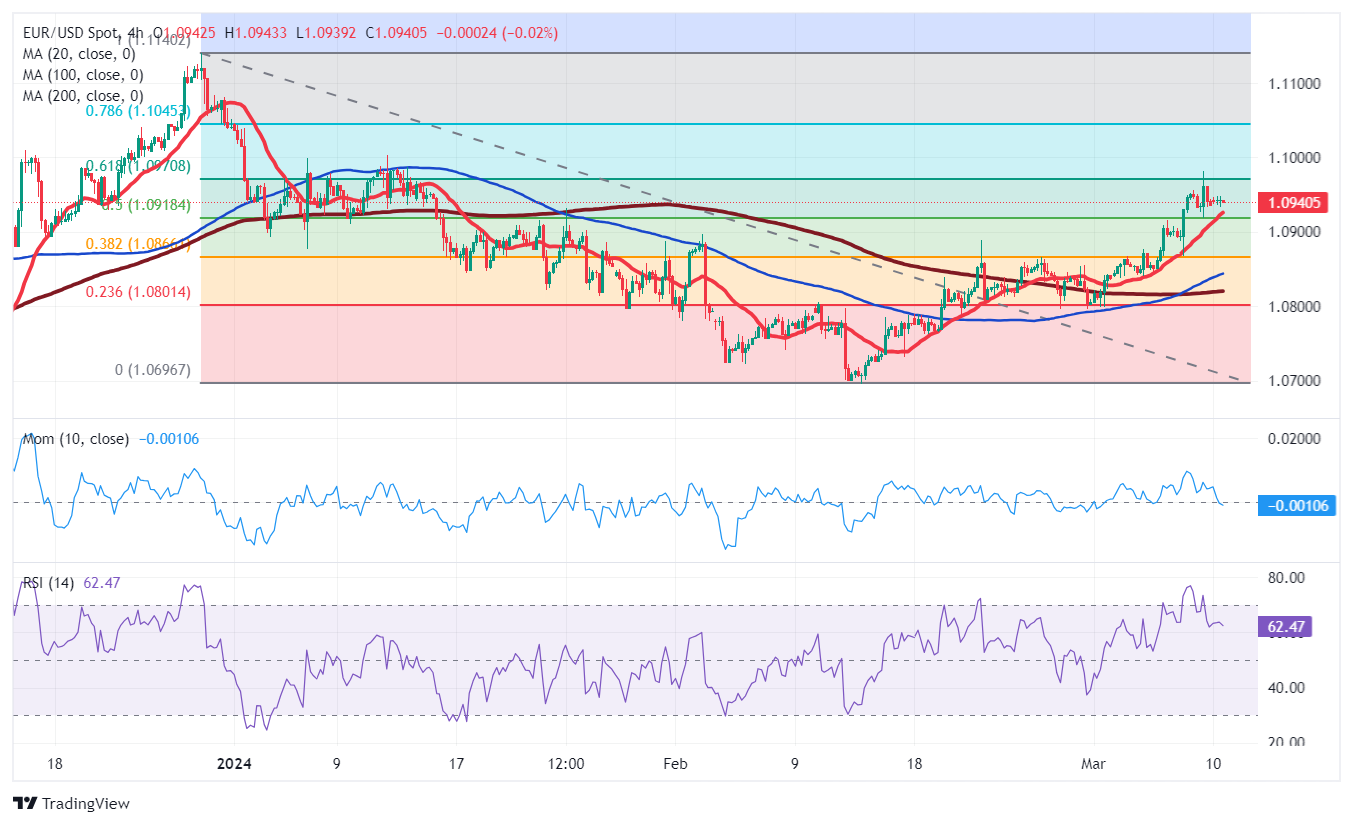
The EUR/USD pair hovers around 1.0940 on Monday, trading lifelessly around its opening level. A scarce macroeconomic calendar and the upcoming United States (US) Consumer Price Index (CPI) on Tuesday keep speculative interest in cautious mode.
Meanwhile, the Euro lacks self-impetus. Demand for the shared currency has been tepid lately, as local macroeconomic data hint at an upcoming economic setback. The European Central Bank (ECB) failed to impress. European policymakers stick to President Christine Lagarde's words delivered after the monetary policy meeting.
ECB Governing Council member Peter Kazimir hit the wires earlier in the day and said that rushing - on rate cuts - isn't "smart and beneficial," adding that with fresh forecasts at hand in June, the confidence level could reach the threshold. Finally, he noted that upside inflation risks are "alive and kicking."
The US will not release macroeconomic figures today, with the focus on the February CPI scheduled for Tuesday. Annual inflation is foreseen at 3.1%, matching January's reading, while the core reading is expected to have eased to 3.7% from 3.9% previously.
EUR/USD short-term technical outlook
The EUR/USD pair trades between Fibonacci levels, developing below the 61.8% retracement of the 1.1139/1.0734 slump at 1.0970. Technical readings in the daily chart maintain the risk skewed to the upside. EUR/USD develops above all its moving averages, with the 20 Simple Moving Average (SMA) about to cross above the longer ones, all of them converging around 1.0830. At the same time, technical indicators have lost their bullish strength but remain well above their midlines and without signs of upward exhaustion.
According to the 4-hour chart, the risk is also skewed to the upside in the near term, although the pair needs to clear the aforementioned Fibonacci resistance to gain upward traction. Technical indicators stabilized above their midlines after correcting overbought conditions, suggesting absent selling interest. Finally, the 20 SMA maintains a firmly bullish slope around the 50% retracement of the aforementioned rally at 1.0917, while the longer moving averages remain far below the shorter one.
Support levels: 1.0915 1.0865 1.0820
Resistance levels: 1.0970 1.1010 1.1045
Author

Valeria Bednarik
FXStreet
Valeria Bednarik was born and lives in Buenos Aires, Argentina. Her passion for math and numbers pushed her into studying economics in her younger years.
















