EUR/USD Forecast: Bulls give up to evidence of mounting economic trouble in Europe

EUR/USD Current Price: 1.1089
- Disappointing European S&P Global PMIs fueled concerns about a significant economic setback.
- The United States Federal Reserve and the European Central Bank take centre stage this week.
- EUR/USD bearish case gaining strength, although caution reigns ahead of multiple first-tier events.
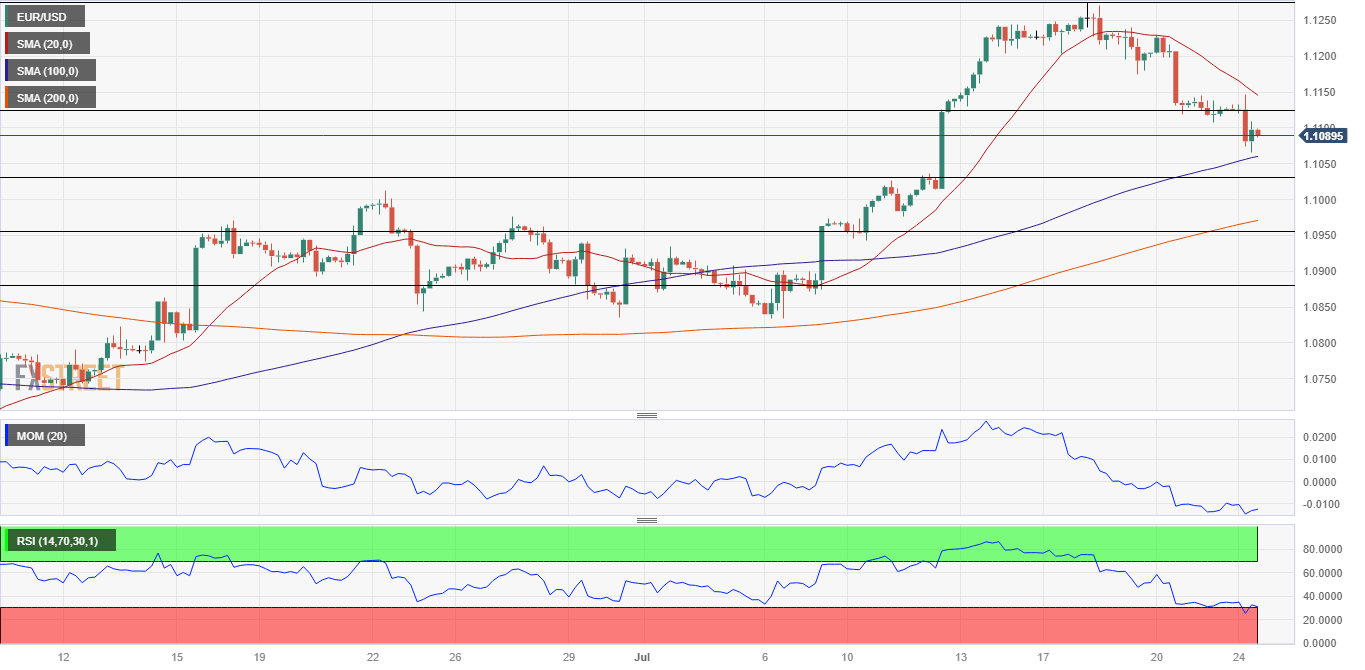
The US Dollar appreciates on Monday, advancing against most major rivals. EUR/USD extended last week’s slide and traded as low as 1.1065, as the Euro got hit by a worsening European economic situation.
S&P Global released the preliminary estimates of the July Producer Manager Indexes (PMIs) for the Union, with all figures missing the market expectations. The German Manufacturing PMI printed at 38.8, its lowest over three years, while the Services PMI resulted in 52, a five-month low. “The German economy moved into contraction territory in July as a deepening downturn in manufacturing output coincided with a sustained slowdown in services activity growth,” the official report reads. The headline Germany Composite PMI Output Index dropped for the third month in a row in July, hitting its lowest for 2023 at 48.3.
Additionally, “Eurozone business output fell at the fastest rate for eight months in July,” according to the S&P Global survey. The manufacturing index printed at 42.7, while the services one fell to 51.1, leaving the Composite PMI at 48.9. EUR/USD pared losses mid-European morning and recovered towards the current 1.1090 price zone, as investors are unwilling to commit to a direction in a packed first-tier events week.
Central banks, inflation and growth
The United States (US) Federal Reserve (Fed) and the European Central Bank (ECB) will announce their decisions on monetary policy, and while both central banks are expected to hike their respective benchmark rates by 25 basis points (bps), the following steps could be quite the opposite, leading to a trend definition around EUR/USD. Also, the US will release the first estimate of its Q2 Gross Domestic Product (GDP) and the June Personal Consumption Expenditures (PCE) Price Index.
Later today, S&P Global will release the preliminary estimates of the July US PMIs, with manufacturing output foreseen improving to 46.4 from 46.3, while services activity is expected to have shrunk from 54.4 to 54.1.
EUR/USD short-term technical outlook
The EUR/USD pair broke below the 38.2% Fibonacci retracement of its latest bullish run measured between 1.0833 and 1.1275 at 1.1105, later meeting sellers around the latter on a failed attempt to recover its poise.
The daily chart shows that the pair is losing ground for a fifth consecutive day, which skews the risk to the downside. Nevertheless, EUR/USD is still developing above all its moving averages, with a bullish 20 Simple Moving Average (SMA) offering dynamic support at around 1.1040. Furthermore, the Momentum indicator is stable within positive levels, while the Relative Strength Index (RSI) indicator heads south at around 56.
The pair reached oversold conditions in the near term. The 4-hour chart shows that technical indicators are bouncing modestly from extreme readings, lacking enough positive momentum to deny additional slides. At the same time, the pair trades well below a bearish 20 SMA, while a bullish 100 SMA converges with the 50% retracement of the mentioned rally at 1.1050.
Support levels: 1.1040 1.1005 1.0960
Resistance levels: 1.1110 1.1155 1.1190
Author

Valeria Bednarik
FXStreet
Valeria Bednarik was born and lives in Buenos Aires, Argentina. Her passion for math and numbers pushed her into studying economics in her younger years.

















