EUR/USD Forecast: Bulls await Eurozone HICP and breakout through 100-day SMA
- EUR/USD sticks to a positive bias as dovish Fed expectations keep the USD depressed.
- Bets that the ECB is done cutting rates benefit the EUR and further support spot prices.
- Bulls, however, opt to wait for the flash Eurozone CPI report before placing fresh bets.

The EUR/USD pair attracts some dip-buyers following the overnight pullback from a two-week high and holds steady above the 1.1600 mark through the first half of the European session on Tuesday. The US Dollar (USD) struggles to capitalize on Monday's late rebound from its lowest level since November 14 amid dovish Federal Reserve (Fed) expectations. Apart from this, bets that the European Central Bank (ECB) is done cutting interest rates act as a tailwind for the Euro (EUR) and the currency pair.
The recent comments from several Fed officials suggested that another interest rate cut in December is a live option. Adding to this, a slew of tepid economic data suggests that growth in the world's largest economy is cooling and backs the case for further policy easing by the US central bank. On Monday, the Institute for Supply Management (ISM) reported that its Manufacturing PMI for November fell to 48.2 from 48.7 in the previous month. The reading missed estimates and pointed to a slowdown in the manufacturing sector, which could potentially impact the overall economy. Furthermore, a generally positive risk tone is seen undermining the safe-haven buck and supporting the EUR/USD pair.
Meanwhile, inflation figures from the Eurozone's major economies released last Friday painted a mixed picture. In fact, the inflation rate in Germany unexpectedly accelerated to the highest level in nine months in November, while data from France, Spain, and Italy showed no immediate threat of price hikes. Adding to this, a new ECB survey showed that median consumer inflation expectations for the next year rose to 2.8% in October from 2.7% in the previous month. This reinforces the argument for a policy hold by the ECB next month. Moreover, traders see only a one-in-three chance that the ECB will cut rates by the middle of next year, which backs the case for a further appreciation of the EUR/USD pair.
Bulls, however, seem reluctant and opt to wait for the preliminary Eurozone inflation data before placing fresh bets. The flash version of the report is expected to show that the headline Eurozone Harmonized Index of Consumer Prices (HICP) held steady at the 2.1% YoY rate in November, while the core gauge edged higher to 2.5% from the 2.4% in October. The data, in turn, might influence the shared currency and provide some impetus to the EUR/USD pair. Traders this week will also confront the release of the US Personal Consumption Expenditure (PCE) Price Index on Friday, which will be looked for cues about the Fed's rate-cut path. This, in turn, will drive the USD and the currency pair in the near term.
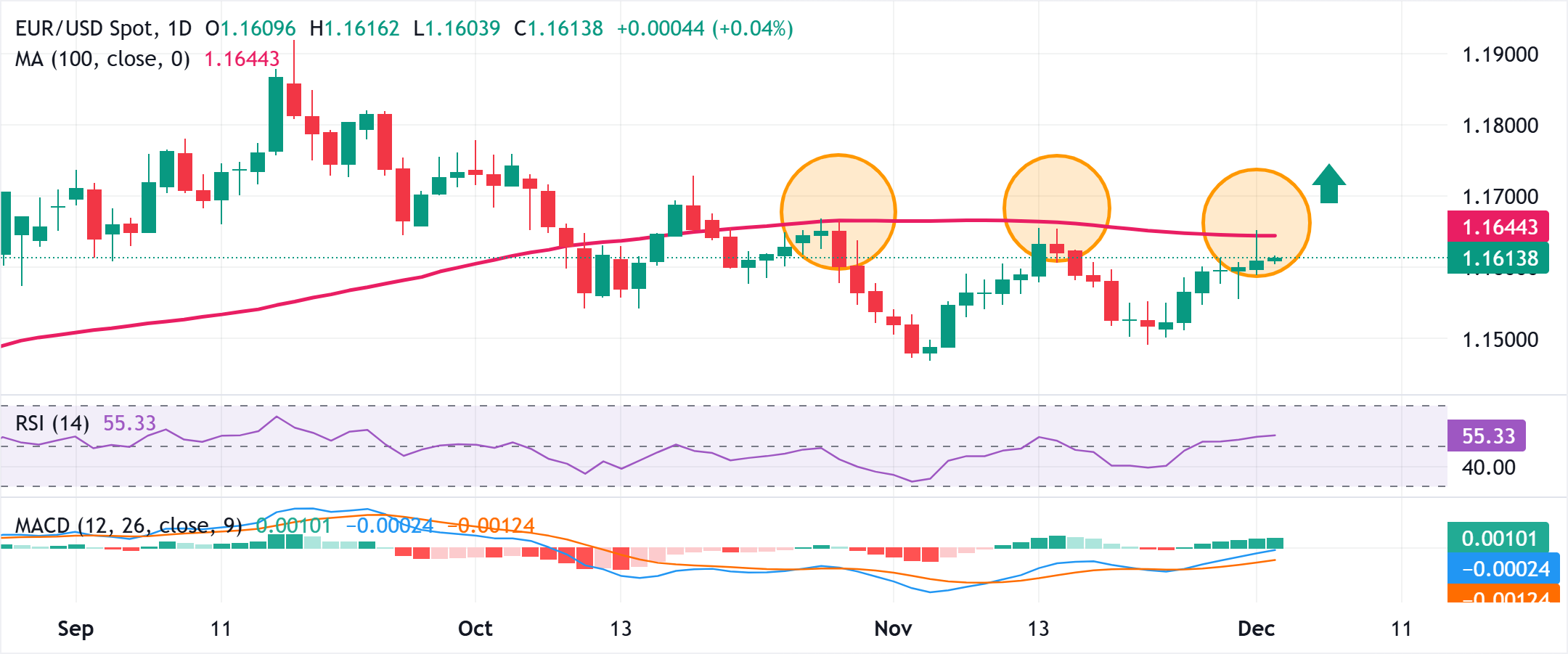
EUR/USD daily chart
Technical Outlook
The EUR/USD pair has been struggling to find acceptance or build on momentum beyond the 100-day Simple Moving Average (SMA) since late October. Meanwhile, oscillators on the daily chart have been gaining positive traction, backing the case for an eventual breakout through the said barrier, currently pegged near the 1.1650 area. The subsequent move up should allow the currency pair to reclaim the 1.1700 round figure and climb further towards the 1.1760-1.1765 supply zone before aiming towards the 1.1800 mark.
On the flip side, any meaningful slide below the 1.1600 mark could attract some buyers near last Friday's swing low, around the 1.1555 region. A convincing break below, however, might expose the 1.1500 psychological mark and make the EUR/USD pair vulnerable to retest the 1.1470-1.1465 region, or a three-month low touched in November. The downward trajectory could extend further towards testing sub-1.1400 levels, or the August monthly swing low.
Author

Haresh Menghani
FXStreet
Haresh Menghani is a detail-oriented professional with 10+ years of extensive experience in analysing the global financial markets.