EUR/USD Forecast: Break below YTD lows, 1.1300 mark remains a distinct possibility

The shared currency lost some additional ground on Tuesday and this time was weighed down by softer economic data, showing that the Euro-zone GDP growth halved to 0.2% q/q in Q3. Adding to this, Italy's GDP stalled in Q3, giving the coalition government another reason to stick with its budget deficit plan for 2019. Italian worries largely offset hotter-than-expected German consumer price inflation figures, soaring to a 10-year high level of 2.5% y/y, and did little to lend any support.
Meanwhile, a strong follow-through US Dollar buying interest, thanks to the US President Donald Trump's positive comments over a possible trade deal with China, exerted some additional downward pressure through Tuesday's trading session.
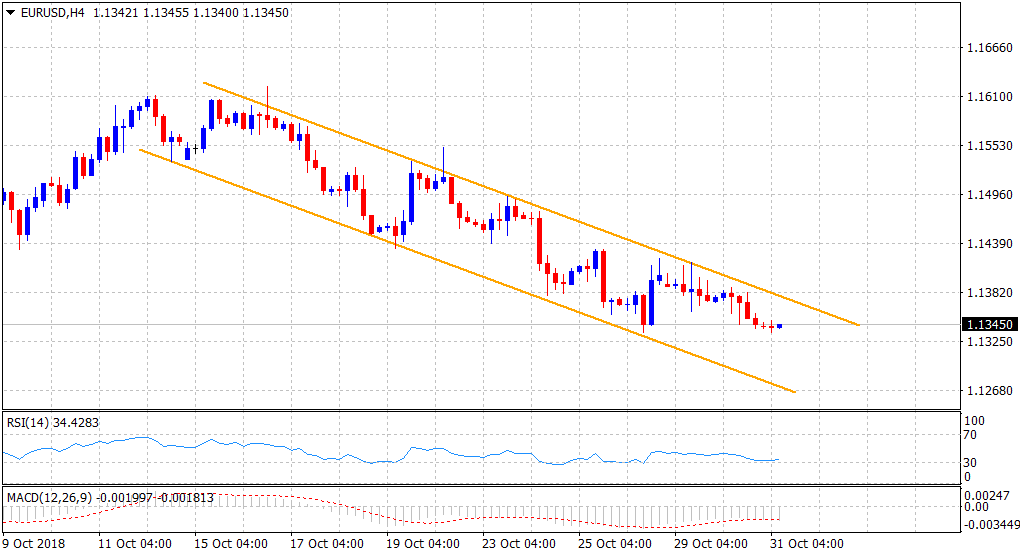
The EUR/USD pair now seems to have entered a bearish consolidation phase and was seen oscillating in a narrow trading range, just below mid-1.1300s through the Asian session on Wednesday. Market participants now look forward to the flash Euro-zone CPI print for October for some fresh impetus. Later during the early North-American session, the ADP report on the US private sector employment might influence the USD price dynamics and produce some short-term trading opportunities.
From a technical perspective, bearish traders now look for a sustained weakness through the 1.1335 immediate horizontal support, below which the pair is likely to accelerate the fall towards YTD lows, around the 1.1300 handle. A follow-through selling has the potential to continue dragging the pair further towards the 1.1270-65 region, support marked by the lower end of a short-term descending trend-channel formation on the 4-hourly chart.
On the flip side, any meaningful recovery attempt might now confront fresh supply near the 1.1375 region, trend-channel resistance, above which a bout of short-covering could lift the pair beyond the 1.1400 handle towards its next hurdle near the 1.1430 area.
Author

Haresh Menghani
FXStreet
Haresh Menghani is a detail-oriented professional with 10+ years of extensive experience in analysing the global financial markets.