EUR/USD Forecast: Bears hold the grip ahead of Powell

EUR/USD Current Price: 1.0527
- Manufacturing output in the Euro Zone contracted sharply in Q3.
- US ISM Manufacturing PMI and Chair Jerome Powell stand out in the American afternoon.
- EUR/USD resumed its decline after a modest upward correction, aims for lower lows.
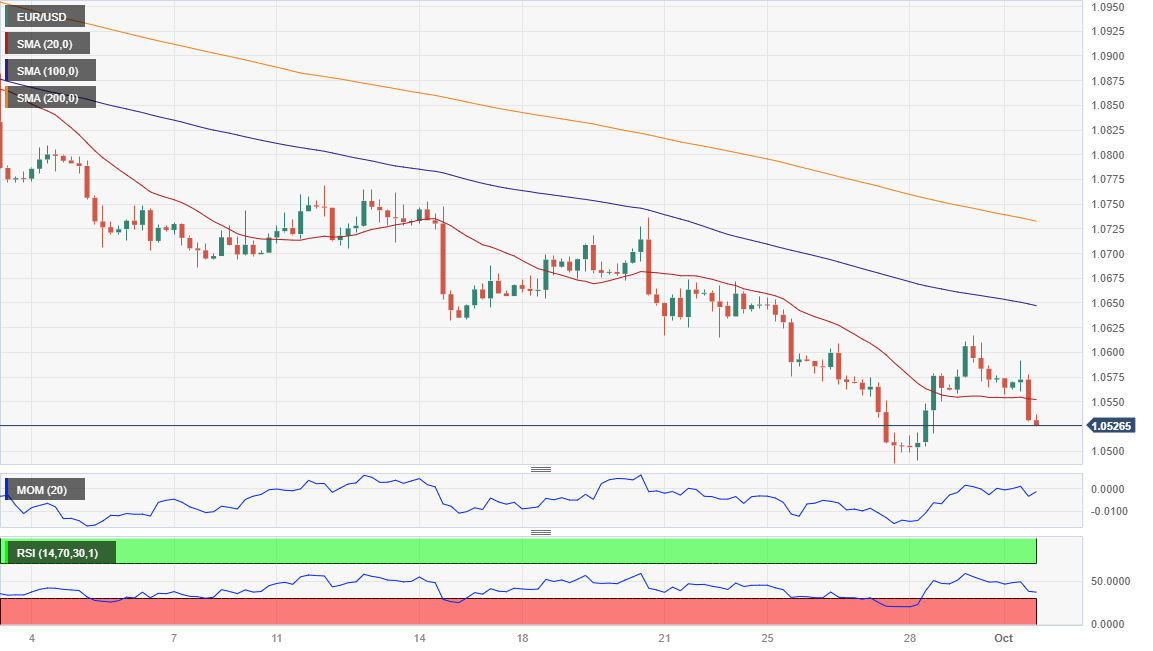
The EUR/USD pair resumed its decline on Monday, following a modest uptick at the beginning of the day. The pair peaked at 1.0591 ahead of London’s opening, to slide below the 1.0550 level ahead of Wall Street’s opening. The market mood was upbeat at the weekly opening. The United States (US) avoided a government shutdown after Congress concluded a last-minute agreement, while Chinese data was generally encouraging.
The country published the official NBS Manufacturing PMI on Saturday, which rose in August to 50.2 from 49.7 in the previous month. The Non-Manufacturing PMI improved in the same period from 51 to 51.7, beating expectations. Finally, the September Caixin Manufacturing PMI printed at 50.6, while the services index came in at 50.2, below the August readings but holding within expansionary territory.
Meanwhile, S&P Global released the final estimate of the Euro Zone September Manufacturing PMIs. The German index was downwardly revised to 39.6, while the EU index was confirmed at 43.4. S&P Global will later publish the US Manufacturing PMI, while the country will release the official index foreseen at 47.7, improving modestly from the previous 47.6. Additionally, Federal Reserve (Fed) Chairman Jerome Powell will participate in a round-table discussion with community members in York.
Finally, rallying US Treasury yields boosted demand for the US Dollar. The 10-year Treasury note yielded as much as 4.64%, the highest since 2007, while the 2-year note offers 5.10% ahead of the opening, up 5 basis points (bps).
EUR/USD short-term technical outlook
The daily chart for the EUR/USD pair favors a downward extension, as technical indicators resumed their slides within negative levels after correcting the oversold conditions reached last week. At the same time, the 20 Simple Moving Average (SMA) keeps heading south far above the current level while below the longer ones.
In the near term, and according to the 4-hour chart, the risk also skews to the downside. The pair fell through its 20 SMA, while the longer ones offer firmly downward slopes far above the current level. At the same time, technical indicators head south almost vertically, with the Momentum indicator holding above its 100 level but the Relative Strength Index (RSI) indicator hovering around 38, reflecting persistent selling interest.
Support levels: 1.0485 1.0440 1.0395
Resistance levels: 1.0560 1.0610 1.0660
Author

Valeria Bednarik
FXStreet
Valeria Bednarik was born and lives in Buenos Aires, Argentina. Her passion for math and numbers pushed her into studying economics in her younger years.
















