EUR/USD Forecast: A bumpy road lies ahead
- EUR/USD extended its rebound from yearly lows.
- ECB Vujcic said there is no rush to start cutting rates.
- The Fed’s tighter-for-longer narrative remains far from abated.

Following a negative start to the week, EUR/USD extended that pessimism and kept the trade near recent YTD lows in the 1.0725/20 band on turnaround Tuesday.
The pair’s bearish price action was accompanied by a vacillating mood surrounding the greenback against the backdrop of some small corrections in US yields across various maturities.
In the meantime, the timing of potential interest rate cuts by the Federal Reserve (Fed) continued to be at the centre of the debate among investors, with speculation for a March rate cut rapidly losing traction in favour of a May or even June cut.
It's important to remember that the recent increase in the pair’s downward trend occurred following Chair Jerome Powell's remarks indicating the Fed's intention to maintain a cautious stance on interest rate adjustments. Powell also emphasized the necessity for greater confidence before considering any reductions in interest rates.
Additionally, Powell underscored the importance of the Fed waiting for concrete evidence that inflation is consistently dropping to 2% while acknowledging the current robust state of the economy, which lowers the likelihood of a recession. The Fed remains vigilant in monitoring potential threats to stable prices and maximum employment and may contemplate expediting rate cuts if job growth weakens. Powell also highlighted the significance of striking a balance between acting prematurely or belatedly, prioritizing the tangible economy, and making decisions in the best interest of the long-term well-being of the American population.
Amid the ongoing discussion about the possible timing of an interest rate cut by the Federal Reserve, the likelihood of such an event taking place in March has significantly diminished to approximately 16%. However, the probability increases to around 52% in May and just above 40% at the June 12 event, as indicated by CME Group's FedWatch Tool.
From the European Central Bank (ECB), Board member De Cos expressed confidence in that inflation is heading back to the bank’s goal. He emphasized that the ECB adheres to its own evaluation rather than being swayed by market expectations. His colleague Vujcic reported that it is crucial for the ECB's credibility to be accurate regarding rate cuts. He suggested that the ECB should refrain from hastening the initiation of the rate-cutting cycle, noting that there is still significant resilience in services inflation and wages.
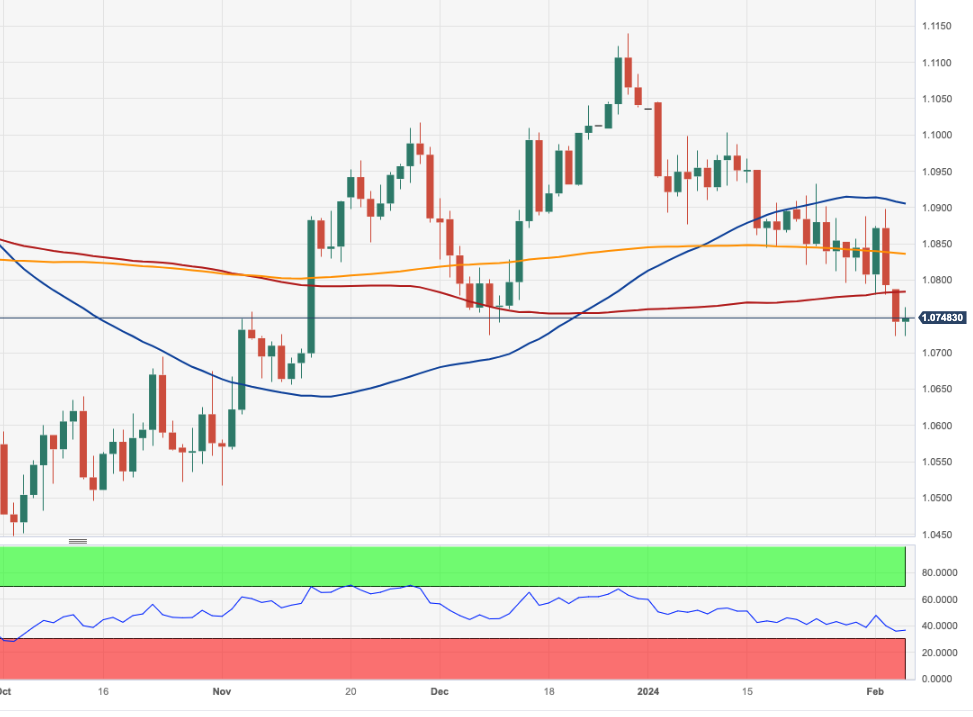
EUR/USD daily chart
EUR/USD short-term technical outlook
If EUR/USD breaches the 2024 bottom of 1.0722 (February 6), it could then set sails to the November 2023 low of 1.0516 (November 1), followed by the weekly low of 1.0495 (October 13, 2023), which comes before the 2023 low of 1.0448 (October 3) and the round level of 1.0400.
The pair's outlook is predicted to turn bearish if it consistently clears the important 200-day SMA (1.0835).
On the upside, spot must break above the weekly high of 1.0932 (January 24) to reach the next weekly top of 1.0998 (January 11), which would reinforce the psychological 1.1000 level. Further increases from here might pave the way for a possible push to hit the December peak of 1.1139 (December 28).
The four-hour chart shows a moderately unfavourable trend for the time being. South of 1.0722 now emerges 1.0656. Bullish efforts, on the other hand, may seek to test the 55-SMA at 1.0823 before moving on to the 100-SMA at 1.0853, all of which are above 1.0897. The MACD remains bearish, but the RSI recovers a tad above 33.
Author

Pablo Piovano
FXStreet
Born and bred in Argentina, Pablo has been carrying on with his passion for FX markets and trading since his first college years.
















