EUR/USD Falls to 7-Week Lows Following Dovish ECB Signals

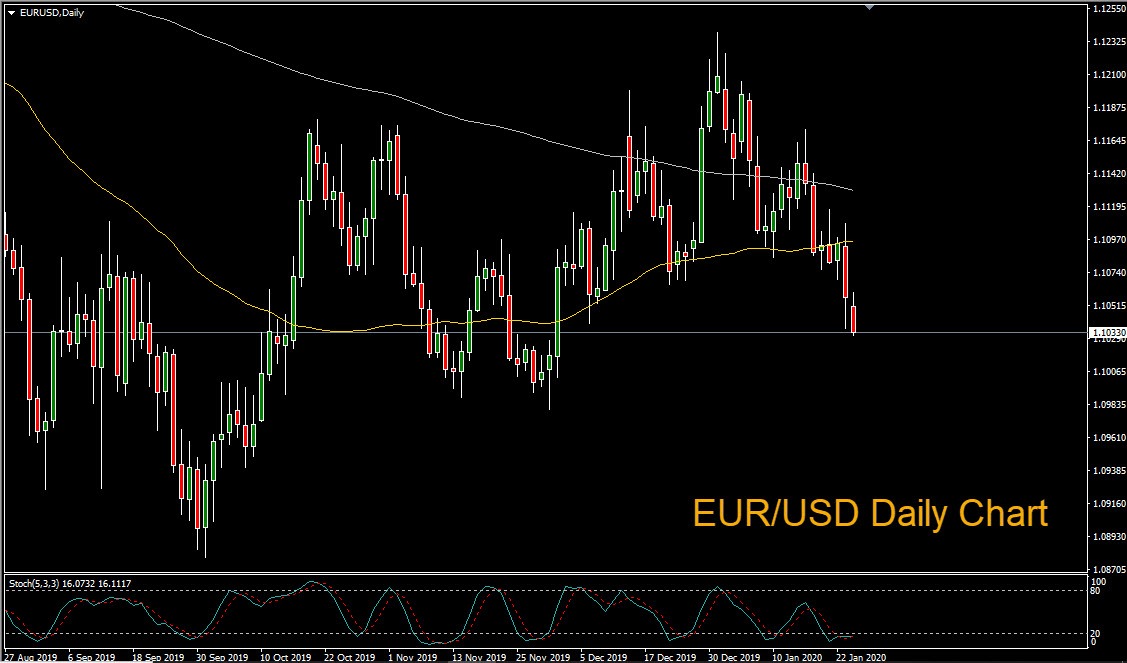
EUR/USD fell to its lowest level since December 2nd in Friday trading, after the European Central Bank (ECB) signaled a more dovish than expected outlook. On Thursday, the ECB reaffirmed its commitment to hold or even cut interest rates, while continuing bond purchases until euro zone inflation returns to its target level of just under 2%.
The ECB held its rate on overnight bank deposits at a record low of -0.50%. The main refinancing rate was kept unchanged at 0.00% while the rate on the marginal lending facility stayed at 0.25%.
Speaking at the conference after the meeting, ECB President Christine Lagarde cited downside risks to euro area economic growth. She stated: “The risks surrounding the euro area growth outlook, related to geopolitical factors, rising protectionism and vulnerabilities in emerging markets, remain tilted to the downside, but have become less pronounced as some of the uncertainty surrounding international trade is receding.”
On Friday, PMI data signaled a positive start to 2020 for business activity in the German private sector. IHS Markit’s Flash Composite Purchasing Managers’ Index (PMI) indicated that growth was up to 51.1 from 50.2 in December, a 5-month high.
However, Eurozone PMI data showed that Eurozone business activity remained muted at the start of the year. The Flash Eurozone PMI Composite Output Index came in unchanged at 50.9, while the Flash Eurozone Services PMI Activity Index fell to 52.2 from 52.8 in December.
Finally, at the World Economic Forum 2020 in Davos on Friday, Christine Lagarde cited concerns over Brexit and the deadline for the trade agreement. She stated: “Brexit is a little bit less uncertain, but we still have that possible cliff edge in December of 2020. We don’t know exactly what the trade relationship will be. And it’s a big partner for the euro area, so that’s certainly a question mark.”
Author
Dan Blystone
TradersLog.com
Experience Dan Blystone began his career in the trading industry in 1998. He worked as an arb clerk on the floor of the Chicago Mercantile Exchange (CME), flashing orders into the currency futures pits.