EUR/USD – Euro makes push towards 1.15, German manufacturing data slips

EUR/USD has posted slight losses in the Tuesday session, after starting the week with considerable gains. Currently, the pair is trading at 1.1455, down 0.17% on the day. On the release front, there are no major events. German industrial production produced a sharp decline of 1.9%. The U.S releases JOLTS Job Openings, which is expected to tick lower to 7.07 million. On Wednesday, the eurozone releases the unemployment rate and the Federal Reserve will publish the minutes of its December meeting, when it raised interest rates for the fourth time in 2018.
The U.S. dollar was broadly lower on Monday, as fallout from Fed Chair Powell’s recent remarks continues to weigh on the greenback. Powell engaged in some damage control, seeking to reassure the financial markets that was listening to market concerns about continuing to tighten policy. The markets had given Powell a thumbs-down after the Fed’s December rate statement was on the hawkish side, and stocks plummeted. Powell was dovish in his remarks, saying that he was aware of the risks of a slowdown in the U.S. economy and that the Fed would be patient in its policy decisions.
The Fed seems to be lowering expectations for additional rate hikes. Recent Fed forecasts have indicated two rate increases next year, but on Monday, Atlanta Fed President Raphael Bostic said that the economy would need only one rate hike. Some analysts have gone further, projecting a rate cut in 2019, which has put a chill on sentiment towards the U.S. dollar.
The German manufacturing sector has taken a hit due to ongoing global trade war, and this week’s manufacturing numbers are pointing to a slowdown. On Monday, Factory Orders fell 1.0%, well of the estimate of -0.2%. This was followed by a decline of 1.9% in Industrial Production, much weaker than the forecast of 0.3%. This marked the fifth decline in the past six months. Unless the ongoing trade war eases soon, we can expect German manufacturing data to struggle.
The Powell “Put” continues to resonate
A bit of the feel-good factor has temporarily abated
EUR/USD Fundamentals
-
2:00 German Industrial Production. Estimate 0.3%. Actual -1.9%
-
2:45 French Trade Balance. Estimate -4.9B. Actual -5.1B
-
6:00 US NFIB Small Business Index. Estimate 103.1
-
10:00 US JOLTS Job Openings. Estimate 7.07M
-
15:00 US Consumer Credit. Estimate 17.3B
-
2:00 German Trade Balance. Estimate 17.6B
-
5:00 Eurozone Unemployment Rate. Estimate 8.1%
-
Tentative – German 10-year Bond Auction
-
14:00 US FOMC Meeting Minutes
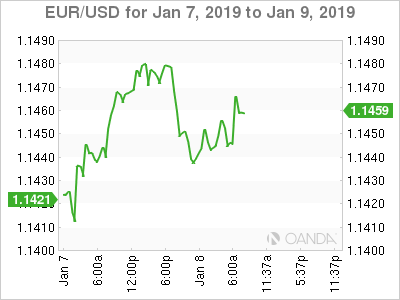
Open: 1.1447 High: 1.1485 Low: 1.1432 Close: 1.1455
EUR/USD Technical
|
S1 |
S2 |
S1 |
R1 |
R2 |
R3 |
|
1.12112 |
1.1300 |
1.1434 |
1.1553 |
1.1685 |
1.1803 |
EUR/USD edged lower in the Asian session and is flat in the European trade
-
1.1434 was tested earlier in support and remains a weak line
-
1.1553 is the next resistance line
-
Current range: 1.1434 to 1.1533
Further levels in both directions:
-
Below: 1.1434, 1.1300, 1.1212 and 1.1120
-
Above: 1.1553, 1.1685 and 1.1803
Author

Kenny Fisher
MarketPulse
A highly experienced financial market analyst with a focus on fundamental analysis, Kenneth Fisher’s daily commentary covers a broad range of markets including forex, equities and commodities.

















