|

EUR/USD Elliott Wave: New yearly low opens the door for further downside [Video]

EUR/USD has finally hit a new low for the year, which we thought would happen sooner or later. As you know, we initially expected this breakdown to come from a triangle, but the decline became much stronger and more extended after price broke out of the base channel on September 16, so it is not surprising that we are now seeing new yearly lows.
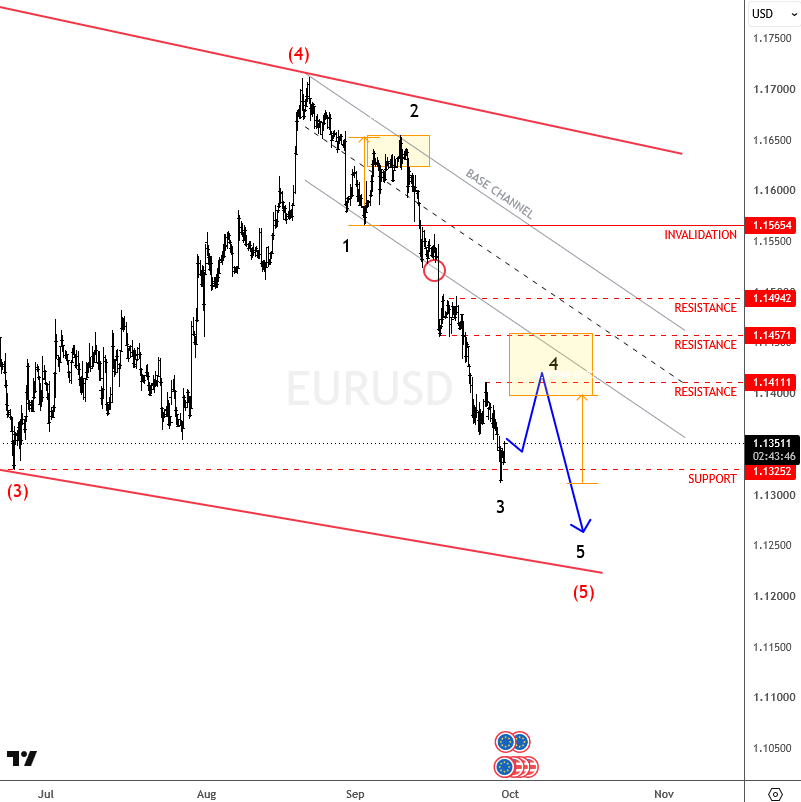
eurusd4h
EURUSD 4H Chart

The bearish impulse still looks incomplete, suggesting that more weakness could follow. However, with price now at a new yearly low, some stabilization is possible. Ideally, we could see a wave four recovery, potentially similar in size to wave two, with resistance around 1.1400–1.1460. This could be an interesting area from where the market may resume lower while price remains below the 1.1565 invalidation level.
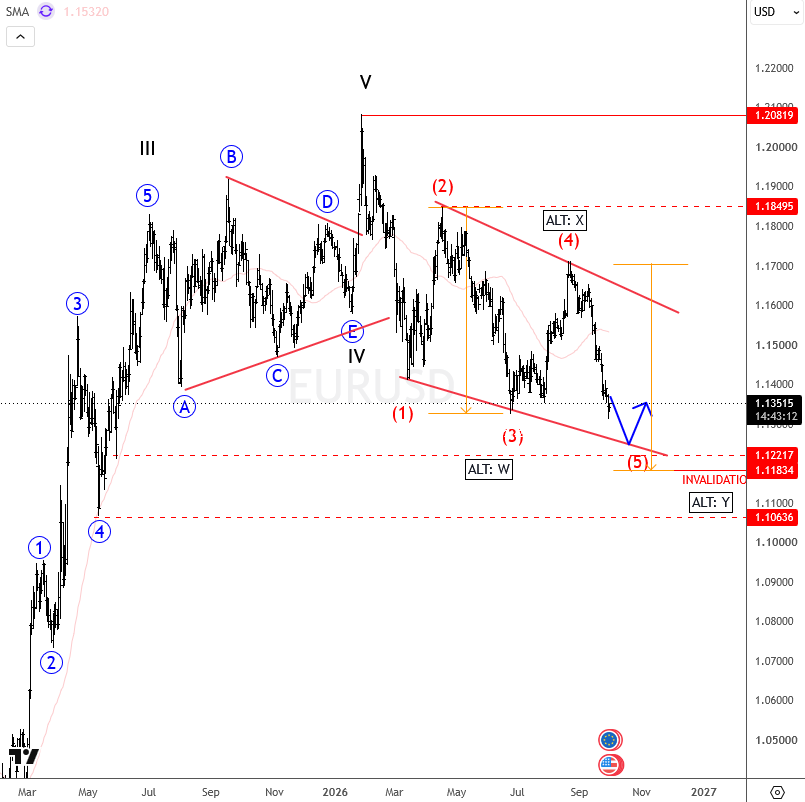
eurusdD
EURUSD Daily Chart

If we are correct, then on the higher-time-frame daily chart, we could now be in wave five, targeting the lower trend line of a potential leading diagonal. Alternatively, the decline could still be part of wave A of a second zigzag.

For more analysis like this, you can watch below our latest recording of a live webinar streamed on September 28:

Youtube preview

Get Full Access To Our Premium Elliott Wave Analysis For 14 Days. Click here.

Author

Gregor Horvat

Gregor Horvat

Wavetraders

Experience Grega is based in Slovenia and has been in the Forex market since 2003.

More from Gregor Horvat
Share:

Editor's Picks

AUD/USD keeps range near 0.6950 after Australian trade data

AUD/USD consolidates near a two-month low, trading around mid-0.6900s in the Asian session on Thursday amid a bullish US Dollar. The US PCE data tempered October Fed hike bets, though oil-driven inflation fears remain supportive of elevated US bond yields. Meanwhile, Australia's trade surplus shrank sharply in August to AUD495M, having limited impact on the Aussie Dollar and the pair.


USD/JPY sits at weekly top above 158.00 as bullish USD counters intervention risks

USD/JPY is sitting at the top end of its weekly range above 158.00 in the Asian session on Thursday. Despite the softer US PCE data, oil-driven inflation risks keep US bond yields elevated near multi-year highs. Moreover, the US-Iran standoff benefits the safe-haven US Dollar and supports the pair. Broad US Dollar strength counters hawkish BoJ expectations and Japanese intervention risks.

Gold fails ahead of $4,200 as surging US yields and Iran risks lift USD closer to YTD top

Gold struggles to capitalize on a modest intraday move up to the $4,200 neighborhood, trading nearly unchanged for the day during the first half of the European session. Despite softer-than-expected US inflation data on Wednesday, US Dollar buying remains unabated as US bond yields continue scaling new multi-year highs. This is seen as a key factor undermining demand for the non-yielding bullion.

Hyperliquid pares gains as ETF outflows cap tentative bullish recovery

Hyperliquid (HYPE) is down 2% at press time on Thursday, trimming its 5% gains from the previous day. Institutional demand is easing, with $5 million in outflows on Wednesday, weighing on near-term investors' sentiment. The technical outlook for HYPE indicates a near-term mixed tone as the price remains capped below $90.

The Euro is near a one-year low: Inflation could trigger its rebound, not its fall

EUR/USD has fallen to its lowest level since May 2025, but a fresh inflation shock in the Eurozone could give the Euro an unexpected lifeline. The pair hit 1.1312 on Wednesday and trades well below the January peak of 1.2082. The decline reflects a powerful combination of US Dollar strength, geopolitical uncertainty and renewed concerns about Europe's exposure to higher energy prices.

The Euro is near a one-year low: Inflation could trigger its rebound, not its fall

EUR/USD has fallen to its lowest level since May 2025, but a fresh inflation shock in the Eurozone could give the Euro (EUR) an unexpected lifeline. The pair hit 1.1312 on Wednesday and trades well below the January peak of 1.2082.