EUR/USD analysis: pressuring 1.2500 ahead of US Nonfarm Payroll report

EUR/USD Current price: 1.2487
- EU manufacturing sector's growth entered 2018 maintaining its solid pace.
- US Nonfarm Payroll report expected to show 180K new jobs in January.
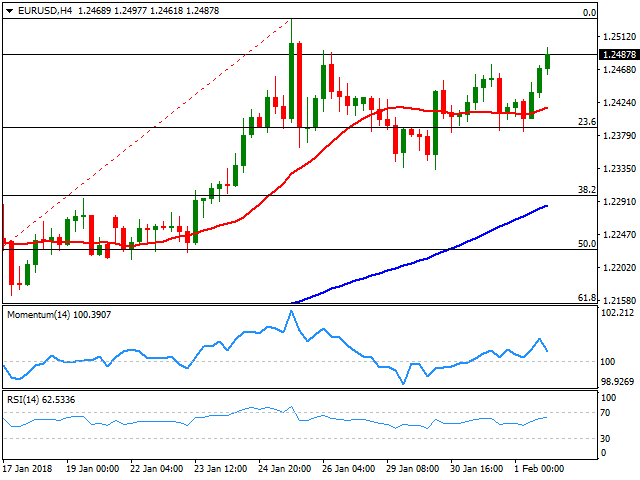
The EUR/USD pair resumed its advance this Thursday, ignoring US positive macroeconomic figures and reaching a fresh weekly high of 1.2497 mid-US afternoon, holding nearby ahead of the Asian opening. There was no particular catalyst for dollar's decline, and in fact, the American currency managed to advance against some of its rivals, as the rally in T-yields persisted. For sure, the common currency got support in local data, as the final January Markit Manufacturing PMI for the EU was confirmed at 59.6 with growth in the sector holding near record highs. But US data were also upbeat, as the final January Markit Manufacturing PMI held at 55.5 against an expected revision to 54.9, while the official ISM PMI also beat expectations by printing 59.1. Weekly unemployment claims, for the week ended January 26 resulted at 230K, better than the expected 238K. Unit labor costs surged 2.0% in the last quarter of 2017, much better than the expected 0.8%, although Nonfarm Productivity disappointed, down 0.1% against a 1.0% advance expected. Investors are now focused on the US NFP report, to be released early Friday. The US economy is expected to have added 180K new jobs in January, while the unemployment rate is seen steady at 4.1%. Wages are expected to post a modest uptick from December numbers, nothing that can impress market's participants or trigger solid dollar's demand.
The pair holds on to gains after flirting with the 1.2500 figure, although short-term technical readings continue indicating that the upward momentum is limited, mostly due to the pair being ranging ever since the day started. Nevertheless, it remains above the 23.6% retracement of its January rally, and in the 4 hours chart, is now moving away from its 20 SMA for the first time this week. Technical indicators in the mentioned chart lack upward strength but hold within positive territory. The multi-year high of 1.2535 is a key resistance for this Friday, as a break above the level on poor US data, will likely see the pair nearing 1.2600 ahead of the weekly close.
Support levels: 1.2440 1.2400 1.2360
Resistance levels: 1.2500 1.2535 1.2580
Author

Valeria Bednarik
FXStreet
Valeria Bednarik was born and lives in Buenos Aires, Argentina. Her passion for math and numbers pushed her into studying economics in her younger years.

















