|

EUR/USD analysis: no signs of bottoming yet

EUR/USD Current price: 1.0592

The market kept buying the greenback for a second consecutive week, pushing the EUR/USD pair to a fresh year low of 1.0568 on Friday. Demand for dollar assets, triggered by Trump´s victory and hopes his growth policies will send inflation higher, sent the dollar index to its highest close since 2003, up 2.15% for the week at 101.32. FED's Chair, Janet Yellen, said this past week that a rate hike could take place "relatively soon,"  fueling dollar's rally, alongside with positive local data, including the CPI that rose in October by 0.5% from a year earlier, at the fastest rate of growth in two years, whilst weekly unemployment claims fell to 235K, the lowest reading since November 1973.
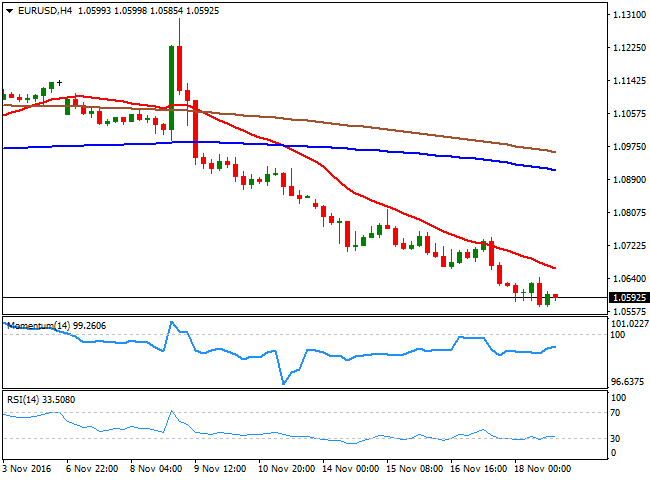
Still, the movement seems quite overstretched, as the EUR/USD pair has fallen for ten days in-a-row, as a December hike has been fully priced in. A corrective movement should not be dismissed, although is yet to be seen if that could be enough to revert the dominant bearish trend. Technically, the daily chart shows that indicators maintain the strong bearish strength, despite being in extreme oversold territory, suggesting the pair may extend its slide, down to 1.0505 first, December 2015 monthly low, and 1.0460 later, the lowest for 2015. In the 4  hours chart, a bearish 20 SMA has been steadily rejecting advances for the last two weeks, while technical indicators are consolidating within negative territory, supporting a downward extension on a break below 1.0560, the immediate support.

Support levels: 1.0560 1.0505 1.0460

Resistance levels: 1.0640 1.0690 1.0720

View Live Chart for the EUR/USD

Author

Valeria Bednarik

Valeria Bednarik was born and lives in Buenos Aires, Argentina. Her passion for math and numbers pushed her into studying economics in her younger years.


More from Valeria Bednarik
Share:

Editor's Picks

AUD/USD holds above 0.6950 as bullish USD caps gains

AUD/USD edges lower during the Asian session on Tuesday, stalling a two-day recovery move from a two-month low, touched last week. An extended rout in the fixed income market keeps US bond yields elevated near multi-year highs. This, along with geopolitical uncertainties, helps the US Dollar retain its bullish tone despite receding October Fed hike bets. However, expectations for another RBA rate hike this month could act as a tailwind for the Aussie.

USD/JPY rises back above 158.00 despite hawkish BoJ outlook

USD/JPY rises back above 158.00 in the early European morning on Tuesday. The pair strengthens as the Japanese Yen fails to find any inspiration from hawkish BoJ expectations and looming intervention risks. Meanwhile, geopolitical uncertainty and elevated US bond yields keep the US Dollar near its YTD high despite receding October Fed hike bets. This, in turn, helps the pair stay supported.

Gold seems vulnerable near two-month low amid strong USD, higher US bond yields

Gold sticks to modest intraday losses heading into the European session, though it holds above the $4,100 mark, a two-month low touched earlier this Tuesday. The US Dollar retains its bullish tone and continues to undermine demand for the commodity. However, receding bets for an October Fed rate hike act as a tailwind for the non-yielding bullion and help limit further losses.

Ripple and Stellar weaken as derivatives positioning fades
Ripple (XRP) and Stellar (XLM) face pressure trading below $1.499 and $0.220, respectively, on Tuesday after a modest correction at the start of the week. Traders should be cautious as weakening derivatives metrics and fading bullish momentum suggest further corrections for XRP and XLM. Derivatives data shows a weakening and cautious signal among traders.
Europe in focus as French and Spanish politics drive sentiment

There are no tier-1 releases today. Focus will remain on developments in the European markets and geopolitical developments in the Middle East. In France, the key issue in the coming days will be whether the Socialists and Marine Le Pen's National Rally signal they are willing to topple the government over the budget.

Eurozone inflation just hit 3.8%, its highest in three years. This chart shows why the ECB can’t simply hike its way out

The ECB would normally have a relatively straightforward answer to inflation running almost twice its target: raise interest rates. But these are not normal circumstances. This time, the bond market is already doing part of the tightening for it, leaving the ECB facing an increasingly difficult dilemma.