EUR/USD analysis: near its weekly high, but bulls cautious

EUR/USD Current price: 1.1910
- EU inflation, German retail sales disappointed, but the EUR is up anyway.
- US data marginally positive, but inflation still sluggish.
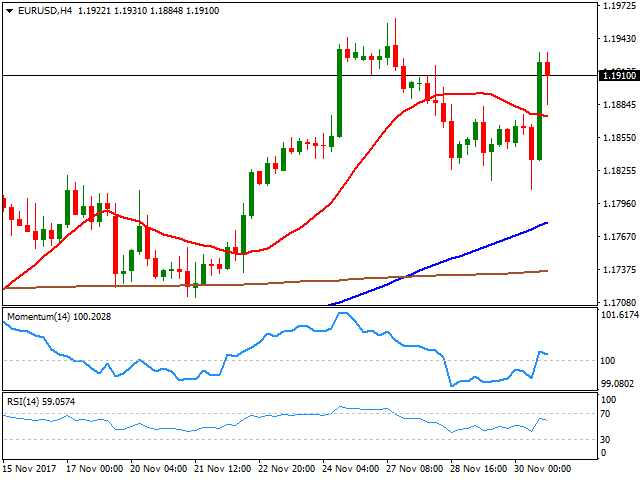
The EUR/USD pair regained the 1.1900 level after the US opening and advanced up to 1.1931, as dollar buyers gave up. The greenback started the day with a positive footing, steady through the Asian session and up in the European one, helped by softer-than-expected EU inflation data. According to the official release, Euro area annual inflation is expected to be 1.5% in November 2017, up from 1.4% in October, but below the expected 1.6%. The core reading is expected to remain unchanged at 0.9% against expectations of 1.1%. Also, German retail sales unexpectedly fell in October, down 1.2% in the month and by 1.4% when compared to a year earlier, well below the expected 2.8% advance. The headlines pushed the pair to a daily low of 1.1808, from where it later recover with no defined catalyst behind it. US data was generally encouraging and in-line with market's expectations but failed to give the greenback a so needed boost. Unemployment claims fell to 238K for the week ended November 24th, better than the 240K expected. Personal spending in October matched market's expectations with a 0.3% gain, while Personal income rose by 0.4%, slightly above the 0.3% forecasted. The PCE price index was up by 1.6% in October, although the core figure disappointed, steady at 0.2%, indicating that inflation remains sluggish, therefore putting on doubt 2018 rate hikes.
The pair holds on to gains ahead of the Asian opening and Friday's data, when Markit will release the final versions of European and US manufacturing PMIs. In the meantime, the pair turned back neutral short-term, given that in the 4s hour chart, the price is holding just a handful of pips above a bearish 20 SMA, while technical indicators turned south within positive territory, now nearing their mid-lines. The pair is midway of its weekly range, clearly showing the absence of a defined trend. Whereas above 1.1960 or below 1.1790 the outlook will be more defined, seems the market will wait for December Fed and ECB's monetary policy announcements before choosing a side.
Support levels: 1.1860 1.1820 1.1785
Resistance levels: 1.1930 1.1960 1.2000
Author

Valeria Bednarik
FXStreet
Valeria Bednarik was born and lives in Buenos Aires, Argentina. Her passion for math and numbers pushed her into studying economics in her younger years.
















