EUR/USD analysis: Dollar smashed by US political turbulence

EUR/USD Current price: 1.2410
- US Secretary Mnuchin nailed the dollar's coffin by celebrating a weaker USD.
- ECB's meeting up next: no changes expected but Draghi expected to express concerns about stronger EUR.
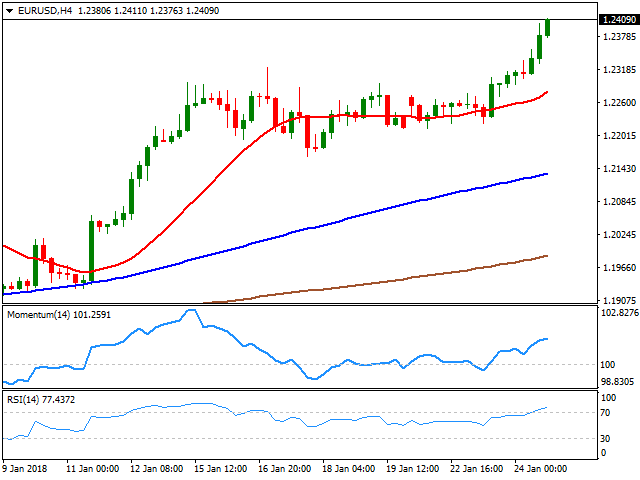
The EUR/USD pair up roared to a fresh multi-year of 1.2411 during US trading hours, as the greenback got smashed by US political turbulence. After a three-day Government shutdown, Trump announced a series of tariffs, aimed to protect American companies from cheap foreign exports, triggered Chinese "strong dissatisfaction" on words of the Chinese Commerce Ministry, although the measures affect the world's largest economy relationship with multiple trade partners. Trump's inclination toward protectionism is no news, but this is indeed is a strong measure that puts the USD one step further away from any chance of strengthening. US Treasury Secretary Mnuchin said that a weaker dollar is good for US trade, adding fuel to the fire.
This Wednesday, the release of the EU January preliminary Markit PMIs showed that the services sector started the year with a strong footing, beating expectations and leading to an over 11-year peak in the composite index for the region of 58.6, up from the previous 58.1. The manufacturing sector grew by less-than-expected according to the same report, but activity holds near record levels. In the US, the situation inverted, as the manufacturing index resulted at 55.5, beating expectations of 55.0, while the service sector lagged, with the index down to 53.3 from the previous 53.7, also below market's forecast. However, the worst surprise came from US Existing Home Sales that fell by 3.6% in December, against a 2.2% drop expected. Investors' attention this Thursday will center on the ECB's monetary policy meeting, with the bank largely expected to maintain the status-quo and attempt to control somehow EUR's strength.
The technical picture is bullish ahead of Asian opening, with the pair holding near the mentioned multi-year high, and despite extreme overbought readings and the upcoming risk event. The 4 hours chart shows that the price has moved well above a now bullish 20 SMA, while technical indicators have reached overbought territory before losing upward strength, anyway consolidating, far from signaling a possible correction ahead. Higher highs are likely for the upcoming sessions, with 1.2460 becoming a possible short-term target. Profit-taking ahead of ECB's meeting is not out of question for late Asia/early Europe.
Support levels: 1.2370 1.2325 1.2280
Resistance levels: 1.2425 1.2460 1.2500
Author

Valeria Bednarik
FXStreet
Valeria Bednarik was born and lives in Buenos Aires, Argentina. Her passion for math and numbers pushed her into studying economics in her younger years.
















