EUR/USD analysis: dollar bulls seize every chance

EUR/USD Current price: 1.1469
- EUR under pressure despite Italian PM Conte saying they won't leave the eurozone.
- EUR/USD heading into the Asian session near October low at 1.1431.
The American dollar gained throughout the European and American sessions, despite the flips in the market's mood. Risk appetite dominated the first half of the day, led by Chinese shares, with the Shanghai Composite up roughly 4.0%, which led to gains in its overseas counterparts. The greenback was also boosted by political concerns in the Old Continent, with Brexit and the Italian budget turmoil dominating the news. Wall Street kicked off with a strong opening, which quickly faded, although the greenback continued strengthening against most rivals. Meanwhile, concerns around Italy eased after PM Giuseppe Conte told reporters "read my lips," Italy won't leave the eurozone, despite the dispute over the budget, adding a pledged to keep 2019 deficit below the 2.4% of GDP.
The macroeconomic calendar was quite scarce, with no relevant releases in the EU and the US just offering the Chicago Fed National Activity Index for September came in at 0.17, while August reading was upwardly reviewed to 0.27 from 0.18. This Tuesday, Germany will release its September PPI, the EU will offer preliminary Consumer Confidence for October while the US will release the Richmond Fed Manufacturing Index for the same month, expected at 25 vs. the previous 29.
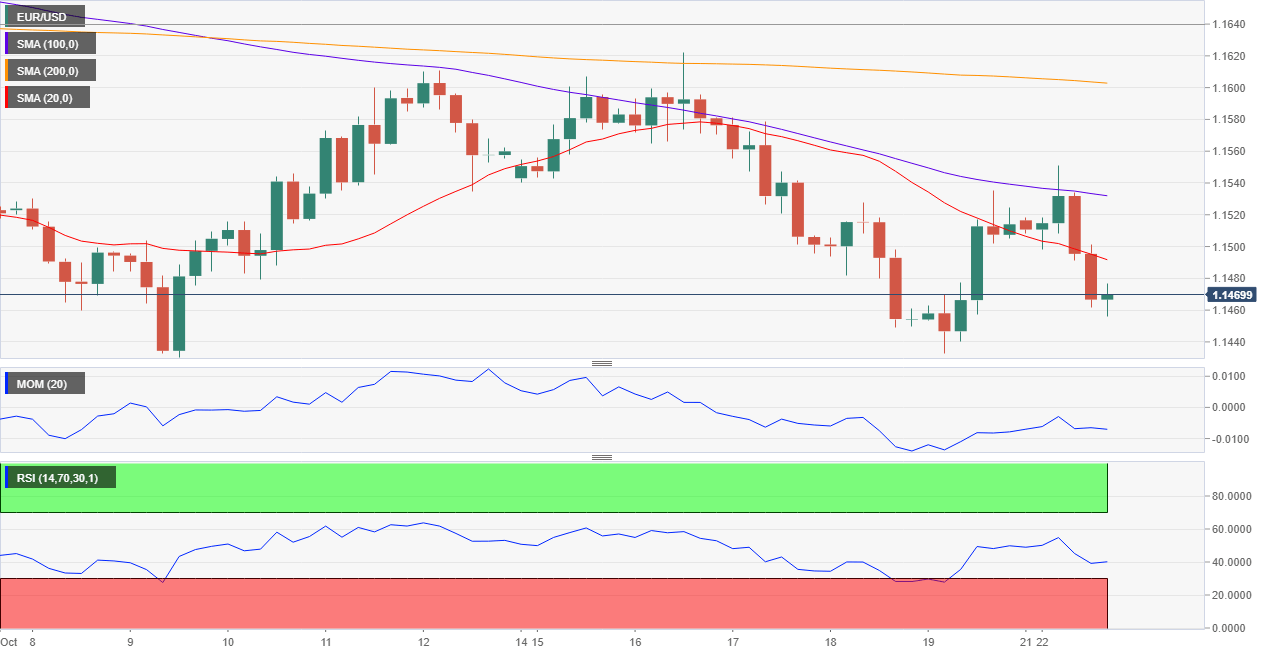
The EUR/USD pair neared the monthly low at 1.1430 after trading as high as 1.1549 with a markedly bearish stance according to intraday technical readings, as the 4 hours chart shows that an early attempt to advance was rejected by sellers aligned around a bearish 100 SMA, with the pair now also below the 20 SMA. Technical indicators in the mentioned chart entered bearish ground mid-European morning, holding below their midlines, and with the RSI still heading south, in line with additional slides ahead, particularly on a break below the mentioned 1.1430 level. The Momentum indicator turned modestly higher, rather following the price than suggesting the end of the downward move.
Support levels: 1.1430 1.1400 1.1365
Resistance levels: 1.1490 1.1525 1.1575
Author

Valeria Bednarik
FXStreet
Valeria Bednarik was born and lives in Buenos Aires, Argentina. Her passion for math and numbers pushed her into studying economics in her younger years.