|

EUR/USD Analysis: bulls face key resistance around 1.1240

EUR/USD Current price: 1.1227

  • EU Q1 GDP and German April inflation surprised to the upside.
  • USD under pressure ahead of Fed's monetary policy meeting this Wednesday.
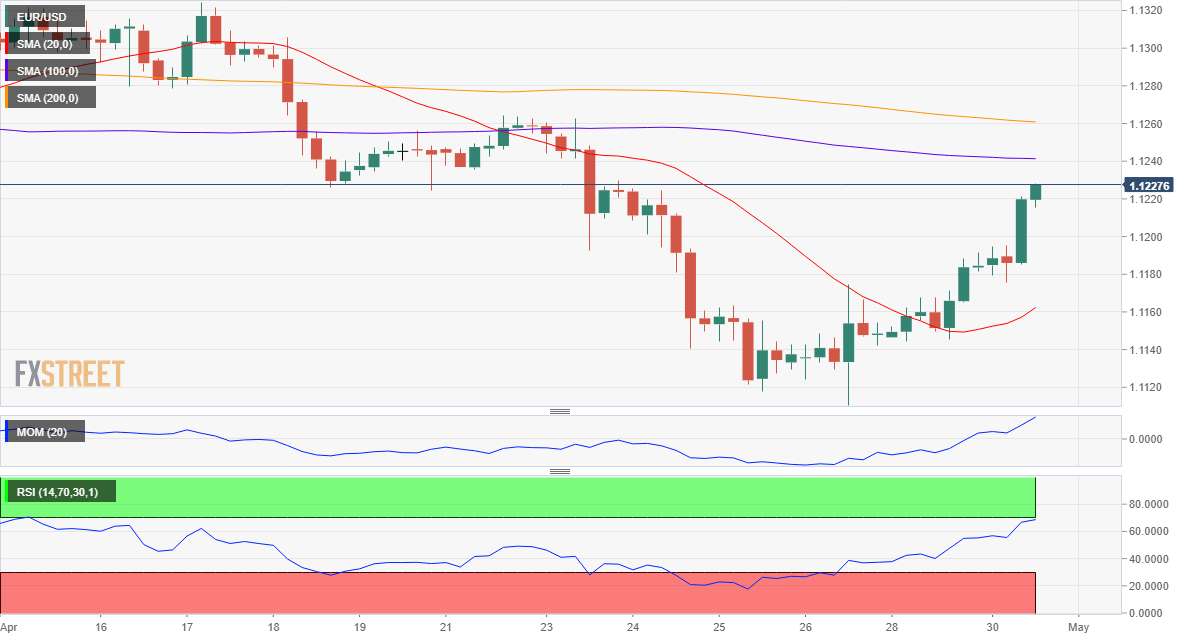
The EUR/USD pair advanced past 1.1200, as dollar's selling intensified ahead of the US Federal Reserve announcement on monetary policy this Wednesday, also backed by upward surprises in European data. The German GFK Consumer Confidence Survey for May came in unchanged at 10.4, but the preliminary estimate of EU Q1 GDP printed 0.4%, better than the 0.3% expected and above the previous 0.2%, giving signs that the economic slowdown may have receded. German preliminary April inflation was quite strong, up by 2.1% YoY, when harmonized with EU.

The US released Q1 Employment Cost Index, which remained steady at 0.7%. Pending of release are the CB Consumer Confidence Index, and Pending Home Sales. Meanwhile, US equities are poised to open sharply up, skewing the risk in favor of the EUR when it comes to the EUR/USD pair.

The EUR/USD pair is pressuring a daily high of 1.1228 and seems ready to extend its advance. It has surpassed the 50% retracement of its latest daily decline, with the 61.8% retracement of the same slide providing an immediate resistance around 1.1240. In the 4 hours chart, the 100 SMA converges with the Fibonacci resistance, while the 20 SMA turned higher below the current level. Technical indicators continue advancing firmly within positive levels, now nearing overbought territory, although with no signs of exhaustion. Failure at around 1.1240 should be a big warning for bulls.

Support levels: 1.1190 1.1155 1.1110

Resistance levels: 1.1245 1.1280 1.1310

View Live chart for the EUR/USD

Author

Valeria Bednarik

Valeria Bednarik was born and lives in Buenos Aires, Argentina. Her passion for math and numbers pushed her into studying economics in her younger years.


More from Valeria Bednarik
Share:

Editor's Picks

AUD/USD turns lower toward 0.7000 after mixed Australian jobs data

AUD/USD is losing ground toward 0.7000 in the Asian session on Thursday, following the release of the Australian August jobs report, which showed that the Unemployment Rate rose to 4.6% versus 4.5% expected, while Employment Change beat estimates, arriving at 39.5K. Traders also remain unnerved ahead of the critical Trump-Xi meeting.

USD/JPY eyes breakout above 200-SMA, near mid-158.00s amid bullish USD

USD/JPY sits near a three-week high, around the 158.35 zone during the Asian session on Thursday. The BoJ's dovish rate hike last week undermined the Japanese Yen, while the US Dollar preserves overnight gains to a two-month high amid hawkish Fed bets and elevated US bond yields. This favors bulls, though intervention fears could cap the upside.

Gold consolidates below $4,300 as bears await Trump-Xi meeting

Gold struggles below $4,300 during the Asian session on Thursday and seems vulnerable amid a bearish fundamental backdrop. US bond yields rallied to fresh multi-year highs amid rising Fed rate-hike bets, helping the US Dollar preserve Wednesday’s strong gains to a nearly two-month high and undermining the non-yielding bullion. Bears, however, seem hesitant ahead of the Trump-Xi meeting.

Bitcoin rallies above major cost bases as bulls eye $96K resistance
Bitcoin (BTC) has moved above several cost bases, strengthening the structure of its recent recovery as selling pressure remains relatively subdued. In a report on Wednesday, Glassnode stated that Bitcoin’s latest move is notable because the top crypto has recovered above the True Market Mean at roughly $77,000 and the Short-Term Holder (STH) Cost Basis.
Oil price rise weighs on stocks

Rising oil prices and higher yields have thrown the equity rally off track. After the risk-on start to the week renewed gains for oil prices and yields have weighed on indices.

BoJ Recap: Not as hawkish as expected

The Bank of Japan (BoJ) raised its short-term interest-rate target to 1.25% from 1.00% in a 7-2 vote, marking another step in the normalisation of monetary policy and widely matching what everyone has been expecting for weeks.













