|

EUR/USD analysis: 1.1800 likely on a disappointing Fed

EUR/USD Current price: 1.1655

The EUR/USD pair recovered some ground this Tuesday, ending the day marginally higher at 1.1655, but not before setting a fresh almost 2-year high of 1.1711. A bout of dollar selling took place ahead the US opening, with no certain catalyst behind the move, yet as usual, data coming from Europe was stronger-than-expected, whilst in the US, macroeconomic releases were mixed, once again with numbers below expected. Early Europe, the release of the German IFO survey showed that local business confidence rose in July to a new record high, with the index reaching 116.0 from 115.2 in June, reflecting the strong momentum in the local economy. In the US, house prices rose in May by less than expected, rising by 5.7% when compared to a year earlier, although the Richmond manufacturing index rose from 7 to 14 in July.
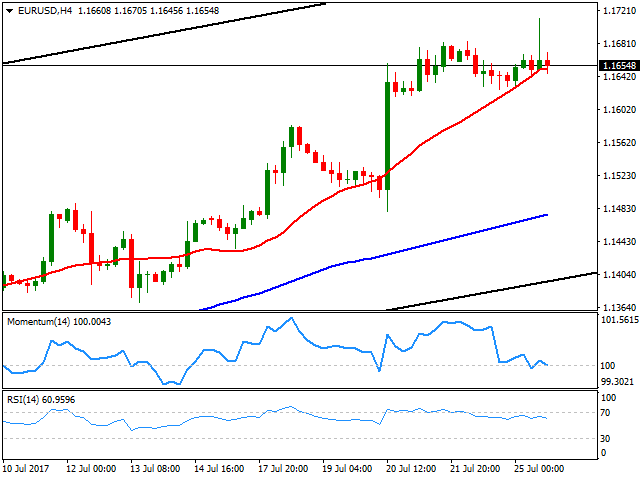
The retracement from the mentioned high was a consequence of profit taking as the Fed looms, rather than diminishing buying interest around the pair, as despite the US Federal Reserve is expected to keep its monetary policy unchanged, it could make some sort of announcement, particularly related to reducing the balance sheet.

Anyway, and from a technical point of view, the bullish trend prevails, with the EUR/USD pair developing within an ascendant channel, coming from mid April, although in the short term, the stance is neutral, as the price barely holds above a bullish 20 SMA, whilst technical indicators lose upward momentum within positive territory. The 2015 yearly high was 1.1713, and a break above the level could see the pair approaching to the 1.1800 figure, where the pair has the 200 SMA in the weekly chart, and the top of the current bullish channel.

Support levels: 1.1615 1.1580 1.1530

Resistance levels 1.16600 1.1710 1.1745

View Live Chart for the EUR/USD

Author

Valeria Bednarik

Valeria Bednarik was born and lives in Buenos Aires, Argentina. Her passion for math and numbers pushed her into studying economics in her younger years.


More from Valeria Bednarik
Share:

Editor's Picks

AUD/USD: Next upside target comes at 0.7000

AUD/USD has advanced further, clinching its third consecutive day of gains and trading at shouting distance from the key 0.7000 threshold on Tuesday. The widespread improved sentiment in the risk complex helped the Aussie maintain its upside momentum, while the fresh selling impulse in the Greenback also contributed to the move.

USD/JPY rises back above 158.00 despite hawkish BoJ outlook

USD/JPY rises back above 158.00 in the early European morning on Tuesday. The pair strengthens as the Japanese Yen fails to find any inspiration from hawkish BoJ expectations and looming intervention risks. Meanwhile, geopolitical uncertainty and elevated US bond yields keep the US Dollar near its YTD high despite receding October Fed hike bets. This, in turn, helps the pair stay supported.

Gold stays firm; looks at $4,200

Gold builds on Monday’s marginal bounce, although it struggles to reclaim the key $4,200 mark per troy ounce so far on Tuesday. The yellow metal’s advance comes on the back of the fresh downside momentum in the US Dollar in tandem with retreating US Treasury yields across the curve.

Ethena Price Forecast: ENA corrects as Ether.Fi launches stablecoin on the protocol
Ethena (ENA) trades near $0.24000 on Tuesday amid growing technical weakness. The Ethereum Layer-2 token has shed some of its recent gains, which peaked at $0.2946 on September 27, reinforcing profit-taking and buyer exhaustion. An extended sell-off would bring ENA to test the psychological support at $0.2000 and key technical levels further down.
Japanese Yen nears 158.00: Two analysts agree it's bullish, and disagree on how far the breakout goes

The JPY is drifting near 158.00 against the USD ahead of a busy week of Japanese data and a still-unclear BoJ timetable. The two most recent FXStreet analyses agree on the direction, but they disagree on the target and the mechanism.

Eurozone inflation just hit 3.8%, its highest in three years. This chart shows why the ECB can’t simply hike its way out

The ECB would normally have a relatively straightforward answer to inflation running almost twice its target: raise interest rates. But these are not normal circumstances. This time, the bond market is already doing part of the tightening for it, leaving the ECB facing an increasingly difficult dilemma.