EUR/GBP slides in quiet channel as rate-cut hopes lift risk assets

Executive summary
- Euro area money and credit growth remain subdued, with broad money (M3) expanding around the mid-2% area year-on-year and loan growth to firms and households similarly sluggish, pointing to a soft growth backdrop and keeping the European Central Bank biased toward further easing.
- UK data are hardly stellar – CBI retail and manufacturing surveys point to ongoing demand weakness – but gilt yields remain above German bunds and markets still see the Bank of England cutting later and more cautiously than the ECB, offering a modest relative-yield tailwind for sterling.
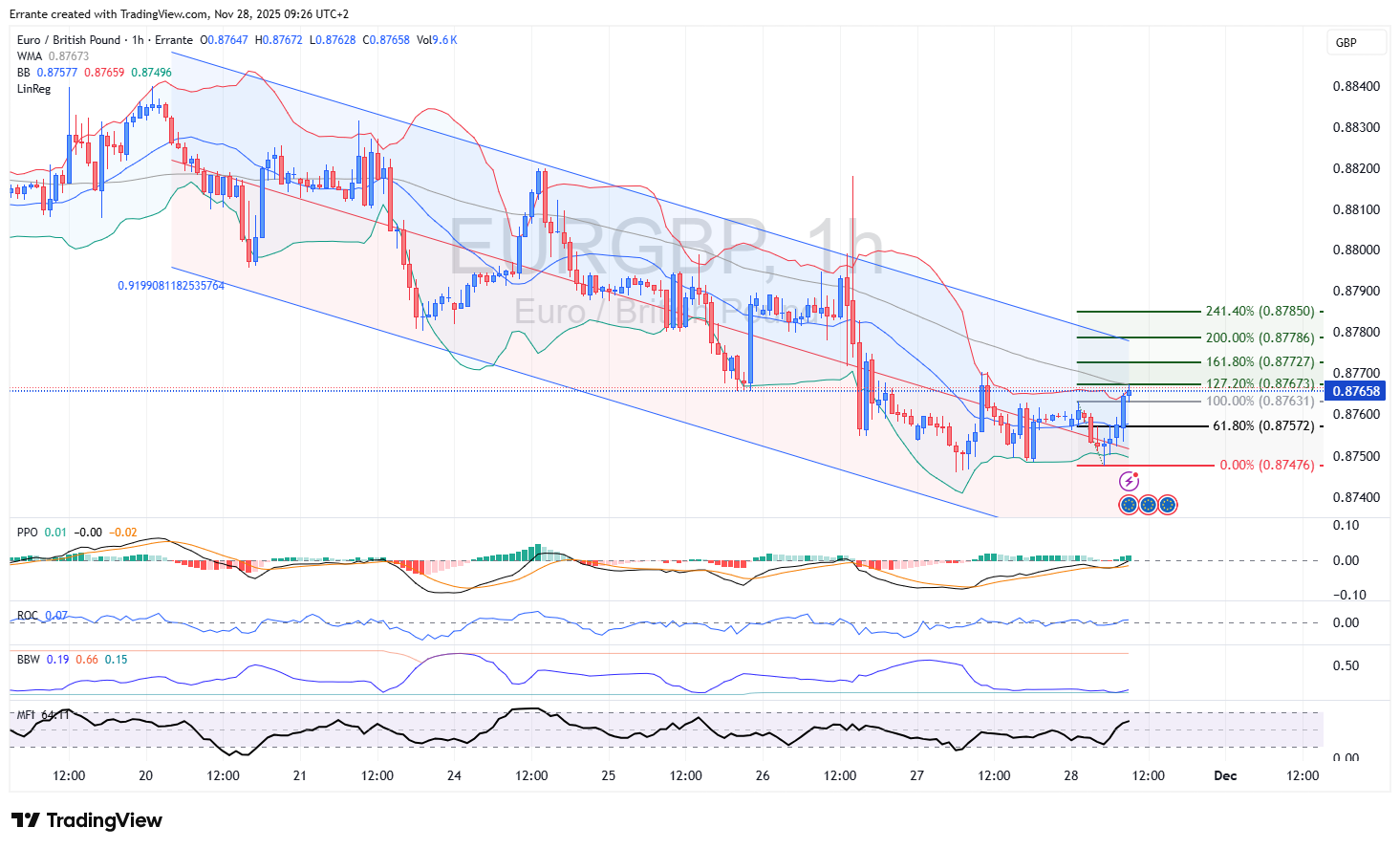
- On the hourly chart, EUR/GBP trades within a well-defined descending channel, with the latest bounce from 0.8745–0.8750 pushing price back toward mid-channel resistance around 0.8765–0.8775. Oscillators have turned up from oversold, but volatility and Bollinger bandwidth remain compressed, arguing for a grinding, mean-reversion style move rather than an impulsive reversal.
Market overview: EUR/GBP in a risk-on, Euro-soft/sterling-mixed world
Euro area: soft credit, fragile confidence, persistent inflation worries
Recent euro area monetary statistics show broad money (M3) growth running near 2.8% year-on-year in October, with loans to non-financial corporations expanding around 2.9% and private-sector lending around the high-2% area.
This pace of credit creation is weak by historical standards and consistent with subdued investment and sluggish medium-term growth. It supports the idea that the ECB’s past tightening is still working its way through the system and that, even as headline inflation falls, the economy is far from overheating.
The European Commission’s latest business and consumer survey tells a similar story. The composite economic sentiment indicator sits around 97, below the long-term average of 100, with industrial sentiment in notably negative territory (around −9) while services sentiment is mildly positive. Consumer confidence is stuck well below zero, and inflation expectations in the survey have ticked up again, reminding policymakers that the inflation fight is not entirely over.
Taken together, these data justify an ECB stance that talks tough on inflation but is quietly comfortable with the market pricing several additional rate cuts over the coming year. For the euro, that means the “real yield” cushion is limited: while nominal policy rates may still look high, weak growth and tepid loan growth cap how far real yields can rise. In a world where the Fed and BoE are cutting too, that leaves the euro as a relatively low-beta, low-carry currency.
United Kingdom: Weak demand but still-sticky rates
On the UK side, high-frequency indicators have been disappointing. The CBI distributive trades survey – a good proxy for retail conditions – has sat deep in negative territory for months, with retailers reporting falling sales and cautious consumers.
Manufacturing output has also been under pressure, with recent surveys pointing to the sharpest three-month drop in production since 2020, as firms delay investment and hiring decisions ahead of further fiscal changes.
However, inflation in the UK remains more stubborn than in the euro area, wage growth is elevated, and gilt yields are still meaningfully above German bund yields at comparable maturities. Markets expect the Bank of England to cut, but generally see it lagging the ECB in both timing and magnitude. In relative terms, that means:
- Sterling still offers a modest carry advantage over the euro.
- The BoE is less likely to endorse deep rate cuts unless growth deteriorates much further.
- Fiscal policy (as laid out in the Autumn Statement) is trying to thread a needle between supporting growth and preserving credibility, but not enough to fundamentally change gilt-Bund spreads in the near term.
In a risk-on global environment, that combination tends to keep sterling better bid on dips versus low-yielders such as the euro, even when the UK’s domestic growth story is uninspiring.
Cross-asset lens: Gold/Silver and what they tell us about EUR/GBP
Gold and silver have been supported by lower real yields and a softer dollar but are not yet in a parabolic move. That is consistent with a macro regime where:
- Inflation risks are perceived as under control but not dead.
- Central banks are moving into an easing cycle, but gradually.
- Risk appetite is strong: equities rally, credit spreads tighten, and cyclical commodities find a bid.
Historically, such regimes often coincide with:
- EUR performing better versus the dollar than versus higher-beta G10 currencies.
- GBP acting as a “semi-cyclical” asset: doing well when global growth and risk sentiment improve, as long as UK-specific risks (Brexit-style shocks, violent fiscal missteps) are contained.
The hourly EUR/GBP chart fits this story: a steady, orderly decline rather than a crash. The down-channel represents a slow repricing of relative growth and rate expectations, with the euro quietly losing ground to sterling, not collapsing.
Technical and volume analysis: EUR/GBP in a well-behaved down-channel
Current technical conditions and main scenario
The 1-hour EUR/GBP chart shows a clear, well-respected descending channel stretching back several sessions. Price has been making lower highs and lower lows, with the channel boundaries acting as reliable dynamic resistance and support.
Key observations from the current snapshot:
- Price is trading around 0.8765–0.8766, near the mid-point of the channel and slightly above the 100% Fibonacci retracement of the most recent downswing (clustered around 0.8763).
- The most recent swing low sits near 0.8747, which also corresponds to the 0% Fibonacci anchor in the current intraday structure.
- The bounce from that low has been relatively orderly, with candles hugging the middle Bollinger band and the upper band now starting to flatten rather than expand.
From a trend-following perspective, nothing in this structure suggests a completed downside move. The channel is intact, and price is rebounding from the lower boundary towards a region where prior rallies have repeatedly failed.
The main scenario, therefore, is:
- EUR/GBP continues to treat the 0.8770–0.8785 area as sell-zone resistance.
- As long as hourly closes remain below roughly 0.8790, the broader downtrend is assumed to persist.
- Short-term, that implies scope for a mean-reversion move from current levels back toward 0.8755–0.8745, retesting the recent low and, if broken, targeting the next projected support closer to 0.8725 (extrapolating the channel and extension structure).
In other words: this looks less like the start of a bullish reversal and more like a classic short-covering rally inside a declining range.
Oscillators and volatility: Shifts but not a regime change
The indicator stack under the price adds nuance:
- PPO (a MACD-style momentum oscillator) has just crossed back above its signal line from depressed levels near zero. The histogram has flipped slightly positive, signalling short-term bullish momentum, but the overall amplitude of the oscillator is modest. This is consistent with a corrective bounce rather than a new impulsive up-leg.
- Rate of Change (ROC) has turned positive after a stretch of negative readings, again pointing to an upswing in short-term price velocity, but it remains within a narrow band – there is no evidence of a blow-off or panic bid.
- Bollinger Band Width (BBW) is low, reflecting tight, compressed volatility. This typically precedes larger moves but, for now, still favours range trading and fade-the-edge strategies over momentum breakouts.
- Money Flow Index (MFI) has climbed from sub-50 readings into the high-50s to low-60s, suggesting that buying pressure on this bounce is moderately strong but not yet overbought. That supports the idea of a move towards the upper half of the channel, but not necessarily a break above it.
Tick volume (as indicated in the panel header) has picked up modestly during the recent recovery from 0.8745, suggesting that some real flows are participating in the move, yet volumes remain far from the peaks seen during the previous sharp sell-offs. The market feels engaged but not panicked.
Put together:
- Momentum and money flow confirm a short-term bullish correction inside a broader downtrend.
- Volatility compression warns that a more directional move could be building; however, given price location (middle of a falling channel), the path of least resistance remains gently lower unless a catalyst forces a topside breakout.
Key support and resistance levels
The following zones stand out on the current intraday map:
Resistances:
- 0.8763–0.8767: 100%–127.2% Fibonacci zone of the latest swing; also near the mid-channel line.
- 0.8773–0.8779: 161.8%–200% Fibonacci extensions; prior intraday congestion.
- 0.8785–0.8790: 241.4% Fibonacci projection and proximity to the descending channel’s upper boundary; key pivot for any bullish reversal attempts.
Supports:
- 0.8752–0.8757: 61.8% retracement cluster; first line of defence on pullbacks.
- 0.8745–0.8748: recent swing low and 0% Fibonacci anchor.
- 0.8725–0.8730: projected lower channel boundary area if the current leg resumes lower.
These levels provide a practical roadmap: sellers are likely to lean into 0.8770–0.8785, while buyers will defend 0.8750 initially and then 0.8745 and the low-0.8730s if pressure builds.
Alternative (less probable) scenario
The bearish channel view would be challenged if:
- Price manages to close decisively above 0.8790 on an hourly basis, ideally accompanied by a clear expansion in Bollinger bandwidth and a sharp rise in tick volume.
- PPO breaks into a sustained, strong positive trend, and MFI pushes into the 70–80 band, showing aggressive buying rather than mere short-covering.
In that scenario, the market would be signalling that:
- A new piece of information has altered the relative ECB vs BoE path – for example, surprisingly hawkish ECB rhetoric or a notably dovish UK fiscal or growth surprise;
- Short positioning in EUR/GBP had become too crowded and is being squeezed out.
Under that alternative, upside targets would migrate to 0.8820–0.8840 (upper channel and previous swing highs), with 0.8790–0.8800 becoming the new support zone on dips.
For now, this remains a lower-probability path, but it is the key risk for traders who are structurally short EUR/GBP.
Fundamental outlook from the economic calendar
The upcoming data and events for the euro area and the UK are not blockbuster releases like CPI or employment, but they matter for the narrative that underpins the channel move.
Euro area calendar
The euro area slate centres on monetary and credit statistics plus a dense roster of central-bank speakers:
- M3 money supply and loan growth figures confirm that credit creation is soft but stable, with broad money around 2.8% year-on-year and corporate loans near 2.9%.
- Business and consumer surveys show sentiment stuck in a low-growth regime, with industrial confidence negative and services providing the only bright spot.
- ECB officials – including the president and key board members – are scheduled to speak repeatedly. The tone of these remarks will be crucial:
- Any emphasis on downside growth risks, credit weakness, or the need to support bank lending would reinforce expectations for further cuts and weigh on the euro.
- Conversely, if officials push back against aggressive easing expectations by stressing persistent inflation pressures or the need for restrictive policy “for longer”, the euro could find some support, particularly against low-yielders.
Given the current data mix, the probability leans slightly toward a cautious, data-dependent but not outright hawkish message. That is mildly negative for the euro on crosses like EUR/GBP.
UK calendar
On the UK side, the key scheduled event is the Autumn Forecast Statement, alongside ongoing data on retail conditions and confidence:
- The Autumn Statement is expected to walk a tightrope between supporting an anaemic economy and maintaining fiscal discipline after past credibility shocks. Markets will scrutinise the balance between spending pledges, tax changes, and the independent fiscal watchdog’s projections.
- A fiscally cautious package, with credible plans to stabilise debt, would be modestly supportive for gilts and could reinforce the case that the BoE does not have to cut as aggressively as the ECB. That would favour sterling.
- A more expansionary or market-unfriendly statement could widen UK risk premia, weaken the pound, and open the door to the alternative technical scenario described earlier.
High-frequency data such as car registrations and CBI surveys already paint a picture of soft domestic demand. Unless the fiscal side adds a new shock, these numbers alone are unlikely to change the BoE path dramatically in the very near term; they simply cap how far sterling can rally.
Global context: US data and risk sentiment
Although US releases do not directly enter the EUR/GBP cross, they shape:
- Global risk appetite via equity and credit markets.
- The dollar trend and, thus, the background against which investors allocate among non-USD currencies.
The immediate calendar focuses on US durable goods, GDP revisions, jobless claims, and the Fed’s Beige Book. The underlying story remains:
- Growth is slowing from very strong levels but remains positive.
- Labour markets are cooling gradually, not collapsing.
- Inflation is converging toward central-bank comfort zones.
If that picture holds, markets will remain comfortable with the idea of continued, measured Fed easing rather than a renewed tightening cycle. That combination of lower US yields and solid risk appetite is typically benign for both EUR and GBP against the dollar, but, as argued earlier, tends to favour sterling more on the crosses because of its higher beta.
Strategic takeaways and conclusion
The EUR/GBP cross is a slow-burn expression of a broader macro theme:
- The world is shifting into a “late-cycle, easing-but-not-crashing” regime.
- Precious metals like gold and silver are supported by lower real yields and ongoing geopolitical and fiscal concerns, but they are not screaming crisis.
- In that regime, investors rotate toward carry, cyclical exposure, and risk assets, while trimming pure safe-haven holdings.
Within G10 FX, that supports a gradual preference for sterling over the euro:
- The euro is hampered by weak credit creation, soft industrial activity, and an ECB that is willingly moving into a more accommodative stance.
- The UK’s growth outlook is hardly rosy, but its inflation profile, yield structure, and central-bank stance still look marginally less dovish than the euro area’s, at least for now.
Technically, the 1-hour EUR/GBP chart reflects that story almost textbook-perfectly: a controlled descending channel, with modest corrective rallies fading near mid-channel resistance and new lows eked out slowly as the macro narrative grinds on.
For traders and portfolio managers, the implications are:
- The tactical bias remains to sell rallies toward 0.8770–0.8785 with stops just above 0.8790–0.8800, targeting a retest of 0.8745 and, potentially, the 0.8725 area as the current leg matures.
- Position sizing should respect the low-volatility environment signalled by compressed Bollinger bandwidth and modest ATR: expect grind, not crash. That means small but persistent edge rather than lottery-ticket pay-offs.
- Fundamental risk to this view lies in either:
- A sharp hawkish pivot from the ECB that lifts euro real-yield expectations; or
- A UK-specific shock from the Autumn Statement or incoming data that forces the BoE onto a faster easing path.
Absent such surprises, the path of least resistance for EUR/GBP in the coming days remains gently lower inside the established down-channel – a cross-asset echo of the same forces currently propping up gold, silver, and global risk assets while quietly undermining low-yielding European currencies.
Author

Ali Mortazavi
Errante
BEc, CMSA, Member of IFTA - International Federation of Technical Analysis, Associate Member of STA - Society of Technical Analysis (UK).














