|

EUR/GBP at the edge of a bearish trend reversal

  • EURGBP falls towards February’s support area as geopolitical risks weigh.
  • A negative correction below 0.8590 would signal bearish continuation.

EURGBP is posting its second consecutive negative week as the UK’s energy reliance fuels fears of renewed inflation, while the euro faces geopolitical headwinds amid the Middle East crisis.

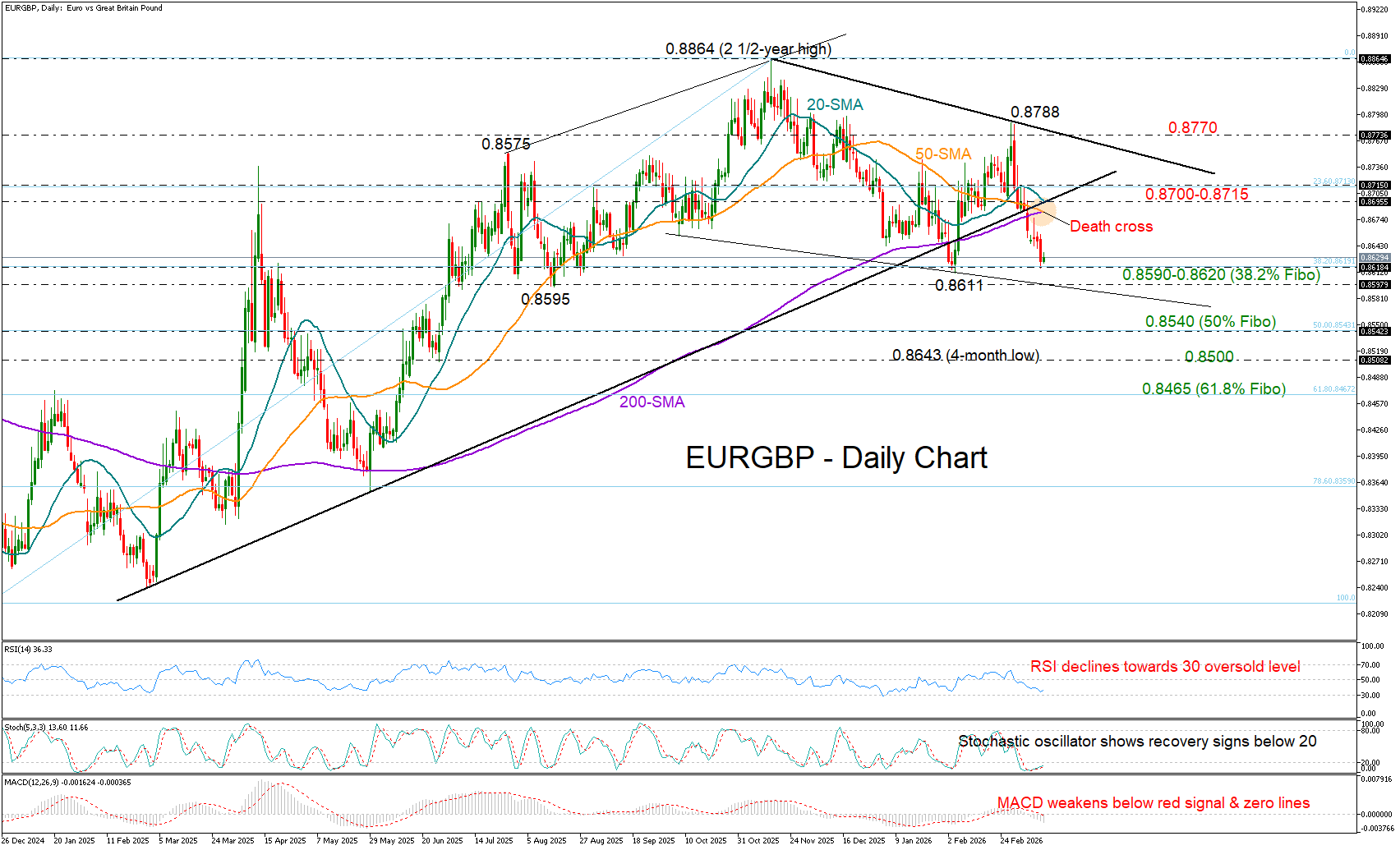
The pair has returned to February’s support region around 0.8620, where the 38.2% Fibonacci retracement of the 2025 uptrend lies. A break below this zone could signal a bearish trend reversal, especially if the tentative support line at 0.8590 gives way. In that case, the sell-off could accelerate towards the 50% Fibonacci level at 0.8540 or the psychological 0.8500 mark. If downside pressure persists, the 61.8% Fibonacci level near 0.8470 could be the next destination.

Meanwhile, a death cross between the 50- and 200-day simple moving averages (SMAs) is currently forming for the first time since January 2024, highlighting the risk of broader trend deterioration. The momentum indicators also remain tilted to the downside, limiting prospects for a meaningful rebound. Still, a recovery attempt cannot be ruled out because the stochastic oscillator and the RSI are hovering near oversold territory, suggesting the bearish momentum may start to ease.

On the upside, if the pair stabilizes near 0.8620, it could push towards the SMAs and the 0.8700-0.8715 zone. Moving higher, the price may next target the key resistance trendline near 0.8770. Breaking this level would eliminate fears of a bearish trend reversal, shifting the focus back to the 2025 peak of 0.8864.

In a nutshell, EURGBP is at risk of a bearish breakout. However, since the pair is trading near a critical support zone, sellers may need confirmation below 0.8590 before gaining stronger control.

Author

Christina Parthenidou

Christina joined Trading Point in May 2017. She holds a master degree in Economics and Business from the Erasmus University Rotterdam with a specialization in International economics.


More from Christina Parthenidou
Share:

Editor's Picks

GBP/USD drops to 1.3200 region as UK PM Starmer resigns

GBP/USD has come under renewed selling pressure in the European session on Monday, falling back to the 1.3200 region. UK PM Keir Starmer announced that he will resign and noted that nominations for new contender will open on July 9.

EUR/USD turns south toward 1.1400 amid concerns over Iran deal progress

EUR/USD turns south toward 1.1400 in the European trading hours on Monday. Concerns about progress for the US-Iran peace deal and expectations of higher US interest rates keep the US Dollar supported against the Euro. ECB President Lagarde is set to speak later on Monday.  

Gold lacks bullish conviction near $4,200 as Fed hike bets and Iran risks underpin USD

Gold maintains its bid tone near the $4,200 mark through the first half of the European session, and seems to have snapped a three-day losing streak, to a more than one-week low set the previous day. Crude Oil prices turn lower after mediators – Qatar and Pakistan – announced a formal 60-day roadmap aimed at securing a final US-Iran peace deal.

Breaking: Iran closes the Strait of Hormuz amid ceasefire deal violation
Iran says it is closing the Strait of Hormuz after accusing the United States (US) and Israel of violating the ceasefire. According to Iran, the decision came over the continued Israeli strikes in Lebanon. The Iranian Revolutionary Guard Corps Navy issued a warning to all vessels: "Do not approach the Strait of Hormuz; otherwise, your security will be jeopardized."
Canada CPI Preview: Inflation expected to tick higher in May, pressuring BoC outlook

The publication of Canada’s May Consumer Price Index figures on Monday will be the focus of attention. Indeed, Statistics Canada data will provide markets with an update on price pressures following its June 10 meeting, where policymakers kept the interest rate steady at 2.25%, matching the broad consensus.

Regime change: Inside Kevin Warsh's first move to make the Fed unreadable on purpose

The rate did not move. That was the least interesting thing about Kevin Warsh's first meeting in charge of the Fed. The FOMC held its benchmark at 3.50%-3.75% for the fourth straight meeting, exactly as priced, and then the new chair used his first press conference to dismantle the machinery the market has leaned on for a decade.