Employment costs rise strongly, but not running away


Summary
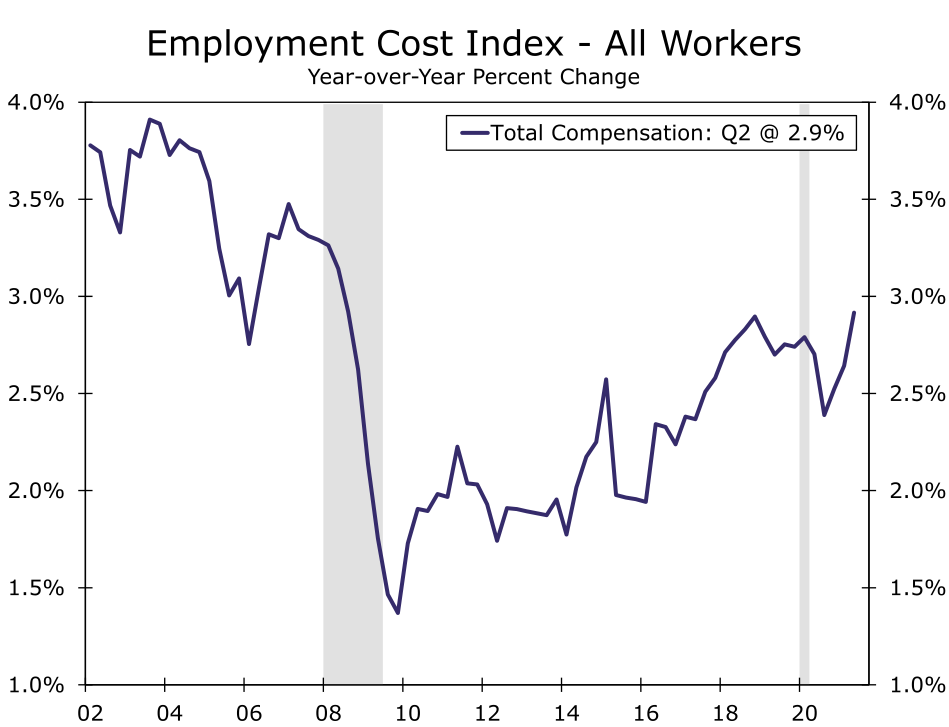
Employment costs rose 0.7% in Q2. That was slower than expected amid a weakening in benefits growth and lackluster private wage growth relative to the recent readings on average hourly earnings. Nevertheless, labor costs are up 2.9% over the past year and match the high watermark of the past cycle, as inflation pressures have broadened out.
Q2 Wage Costs More Subdued than Recent Average Hourly Earnings Indicate
Recent average hourly earnings data from the monthly employment reports have suggested that wage growth has been on a tear as employers scramble to attract and retain workers. Average hourly earnings for private sector workers were up 1.4% from March to June. That was an impressive feat considering lower-pay sectors like leisure & hospitality, retail and transportation & warehousing accounted for an outsized share of job gains, but reflected that employers in those industries were raising wages at a breakneck pace. Today's Employment Cost Index suggests compensation is rising at a more moderate rate. The ECI rose 0.7% over the three months ending in June. That marked a slowdown from Q1, where compensation costs increased 0.9%.
Wage & salaries growth came in stronger than the headline, increasing 0.9% and 1.0% for industry workers. That still fell short of the gain in AHE over the quarter, even before accounting that the AHE numbers faced compositional headwinds recently with lower-paying jobs being added more quickly. The ECI has a few advantages over the average hourly earnings series, in our view. The first is that it controls for shifts in the composition of the workforce, as already alluded to. That was particularly useful a year ago, when lower-paid jobs declined severely, sending average hourly earnings soaring. Another is that the ECI tracks benefits costs, which we discuss shortly. It also captures pay and benefits for the public sector. A disadvantage of the ECI, however, is that it samples only about 6,000 private industry establishments compared to 144,000 businesses in the average hourly earning series. We are therefore inclined to put more weight on the signal coming from the average hourly earnings data: labor has gotten notably more expensive as of late.
Author
Wells Fargo Research Team
Wells Fargo

















