|

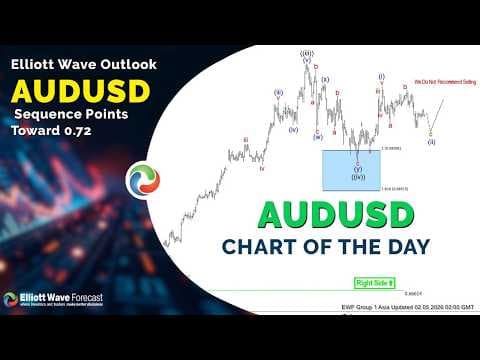
Elliott Wave outlook: AUD/USD sequence points toward 0.7200 [Video]

The AUD/USD pair continues to display an incomplete bullish sequence from the April 7, 2025 low, suggesting further upside potential. The structure favors continuation toward the 100% Fibonacci extension target at 0.72. In the short term, the cycle from the November 21 low remains in progress, unfolding as a five-wave Elliott Wave impulse. This development provides a clear framework for traders monitoring the pair’s near-term trajectory.

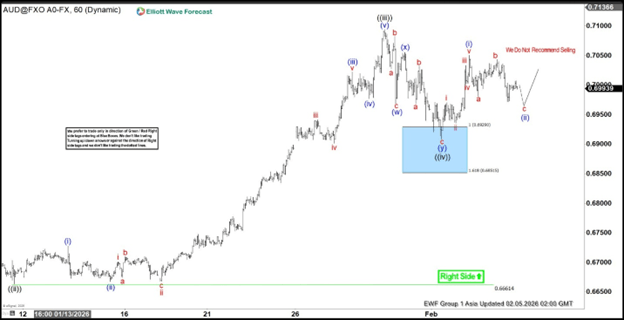
From the November low, wave ((i)) advanced and concluded at 0.6766. A corrective pullback in wave ((ii)) followed, ending at 0.666 as illustrated in the one-hour chart. The pair then resumed its upward momentum in wave ((iii)), which itself subdivided into a smaller impulsive structure. Within this sequence, wave (i) terminated at 0.6727, while wave (ii) retraced to 0.6667. The subsequent rally in wave (iii) reached 0.7022, before a modest pullback in wave (iv) settled at 0.6976. Finally, wave (v) advanced to 0.7094, completing wave ((iii)) in full alignment with Elliott Wave guidelines.

Afterward, the pair corrected in wave ((iv)), which ended at 0.6908. It then turned higher again, beginning wave ((v)). Looking ahead, the expectation remains for AUDUSD to extend further gains. Any pullback should ideally find support within a three- or seven-swing corrective structure, provided the pivot at 0.666 stays intact. This condition preserves the bullish outlook and keeps the path open toward the projected 0.72 target.

AUD/USD 60-minute chart
AUDUSD

AUD/USD Elliott Wave [Video]

Youtube preview

Author

Elliott Wave Forecast Team

Elliott Wave Forecast Team

ElliottWave-Forecast.com

More from Elliott Wave Forecast Team
Share:

Editor's Picks

EUR/USD softens below 1.1800 ahead of ECB rate decision

The EUR/USD pair loses ground to around 1.1785 during the early European trading hours on Thursday. The Euro softens against the US Dollar as Eurozone inflation declined well below target ahead of the European Central Bank interest rate decision. The German Factory Orders and Eurozone Retail Sales are also due later on Thursday. 

GBP/USD falls toward 1.3600 ahead of BoE policy decision

GBP/USD extends its losses for the second successive session, trading around 1.3620 during the Asian hours on Thursday. The pair weakens as the Pound Sterling comes under pressure ahead of the Bank of England’s interest rate decision later in the day.

Gold recovers major part of intraday losses to sub-$4,800 levels; down a little on firmer USD

Gold rebounds swiftly following the Asian session fall to sub-$4,800 levels and climbs back above the $4,900 mark in the last hour, though the upside potential seems limited. Wednesday's softer US ADP report pointed to labor market weakness and strengthened the case for interest rate cuts by the Federal Reserve, lending support to the non-yielding yellow metal.

BTC steadies as bears shift focus toward $70,000

Bitcoin price remains under pressure so far this week, with the Crypto King slipping below $73,000 on Tuesday for the first time since November 2024. The price dip in BTC was fueled as the news came in late Tuesday that the US military shot down an Iranian drone that “aggressively” approached the USS Abraham Lincoln aircraft carrier in the Arabian Sea. 

BoE expected to keep interest rate steady amid sticky inflation, cooling job market

The Bank of England (BoE) will deliver its first monetary policy decision of 2026 on Thursday. Most analysts think the ‘Old Lady’ will sit tight, keeping the base rate at 3.75% after the cut delivered back on December 18. Alongside the decision, the bank will also release the Minutes, which should shed a bit more light on how policymakers weighed the arguments around the table.

Top Crypto Losers: Zcash, Stacks, BNB drop further as Bitcoin weakens

Zcash, Stacks, and BNB (formerly Binance Coin) are among the biggest losers over the last 24 hours as Bitcoin approaches $72,000. The correction is driven by multiple factors, including massive, steady outflows from institutions and large-wallet investors, broader-market risk-off sentiment, and the delay in the Digital Asset Clarity Act.