ECB Quick Analysis: Frankfurt's firepower joins Berlin's boost, EUR/USD higher levels to watch
- The European Central Bank exceeded expectations with a big boost to bond-buying.
- The move joins fiscal stimulus from the German government, encouraging private investors.
- EUR/USD is at the highest since March and ready to attack higher levels.

One-two punch – in favor of the euro. Less than 24 hours have passed since German Chancellor Angela Merkel announced a €130 billion stimulus plan, and in Frankfurt, on the other side of Europe's largest economy, another stimulus boost came.
The European Central Bank has announced an increase of €600 billion to its Pandemic Emergency Purchase Program (PEPP), and it now reaches €1.35 trillion. That has exceeded most economists' expectations. In addition, the bank said it will reinvest proceeds from this program – maintaining a large balance sheet and similar to previous schemes.
Moreover, the bank extended the length of the PEPP to June 2021 – a year from now. The initial funds were projected to run out by the autumn. And while the bank promised flexibility – potentially purchasing more bonds of hard-hit countries such as Spain and Italy – it refrained from junk bonds.
Avoiding such problematic debt leaves room for more action if needed. The Federal Reserve bought such "fallen angels" and also municipal and state debt.
Christine Lagarde, President of the European Central Bank, completed a full shift from saying it is not the bank's job to squeeze spreads, to almost throwing the kitchen sink. The bank's funds will help governments lower borrowing costs and provide further relief to the economy.
Both Merkel and Lagarde's moves may increase business and consumer confidence, which could join in with investments and consumption, adding a third stimulus to the economy.
EUR/USD Technical Analysis
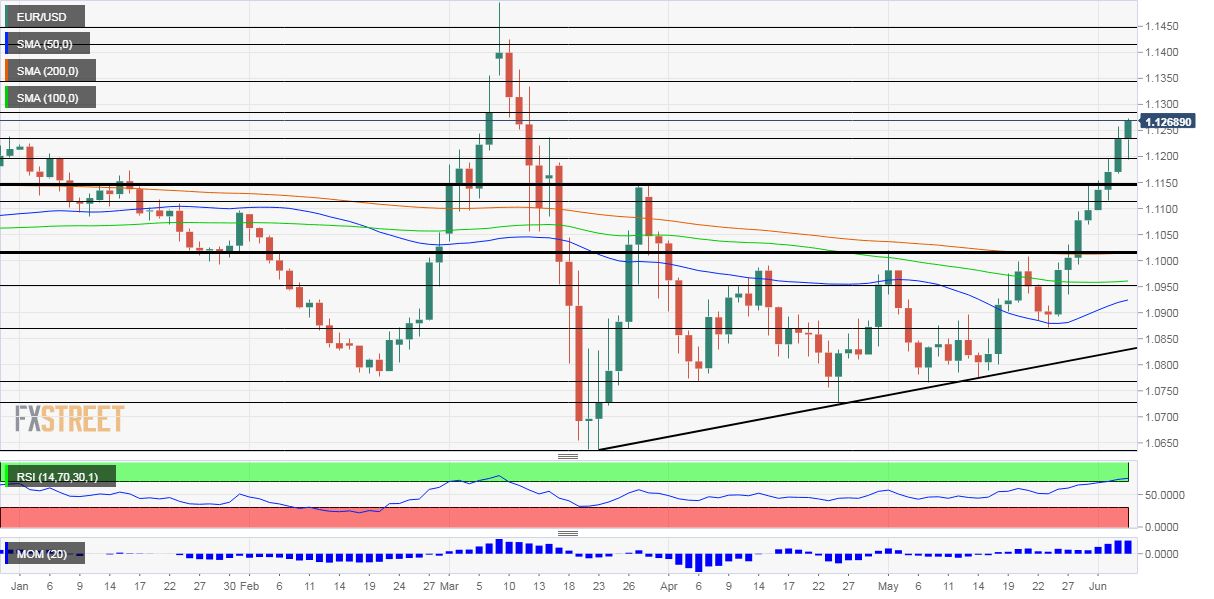
EUR/USD has risen to a high above 1.1270 at the time of writing, the highest since March. The daily chart is showing that the next resistance is at 1.1285, which was a high point early in the year. More importantly, 1.1350 was a stepping stone on the way down and it is followed by 1.1410 and 1.1490, the early March peak.
Support awaits at 1.1240, a high point in March, followed by 1.12 and 1.1150, the latter being April's peak.
It is essential to note that the Relative Strength Index is above 70, pointing to overbought conditions, but the currency pair has previously hovered around oversold or overbought territory before moving out of it.
Author

Yohay Elam
FXStreet
Yohay is in Forex since 2008 when he founded Forex Crunch, a blog crafted in his free time that turned into a fully-fledged currency website later sold to Finixio.