ECB preview: Rate cut assured, but what next?

With the European Central Bank all but certain to cut rates on Thursday (Jun 6th), the attention will be on comments around inflation and further easing.
-
Inflation has ticked up but remains on a broadly downward trend and ECB officials have clearly already made up their minds to cut this week
-
A hawkish cut – one and done, or one-and-wait-and-see, could support EZ yields
-
But the US remains key for EURUSD with the case for the Fed to cut starting to build again
-
For all the talk about divergence between central bank policymaking – particularly the ECB and Fed – the current price action is one of reconvergence, with EZ inflation, yields and the Euro starting to move up and Treasury yields, USD and PCE inflation falling – US/German yield spreads have narrowed a lot over recent weeks.
-
The hawkish repricing already seen could leave the door open for a retracement (lower EUR) but equally the ECB might beat a more hawkish drum than even the market assumes
-
Which takes us back to the point about what probably matters just as much for EURUSD is the Fed and a key nonfarm payrolls report on Friday.
Rate cut assured
The market is fully pricing a rate cut, which would be the first since 2019. Policymakers have been pretty vocal in saying June is ‘on’. In a recent interview, ECB chief economist Philip Lane said that “at this point in time there is enough in what we see to remove the top level of restriction”. You don’t get much clearer a signal than that in central bank speak, and there has been plenty of others basically saying June will see a cut.
What next?
Therefore, with a rate cut a slam dunk, it’s all about the forward guidance and language around the inflation risks. A follow-up cut in July is priced at just 1/10 so anything that hints at this would be euro-negative...but unlikely. Markets assume another cut by October, and I think the ECB will give a signal of sorts towards this kind of date – ie data dependent, think restrictive enough, likely to ease further. I think the move in the EUR to the upside reflects some degree of the market assuming a hawkish cut, but this could be pushed further and the market may not be fully attuned to the chance of the Fed now cutting more aggressively (US high frequency data has started to deteriorate).
Inflation pick-up
Hawks could be nervous about the reacceleration in inflation in May, with headline CPI up from +2.4% to +2.6% and core CPI up from +2.7% to +2.9%. The benchmark German 10yr bund yield jumped to a 6-month high in response. The euro meanwhile has just hit its highest against the USD since March, partially driven by the Euro move, but perhaps mainly on the USD side – weak ISM manufacturing, falling job openings, core PCE softening all pushing down on Treasury yields and the dollar.
The problem is one of non-linear disinflation. I’ve flagged this a lot of course but we are seeing it play out now – lumpy disinflation and bits that are way stickier than others. So, with three-month annualized services inflation running at 5.2%, and the one-month rate at 6.5% the ECB’s hawks will be vocal. You may wonder why a rate cut in this situation is still so nailed-on? Mainly they’ve already committed to it (almost) and at 3.75% from the current 4%, policy rates would remain restrictive. Moreover, doves can point to slower wage growth than projected in December, which may help them to overlook the slight uptick in headline and core inflation. You can choose which data to be dependent on.
However, growth seems to show fewer signs of downside risks than in March. China seems to be picking up, the German data is probably bottoming and the composite EZ PMI hit a one-year high of 52.3. All of which suggests fewer, slower cuts than expected (ie reconvergence).
Data-dependence
Data-dependence is the new mantra for central banks. The ECB is not alone in this and whilst undeniably worthy in some ways, comes with the price of always being ‘behind the curve’ somewhat. What it means for us is that the ECB is unlikely to pre-commit to further hikes, given the stubbornness of some inflation and the uncertainty over what the Fed is about to do next.
And check the US data: JOLTS down to a three-year low and experiencing the kind of decline that is associated with recessions. ISM manufacturing was bad - lowest headline since Feb, lowest prices paid since March, lowest new orders since May 2023 and now in contraction for 2 years. Meanwhile the Atlanta Fed’s GDPNow estimate for Q2 growth was revised down to 1.8% from 2.7%. Add to this the fact that Q1 real GDP was revised down to 1.3% q/q and real consumer spending remains negative and you get a sense that the case for rate cuts is building again.
Politics
Also worth considering the EU elections kicking off on the same day – we have not seen much by way of geopolitical risk premium in yields but we could start to see something in bond spreads that would tend to be net negative for EUR. Fragmentation risks are the thing we are going to listen out for – but as yet we are not seeing much in the way of splintering of the core. Come Sunday night through this might change if right-wing parties gain a lot of ground.
Chart
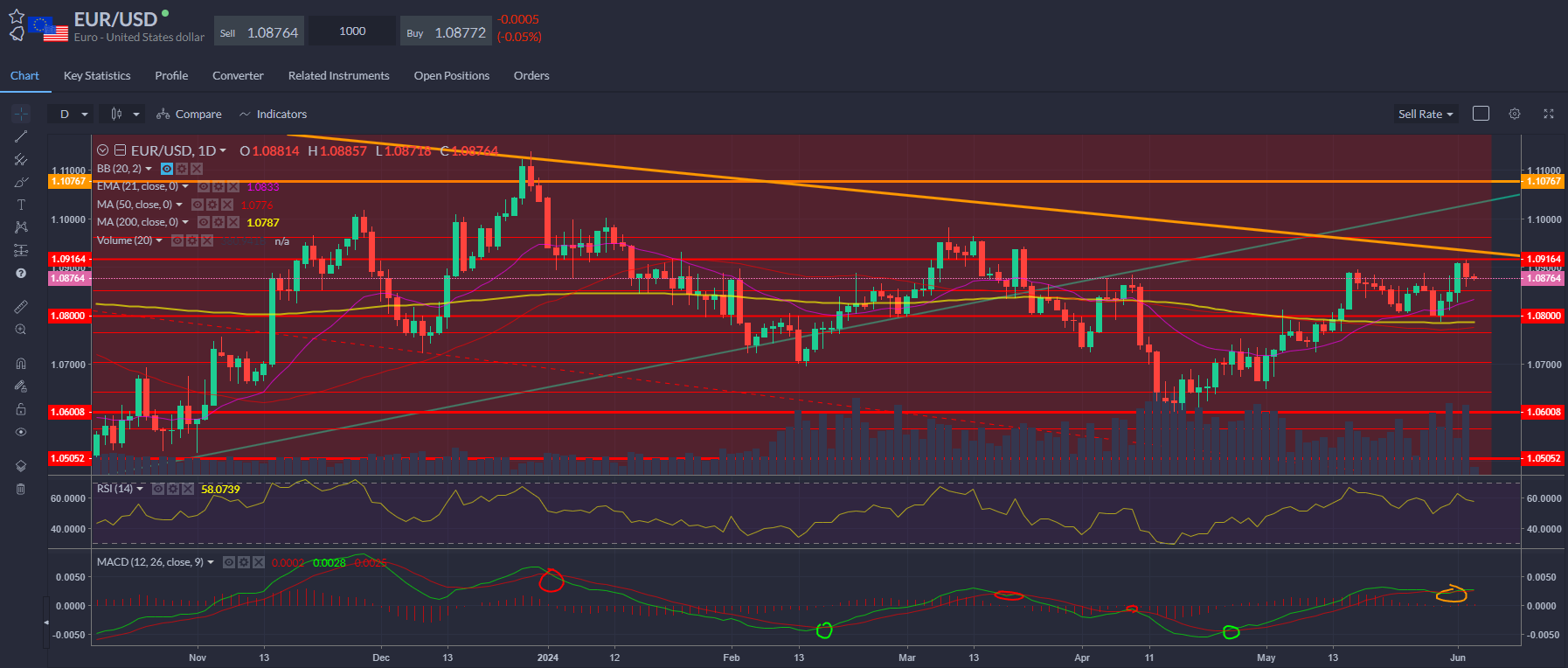
EURUSD has enjoyed a nice run up from 1.08 after tapping the 200-day SMA at 1.0787 to test 1.09 and pulled back from the two-month peak – long-term trend resistance not far above. MACD looks unclear but bullish momentum just about sustained for now. Diminished H4L message from the Fed could see further EUR strength.
- Reconvergence may be the trade – US/German 10yr spreads down to 180bps from peak of around 220bps in mid-April – if we get further weakness in US HF data plus hawkish-sounding ECB may see this narrow further into the weekend and could push EURUSD to test the March highs again but caution that this is an election week with political risk premia coming back to the fore and maybe underpriced.
Author

Neil Wilson
Markets.com
Neil is the chief market analyst for Markets.com, covering a broad range of topics across FX, equities and commodities. He joined in 2018 after two years working as senior market analyst for ETX Capital.
















