|

DXY looks set to break out of recent highs on monthly chart

The end of the world as we know it, but the USD feels fine...

I took my normal constitutional walk yesterday after breakfast and was greeted by our new post apocalyptic landscape. An eerie silence lingered in the air as there was a distinct lack of activity. REM's song immediately sprung to mine as I occasionally passed the odd dog walker who shuffled past me keeping a good distance, of course, from the potential that I was a COVID19 carrier. Welcome to our new coronavirus landscape.

And so returning to my terminal and more strange behaviour, albeit financial in nature this time, I was reminded of the USD as the king of currencies when it comes to a big crisis. In the 'sell everything' landscape the USD is being held as the most liquid currency. With 70% of all currency transactions involving the USD it is little wonder that the USD is attracting more and more bids. I have been explaining this for a few days now to traders and yesterday the USD was bid with a vengeance.

A look at the DXY

The Dollar Index is showing it all. The current monthly candle is engulfing around 14 previous months of dollar action putting in a strong potential bullish Engulfing bar on the monthly chart. For those who like to position trade there is an excellent option here to buy the DXY and come back next month. That will give you plenty of time to plan how you will survive the coming isolation as we try to ride out the coronavirus storm. I hope to meet you on the other side.
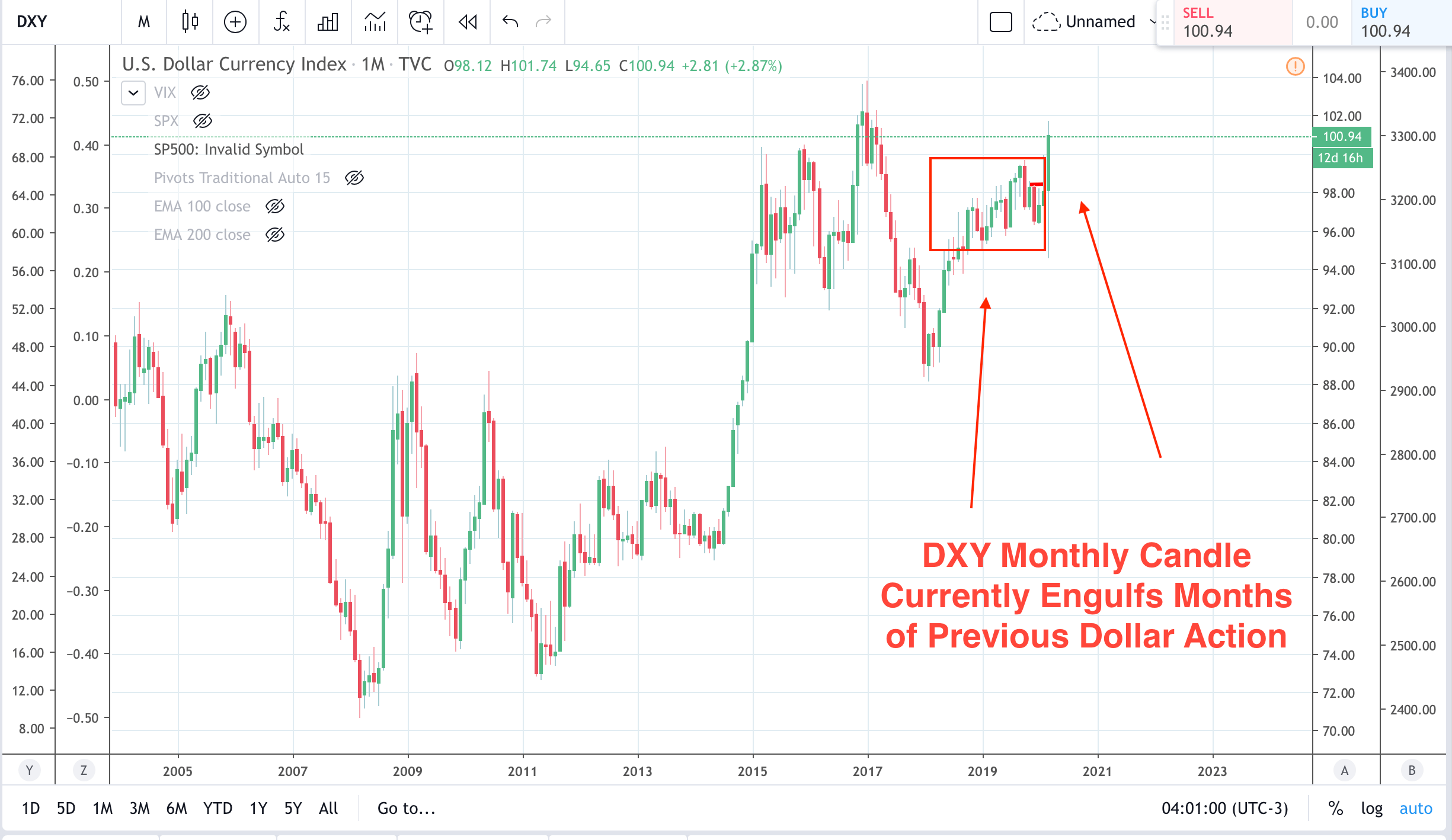
DXY

Learn more about HYCM


Author

Giles Coghlan LLB, Lth, MA

Giles is the chief market analyst for Financial Source. His goal is to help you find simple, high-conviction fundamental trade opportunities. He has regular media presentations being featured in National and International Press.


More from Giles Coghlan LLB, Lth, MA
Share:

Editor's Picks

AUD/USD looks weaker, focus is back to 0.7100

AUD/USD reverses Tuesday’s gains and retreats markedly toward four-day troughs in the low 0.7100s ahead of the opening bell in Asia. The firmer tone in the Greenback weighs on the risk complex amid unabated tensions on the US-Iran front, prompting the Aussie to shed part of recent gains and refocus on the downside. Moving forward, Australian trade balance results should entertain investors early on Thursday.

Japanese Yen bounces up from lows after Japan PM Takaichi’s intervention warnings

The Japanese Yen bounced up from five-week lows against the US Dollar, turning positive on the daily chart, as Japan’s Prime Minister Sanae Takaichi warned that Tokyo is ready to take action against Yen weakness. The USD/JPY pair has pulled back from the 160.00 level, considered a line in the sand for Japanese authorities, to hit session lows at 159.55.

Gold slumps to near $4,450 as strong US jobs data reinforce higher-rate bets

Gold price falls to around $4,450 during the early Asian session on Thursday. The precious metal attracts some sellers amid rising expectations that the US Federal Reserve will raise interest rates this year.


Grayscale launches Hyperliquid staking ETF, undercutting rival fees

Grayscale announced the launch of its Hyperliquid Staking ETF on Wednesday, now trading on Nasdaq. The fund offers investors direct exposure to HYPE and incorporates staking rewards, which the company claims have historically ranged from 2.2% to 2.3% annually. "HYPG represents an opportunity to provide efficient exposure to HYPE in an ETP wrapper," Grayscale noted on its website.

The upside-down math of debt
In 2010, Professors Carmen Reinhart and Kenneth Rogoff published a paper, Growth in a Time of Debt, which instantly went viral. The main thesis of the paper was that once a government's debt-to-GDP ratio crosses above 90%, a financial crisis and default are around the corner.
Recession on paper: What really moves the Canadian Loonie now?

Statistics Canada handed the headline writers a gift and the analysts a headache. Real GDP shrank 0.1% on an annualized basis in the first quarter, and with the fourth quarter of 2025 revised down to a 1.0% contraction, that is two negative quarters in a row, the textbook definition of a technical recession and Canada's first since the pandemic.