US Durable Goods Orders Preview for December: Positive patience
- Business investment expected to be flat after two positive months.
- Impact of US-US China trade deal a few months away.
- Consumption has expanded modestly since June.

The US Census Bureau will issue December’s Manufacturers New Orders for Durable Goods on Tuesday January 28th at 13:30 GMT, 8:30 EST.
Forecast
Durable goods orders are estimated to increase 0.5% in December after November’s revised 2.0% loss. Ex-transport orders are expected to rise 0.2% following a 0.1% decline. Orders ex-defense will gain 0.5% after the 0.7% November rise. Non-defense capital goods orders ex-aircraft and parts is forecast to be flat following November's 0.1% increase.
Durable goods and the US economy
Durable goods are separated from general consumer purchases because their longer useful life involves a different financial analysis for households and businesses. The decision to buy these goods is usually more voluntary and less frequent. For instance, most people do not wait until their car has stopped running before they replace it or they may desire new flatware though the old serves dinner perfectly well.
Because the need for these goods is not immediate volumes tends to rise when consumers are confident about their current and future prospects. Businesses invest when they predict growing sales. These orders tell as much about economic sentiment as they do about consumption.
Durable goods ex-defense, ex-transport
Defense department procurement and commercial aviation sales are subtracted from the totals because the size of a single booking in these sectors can overwhelm that month's figures.
Defense budget items and aircraft orders at Boeing Company of Chicago are generally recorded in toto in one specific month even though the life of the order and its production may stretch over many years.
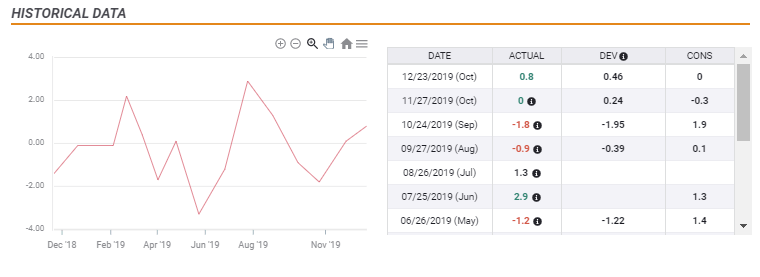
Case in point, last month last month overall durable goods order unexpectedly dropped 2.1% a huge 3.6% swing on the 1.5% forecast. Goods ex-defense however at 0.7% were much stronger than the flat forecast. The difference was that Pentagon spending dropped sharply in November. Does that mean that US defense appropriations have suddenly been cut by Congress, which, if true, would have a large economic impact? Hardly. Government accounting procedures dictated the variations not actual annual spending levels.
Durable Goods ex-Defense
FXStreet
The same is true on the private side for Boeing. If the airplane manufacture receives a large order worth many billions of dollars, it is added to the durable goods numbers for one month. Does that mean consumption has suddenly surged? No. It means that Boeing recored the sale of many aircraft that month
The ex-defense and ex-transport grouping perform the same function as core inflation. They permit statisticians to separate short-term variation from the more important longer term trends.
The two categories have been moderately positive for the last six months. The ex-defense category has averaged 0.38% for the past half year and the ex-transport has measured 0.12%.
The overall durable goods orders have also averaged 0.12% but the month to month variation is the two ex- categories is considerably lower.
Non-defense capital goods ex-aircraft
American GDP in 2019 fell from 3.1% in the first quarter to 2.0% and 2.1% in the second and third quarters and is expected to remain is expected to be unchanged in the final three months of the year.
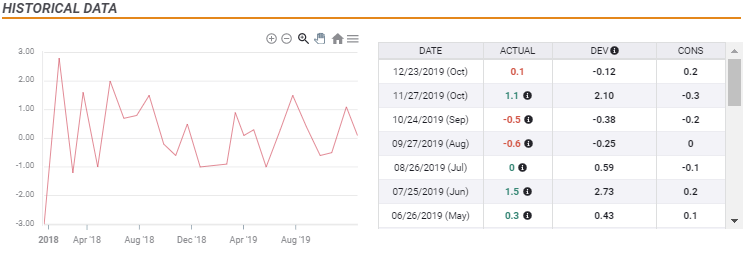
The decline was primarily caused by the near cessation of business capital spending in the second half of the year. Even the 1.2% expansion in October and November just balanced the 1.1% drop in August and September. The average 0.27% growth from June on is due almost entirely to that month’s a 1.5% jump. Non-defense capital goods is a well know proxy for business investment spending
Non-Defense Capital Goods ex-Aircraft
The trade war with China, now partially settled, made pragmatism a logical approach to the chance, albeit small, of a total break in the negotiations and the threat of a global recession. With the dispute on hold until after the US elections, it remains to be seen if the agreement will instill enough confidence in the US business community to raise capital spending. That said, the trade deal was signed on January and though it was long anticipated, December is probably too soon for any change in the recent trend.
Conclusion and the dollar
The Federal Reserve neutral rate policy adopted after the October 31st rate hike was predicated on two factors. First the then probable and now factual US-China trade accord and removing that threat to growth. Second the underlying health of the American economy.
With all of the world’s major central bank on a sustained policy hold the relative strength of their currencies depends on economic comparison. For the US dollar the better the performance of the economy the better for the greenback.
Author

Joseph Trevisani
FXStreet
Joseph Trevisani began his thirty-year career in the financial markets at Credit Suisse in New York and Singapore where he worked for 12 years as an interbank currency trader and trading desk manager.

















