Dr. Copper — Trump tariffs on Copper and its market impacts


Copper (XCU/USD), known on the street as Dr. Copper, just popped +15% and tagged a new all-time high at $5.8095. But why?
Earlier this week, Trump confirmed a 50% import tariff on copper, set to take effect as early as August 1st. This triggered a front-loaded panic buying of physical copper (for stockpiling), triggering a surge in COMEX inventories and blowing the price wide open.
Now, Dr. Copper isn’t just any commodity — everybody takes a sip. Copper is a precious metal used in a wide variety of markets, therefore, it is a macro thermometer for market risk sentiment.
%252023.55.37-638877201452253666.png&w=1536&q=95)
So when copper moves this sharply, markets pay attention.
Sustainable macro move or tariff-driven distortion?
Copper isn’t rising because the economy is booming. It’s a US centric panic buying of copper supplies (by the aforementioned industries and more) ahead of Trump’s 50% tariff. Once the tariff kicks in, this initial demand we’re currently seeing will cease.
At that point, Copper prices would be high without any real sustained buyers, this will likely result in a quick decline after the panic ceases. Copper-heavy industries may slow down production, and cut down forecasts, which ultimately affects businesses.
Potential market impacts
As copper stays high and costs ripple through supply chains, we could start to see the S&P 500 lose momentum or tech stocks underperform. What looks like strength on the copper chart might actually be weakness building underneath the surface.
Usually, if copper is rising because of booming global demand, it’s a good thing. It means factories are busy, infrastructure is expanding, and risk assets like equities and crypto tend to rally alongside.
But when copper rips higher because of a supply shock, like we’re seeing now, the message is very different. When raw material costs like copper spike too fast, manufacturers don’t just eat the cost, they:
- Delay production,
- Cut output,
- Or pass prices onto consumers.
That leads to slower revenue growth, margin compression, and higher operating risk, especially for industrials, construction, EVs, and semiconductors. That pressure will directly flow into the indices.
TA: Copper breaks out, but looks overstretched
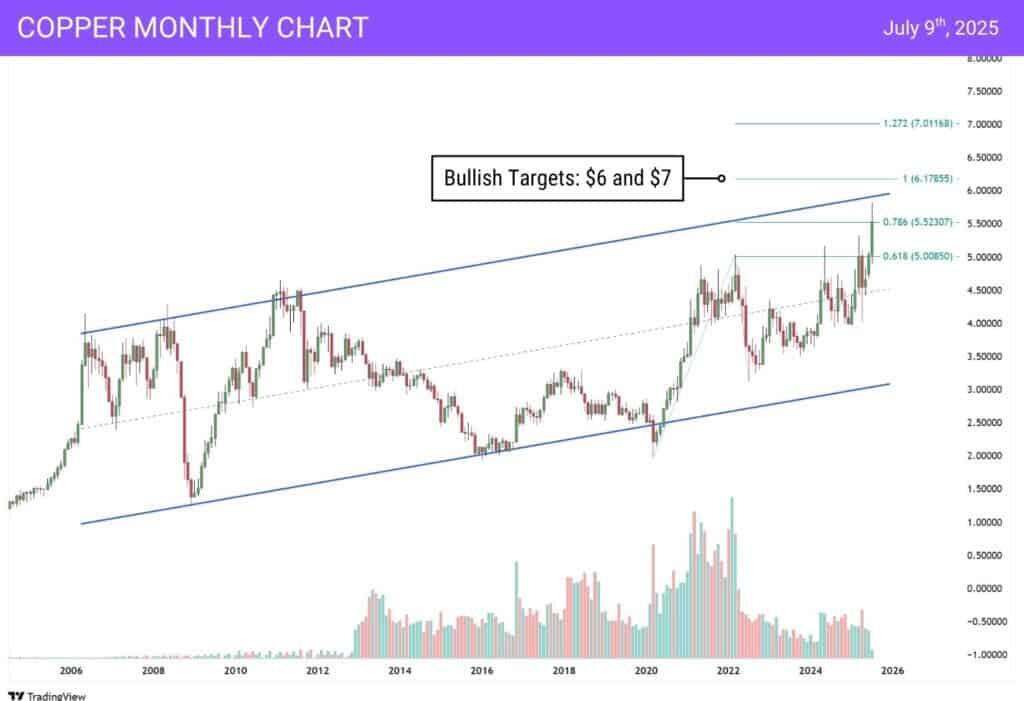
Copper (XCU/USD) just broke out to a new all-time high at 5.8095, just short of tagging a rising parallel channel visible on the monthly timeframe. The next bullish targets would be $6 and $7 based on Fibonacci extensions.
A sustained move higher would likely support the broader commodity complex and signal strong global demand. That could lift cyclical stocks, miners, and energy names, while also reinforcing risk appetite across equities and crypto.
But, that is only if momentum holds.
Pullback target:
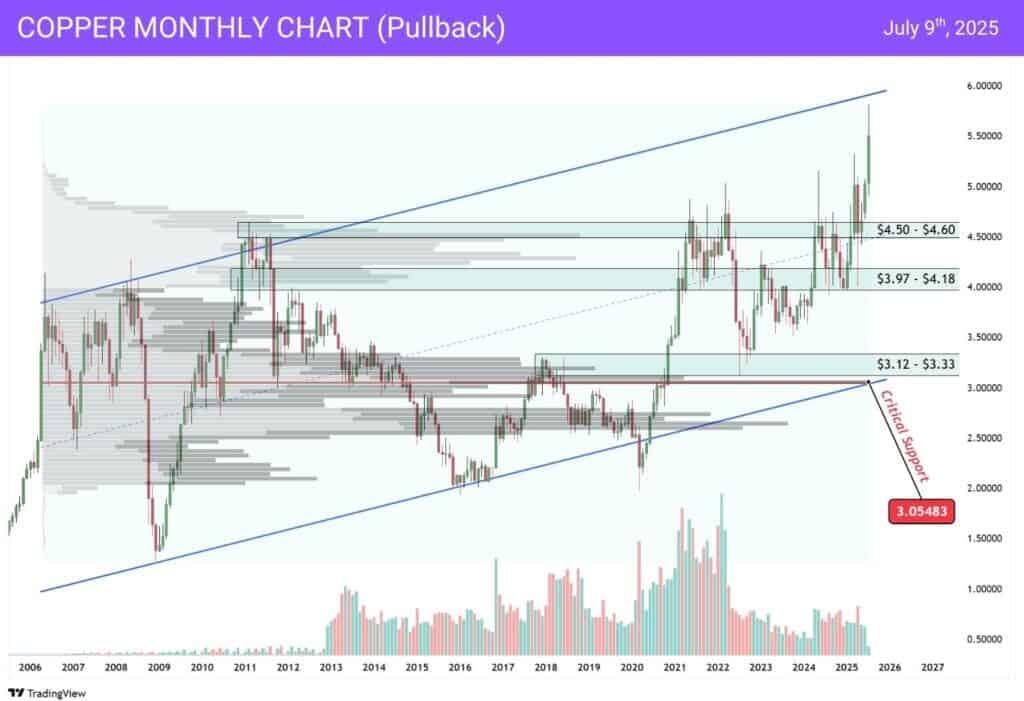
The first significant, volume-backed support sits near $4.50. A deeper pullback could take it back toward $4.00, where stronger demand sits and prior volume had built up.
Worst-case scenario:
Copper could slide back to the $3.00 region — the bottom of the channel and the long-term point of control since 2006. That would be a clear sign of a demand breakdown, likely dragging on equities, especially industrials, energy, and semis, while also triggering a risk-off shift across markets.
Copper’s breakout isn’t just a commodities story. It’s a macro signal. Whether it holds or breaks down could shape the tone for risk assets in the weeks ahead.
Author
Zorrays Junaid
Alchemy Markets
Zorrays Junaid has extensive combined experience in the financial markets as a portfolio manager and trading coach. More recently, he is an Analyst with Alchemy Markets, and has contributed to DailyFX and Elliott Wave Forecast in the past.